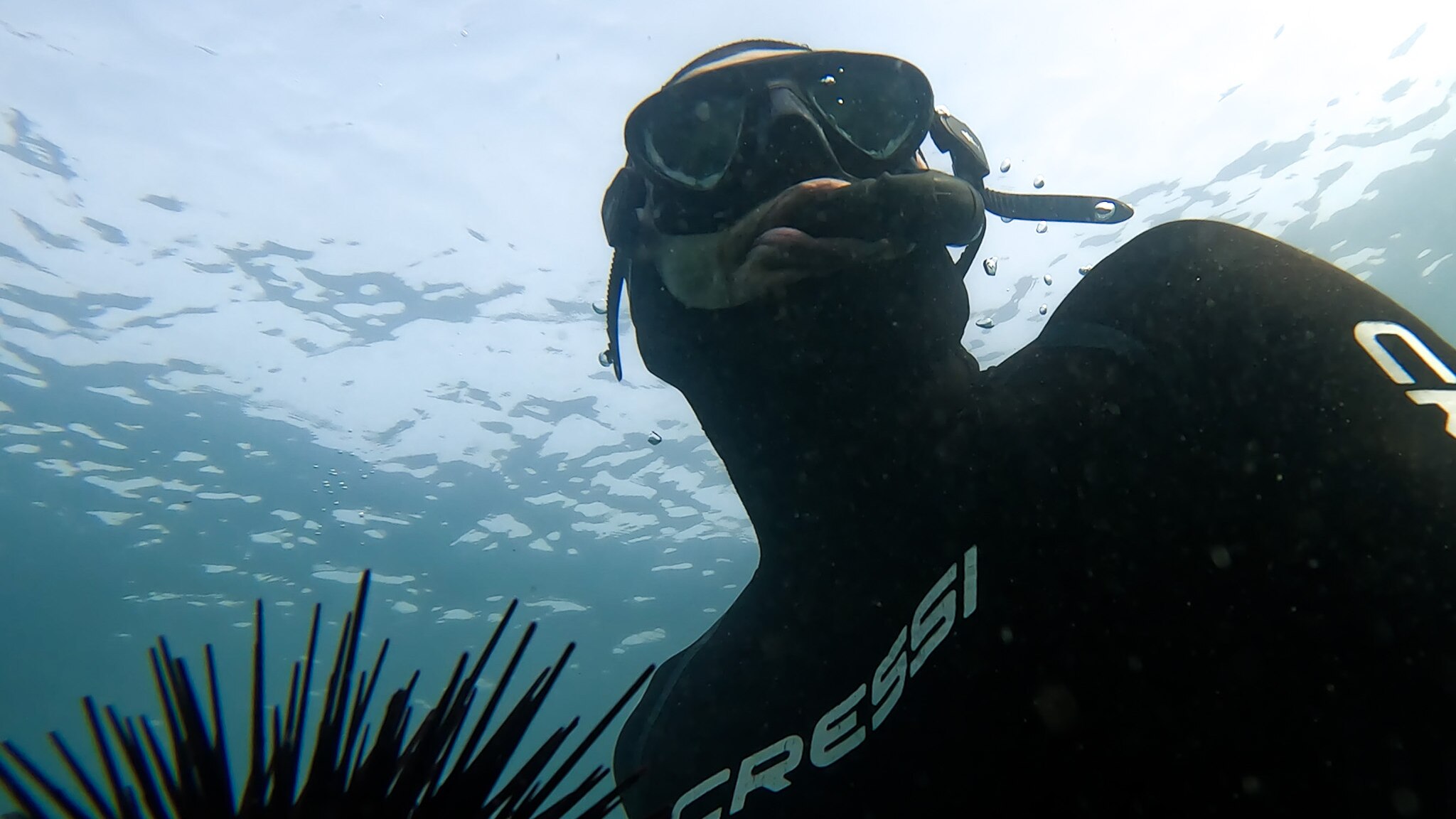
Walbunja diver John Carriage has been diving and gathering from the ocean since he was a child, often clinging to his father’s back as he first learned to duck dive.
Just months ago, he faced a possible 10-year jail term for practising a cultural fishing tradition passed down through generations. However, the case was abandoned by state prosecutors just 11 days into the trial.
“I’ve been to court around four times,” he said. “It’s not a good look for our culture and it scares a lot of the next generation from doing what we do.”
After decades of defending their traditional fishing rights in the courts, Aboriginal custodians on the NSW south coast are now working to protect their saltwater culture from an even greater threat.
The long-spined sea urchin, native to NSW, has seen a dramatic population increase, turning 50 per cent of the shallow reefs that have sustained south coast communities for millennia into barren, white-rock wastelands.
But there is hope for a solution. The NSW government is supporting a plan for an Aboriginal-led sea urchin fishery on the south coast, with a $1.48 million grant to promote sustainable sea urchin management and Indigenous-branded product development.
As part of this initiative, John Carriage and his cousin Denzel will train as professional urchin divers under the guidance of diver and exporter Jamie Newman. Jamie has partnered with the Indigenous non-profit Joonga Land and Water Aboriginal Corporation. He is passionate about creating a “forever industry” that helps regenerate the reef ecosystem.
“Every time we take a sea urchin out, we’re allowing the weed to regrow,” he said. “We should be able to have more fish, more lobster, more abalone, and better quality sea urchins.”
A ‘Goldilocks Zone’ for Sea Urchins
While overfishing of urchin predators like grouper, snapper, and crayfish has led to an explosion in sea urchin numbers in NSW, rising sea temperatures are expanding their range into Victoria and Tasmania. This is causing widespread damage to kelp forests across a 2,000-kilometre stretch of Australia’s Great Southern Reef.
Marine Biologist Cayne Layton described the warming ocean as creating a “Goldilocks zone” on the NSW south coast, where conditions are ideal for sea urchins.
“Southern NSW has some of the largest barrens and some of the largest increases in the areas of those barrens,” Dr. Layton said.
However, he pointed to evidence showing that once urchin densities are reduced, the ecosystem can recover. At a trial site at Merimbula, where 30,000 urchins were removed by a local recreational fishing group, a diverse selection of kelp and seaweed has started to regrow in just 10 months.
With this potential comes the chance to develop a restorative fishery and to address past injustices.
“The urchin industry is relatively new in Australia, and there’s a real opportunity for traditional custodians to lead this industry, rather than being on the margins as we’ve seen with other fisheries in the past,” Dr. Layton said.
‘They called it poaching, we called it survival’
Walbunja elder Newton Carriage holds a black and white photo taken by photographer Ricky Maynard in 1989, capturing the enduring tradition of Aboriginal cultural fishing on the south coast.
In the photo, Newton and his cousin Keith Nye are teaching Newton’s son Shane how to prepare abalone after a dive. Both Keith and Shane later served jail terms for harvesting their traditional sea resources.
“They called it poaching, we called it survival,” Newton said. “We were surviving in our own country.”
Newton’s grandson Denzel is now the third generation to face the court system over cultural fishing, and elders hope his generation will be the last.
In recent years, several prosecutions of Aboriginal cultural fishers have been withdrawn or dismissed while a Native Title claim is being determined on the south coast. Custodians are now focusing on the urgent need to heal sea country.
Tillmann Boehme from the University of Wollongong has been working with the south coast Aboriginal community for four years to develop a sea country plan and a business model for a sustainable Aboriginal-led seafood enterprise.
“We have an Aboriginal community that has been dispossessed of their sea country, dispossessed of their resources,” Dr. Boehme said. “We want the Aboriginal community to take leadership, not just in the restoration, but also to benefit economically from their resources.”
Healing sea country
Walbunja elder Wally Stewart takes the helm of Jamie Newman’s boat as John and Denzel enter the water.
“You can see them in the water, they’re just natural divers, taught by cultural fishermen,” he said.
“And they’ve never been given that opportunity to be part of an industry like this.”
As part of their training, Jamie will teach them to dive with supplied air, to operate their own boat, and to select and process export-quality urchins.
Wally Stewart sees an opportunity for the young divers to become role models in their community and to start healing sea country before it’s too late.
“We need the next generation to take that lead for us now,” he said. “We just need to teach them, but they’ve already got it in their hearts.”
Watch ABC TV’s Landline at 12:30pm AEST on Sunday or stream anytime on ABC iview.