By Iddi Yire, GNA
Accra, May 16, GNA – According to Vice President Professor Jane Naana Opoku-Agyemang, Africa should aim to take the lead in fields like artificial intelligence, digital infrastructure, energy transition, and data sovereignty, as the African Continental Free Trade Area offers chances for market integration and economic expansion.
She mentioned that the Continent could not continue to be just a user of systems created outside its borders; instead, Africa needs to create technologies and solutions based on its own circumstances and goals.
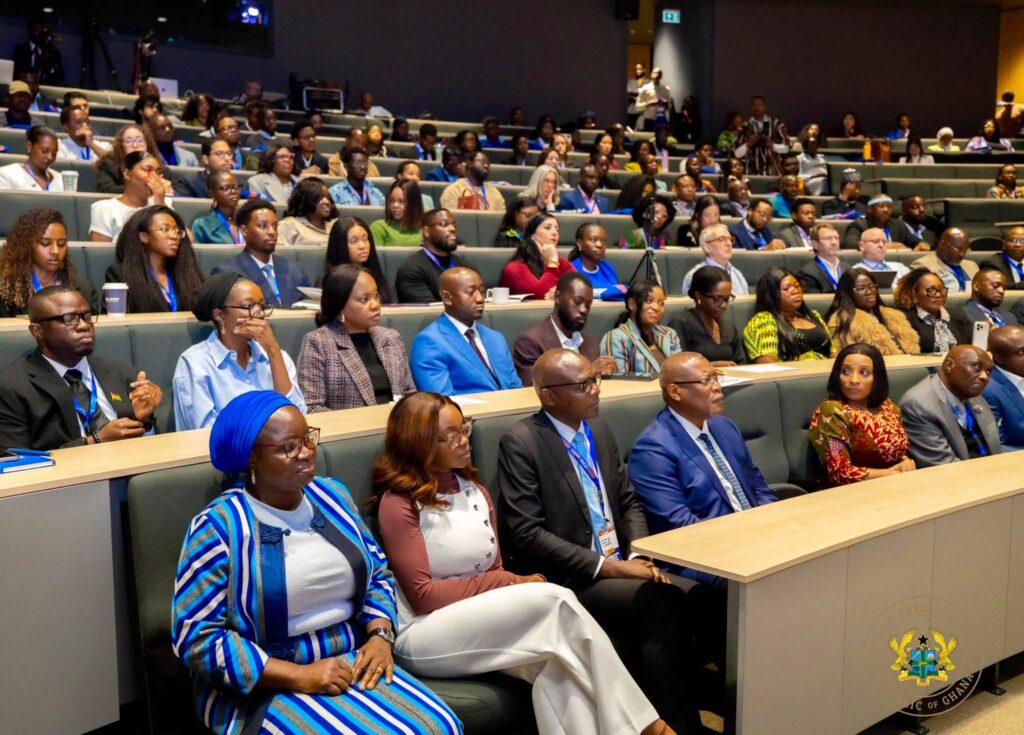
A statement released by the Office of the Vice President mentioned that the Vice President made this comment during her keynote speech at the 16th Oxford Africa Conference, hosted by the Oxford Africa Society, with the theme: “Anchoring Africa: Grounded Leadership in the Age of Disruption.”
Each year’s conference unites leaders, scholars, students, and visionaries to consider Africa’s prospects in an evolving global landscape.
The Deputy Leader stated that change relies on management that stays focused, moral, linked to execution, and based on the population it supports.
She mentioned that successful leadership is characterized by the ongoing duty of making sure that organizations operate properly and that people experience the effects of policies.
It mentioned that although Africa still encounters major difficulties, the continent also has the ability, skills, and assets necessary to determine its own future. Leadership in this period should concentrate on reliable execution, strong institutions, and sustained economic change.
Ghana’s continuous efforts to stabilize its economy, decrease reliance on unprocessed commodity exports, and enhance value creation—especially in areas like cocoa processing—demonstrate this larger move towards a more sustainable economic structure.
Vice President Prof Opoku-Agyemang emphasized programs like the 24-Hour Economy policy and the suggested Women’s Development Bank as tangible steps to include those frequently left out of formal economic structures.
She mentioned that in Africa, women still serve as the foundation of informal trade and economic efforts but remain poorly represented in conventional financial systems.
She observed that the Women’s Development Bank aims not only to offer financial assistance, but also to provide women with the abilities and resources needed for sustainable growth and greater involvement in economic progress.
She also concentrated on the future of technology, commerce, and African unity.
She also provided perspectives drawn from my personal experiences in academia and public service to emphasize the significance of maintaining ties with communities and real-world situations.
Vice President Prof Opoku-Agyemang stated that in the end, Africa’s future will rely not just on the extent of disruption facing the continent, but on how intentionally and jointly Africa decides to structure itself to take the lead.
GNA
Edited by Linda Asante Agyei
Provided by SyndiGate Media Inc.Syndigate.info).