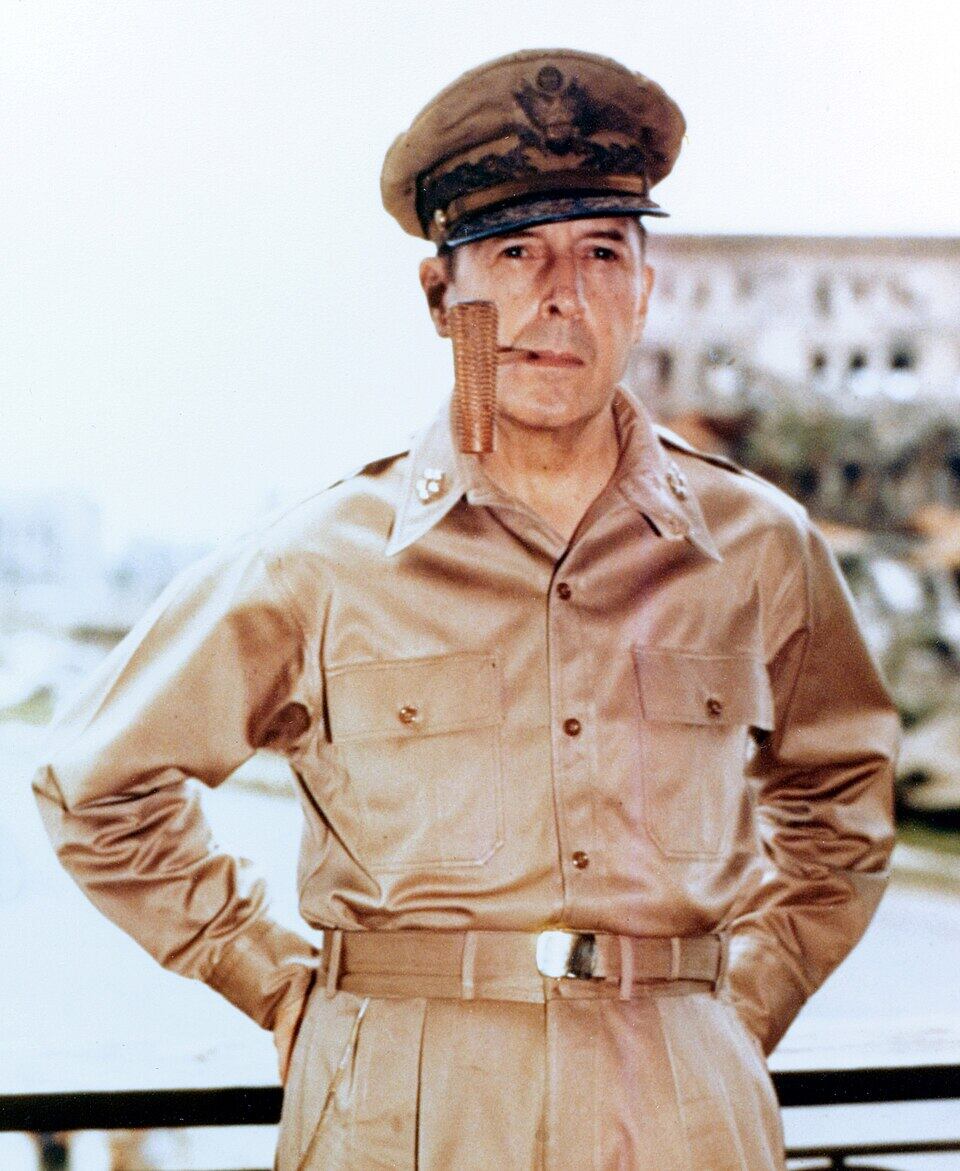
Douglas MacArthur, who served as the Supreme Commander of the Allied Powers from 1945 to 1951, made his first appearance in the Chosun Ilbo on November 23, 1945. The newspaper had been forcibly suspended in August 1940 and was the first issue published after liberation. The article covered MacArthur’s order as the Supreme Commander of the Allied Occupation of Japan to freeze the assets of the Japanese imperial family.
“[Tokyo, November 21, UP] General MacArthur ordered the Japanese government to halt all sales of imperial property except for regular expenditures. Consequently, imperial assets totaling 1.5 billion Korean won were frozen.” (November 23, 1945, front page)
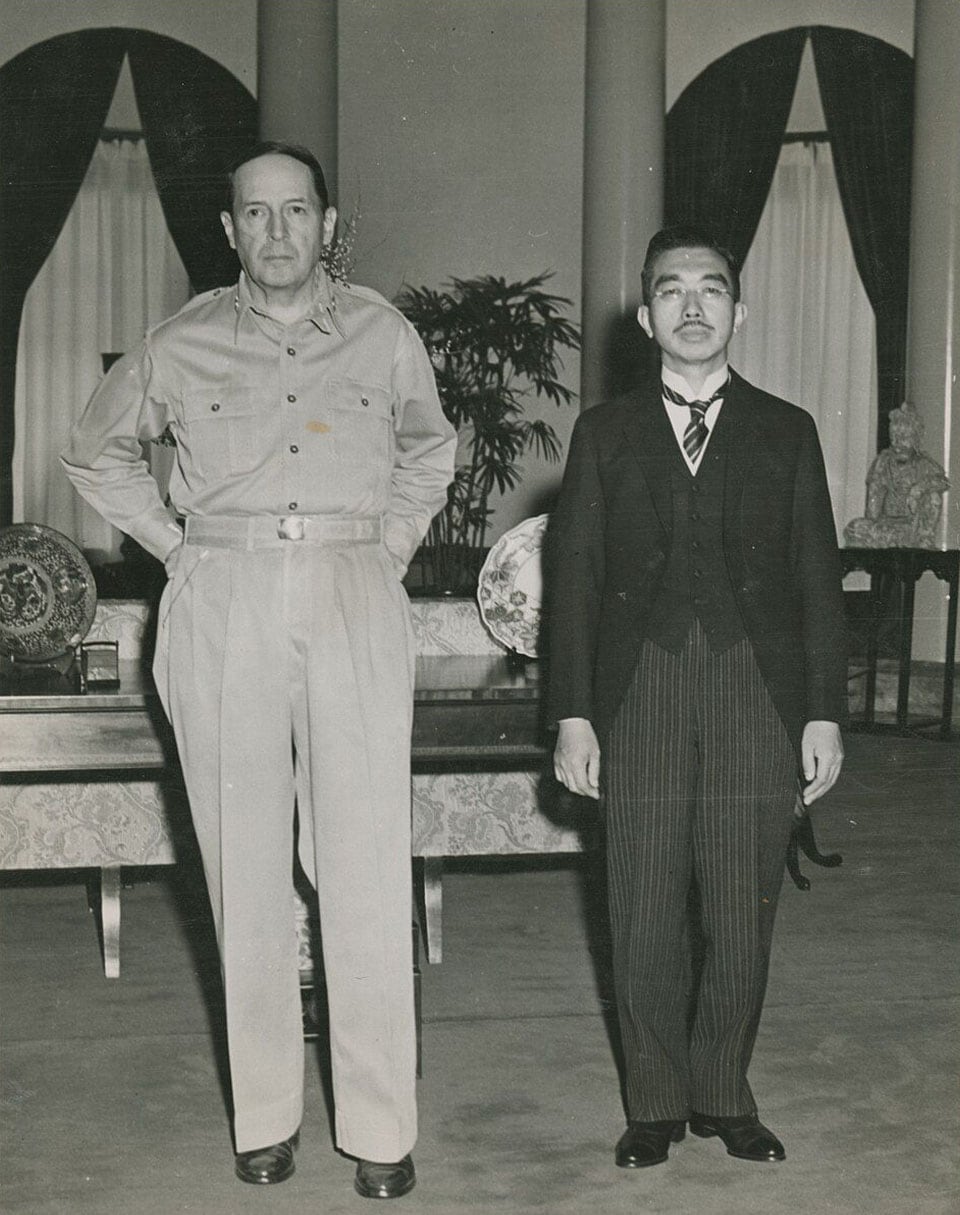
Korean residents’ groups in Japan expressed gratitude to MacArthur, the Supreme Commander governing Japan. Even left-wing Koreans welcomed MacArthur’s administration of Japan.
“Approximately 500 people from the Korean League in Japan, alongside Japanese socialists and Korean communists, gathered at MacArthur’s headquarters to express thanks for Korea’s liberation. The league announced, ‘We extend our gratitude to General MacArthur, whose command aided Korea’s complete independence.’” (December 11, 1945, front page)
MacArthur’s policies during the occupation of Japan drew significant attention in Korea. Related articles included the prohibition of financial support for Shintoism (December 17, 1945, front page), the dissolution of Japanese nationalist groups (January 6, 1946, front page), the strict ban on rice exports from Korea to Japan (January 31, 1946, page 2), and the order to destroy remaining Japanese warships (May 13, 1946, page 2).
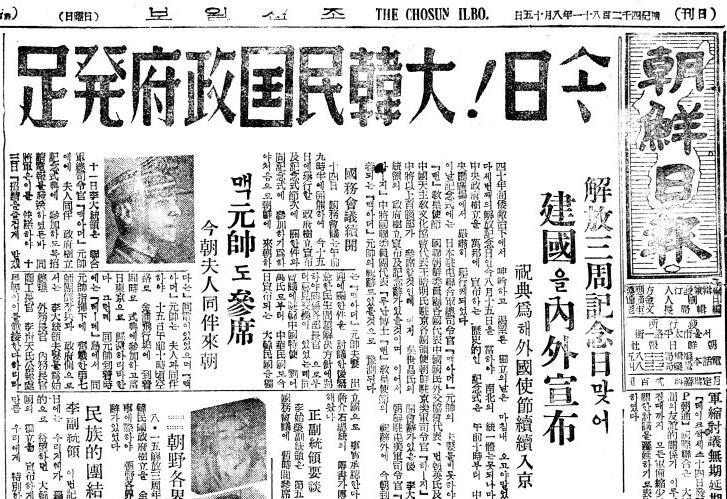
MacArthur attended the establishment ceremony of the Republic of Korea on August 15, 1948, flying from Tokyo with his wife.
“On the third anniversary of liberation from Japanese rule, though unification remained unachieved, the government’s establishment was proclaimed to the world. From the early morning, clear skies greeted the capital, where households raised national flags and streets were cleaned. Central Hall Square overflowed with crowds representing various organizations. Amid the assembled masses, General MacArthur, Supreme Commander of the Allied Powers in the Far East, and his wife entered, joined by numerous domestic and foreign dignitaries. The proclamation ceremony of the Republic of Korea’s establishment and the national celebration began with flowers and choruses, concluding grandly at 1:15 p.m. This was followed by a military parade of 10,000 soldiers at Gwanghwamun Square.” (August 16, 1948, page 2)
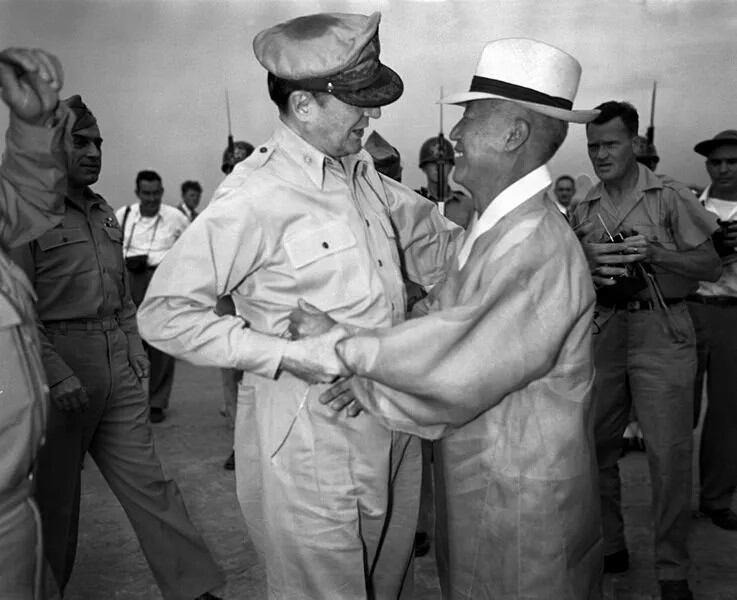
At the Republic of Korea’s establishment ceremony, MacArthur received commemorative gifts from the former imperial family of the Korean Empire, the newly inaugurated president, and the prime minister. “A jade vase was presented by Empress Yoon (Yi Bi, the second queen consort of Emperor Sunjong, Queen Sunjeonghyo) from the former royal palace, a historic bronze incense burner by the president, and a silver incense burner by the prime minister to General and Mrs. MacArthur.” (August 16, 1948, page 2)
MacArthur invited President Rhee Syng-man to Tokyo approximately one month and a half after the government’s establishment.
“Following his participation in the August 15 independence celebration, President Rhee accepted General MacArthur’s invitation to visit him in Tokyo. Accompanied by one secretary each, President and Mrs. Rhee departed Seoul on the 19th via a plane provided by General MacArthur and returned on the 21st. The president’s visit to Japan had no political agenda but aimed to express gratitude to General MacArthur.” (October 9, 1948, front page)
MacArthur heard from Rhee Syng-man about the challenges facing the newly established Republic of Korea. Rhee discussed the threat of communist forces in North Korea and the Korean people’s desire for unification.
“Dr. Rhee stated the following regarding the problems faced by his government, established just a month prior: The major issue confronting the Republic of Korea and its people is the series of communist conspiracies instigated by the Soviet-organized communist government in North Korea. Communist agents from the North are continuously infiltrating the South, causing unrest. As long as the communist regime in the North exists, such conspiracies will persist. Communists are determined to expand their red dictatorship to the South. The Korean people’s paramount concern is national unification—restoring former borders and being governed under a single administration in the North and South.” (October 16, 1948, front page)
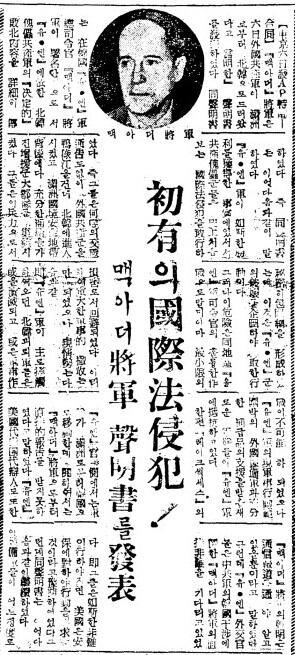
This meeting likely influenced MacArthur’s decision to repel communist aggression immediately after the outbreak of the Korean War. When Chinese forces invaded the Korean Peninsula to support North Korea, MacArthur issued a strong statement calling it “an unprecedented violation of international law” (November 7, 1950, front page).
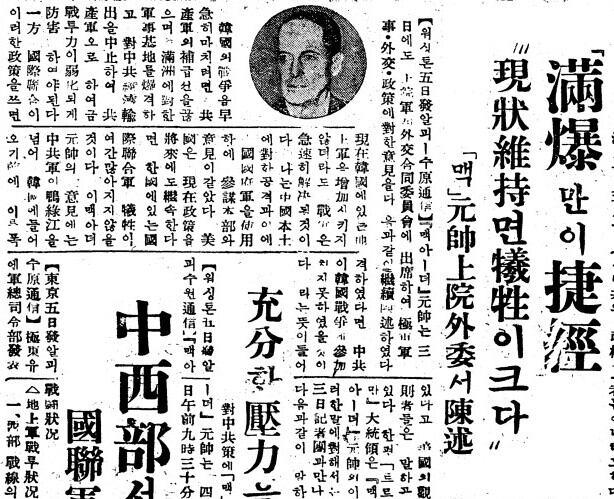
MacArthur testified before the U.S. Senate Committee on Armed Services and Foreign Relations, arguing that bombing Manchuria was necessary to end the Korean War.
“To swiftly conclude the war in Korea, we must cut off the communists’ supply lines, bomb their military bases in Manchuria, and halt exports to Communist China, weakening their combat capabilities. If the United Nations adopts this policy, the war can be resolved rapidly without increasing ground forces in Korea.” (May 6, 1951, front page)
The Truman administration rejected MacArthur’s strategy. Earlier, MacArthur was dismissed as UN Commander on April 11, 1951. Generals Ridgway and Clark later succeeded him.
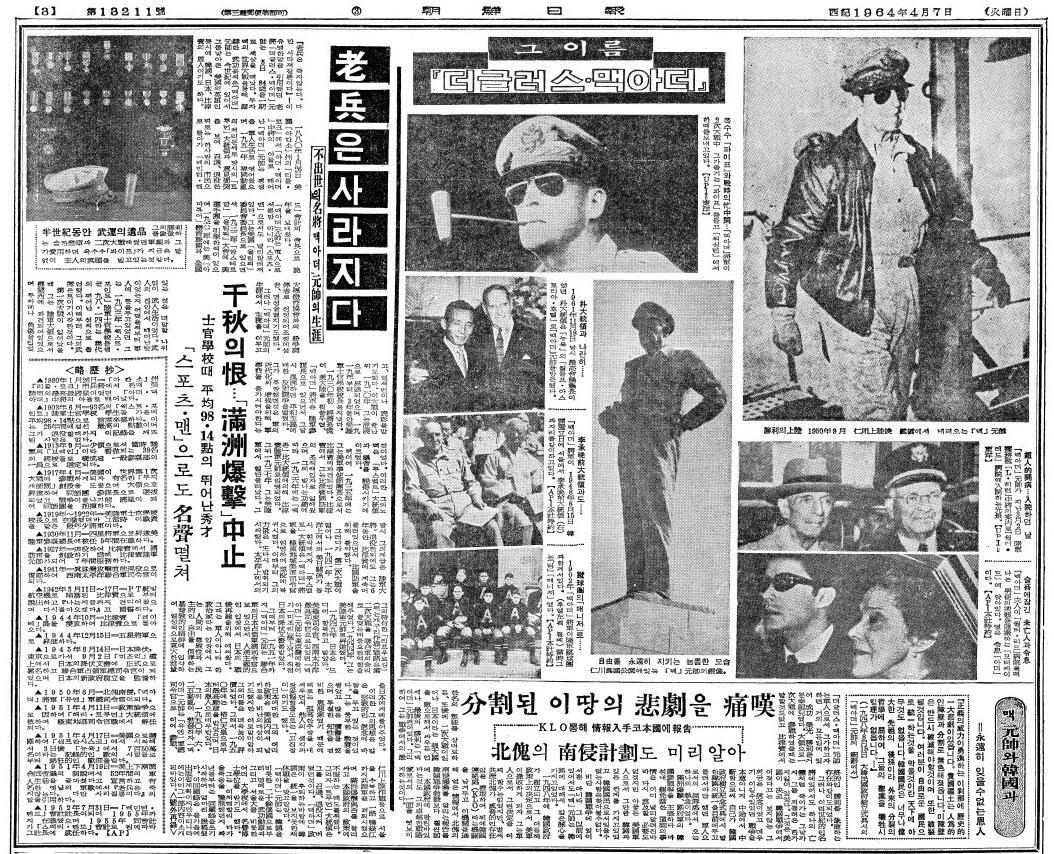
MacArthur was hospitalized in March 1964 due to jaundice and underwent two abdominal surgeries, including gallbladder removal. His condition worsened with pneumonia and kidney failure, leading to his death on April 5.
A commemorative obituary included a speech MacArthur delivered at the Republic of Korea’s establishment ceremony on August 15, 1948, stating that the division of the Korean Peninsula must end.
“At this moment when the power of justice advances, there is a historic tragedy. Your homeland has been discolored by artificial barriers and division. These barriers must and will be destroyed. Nothing in the world can prevent you from unifying as a free people. The Korean people, descendants of such great ancestors, will never yield to foreign philosophies of division and sacrifice their sacred mission.” (April 7, 1964, page 3)
월 5900원 멤버십, 신문 독자에게는 2900원, 조선멤버십
55000원 상당의 신문-잡지 8종 마음껏 보기, 조선멤버십
현금처럼 쓸 7000포인트 받아 알뜰한 쇼핑, 조선멤버십