
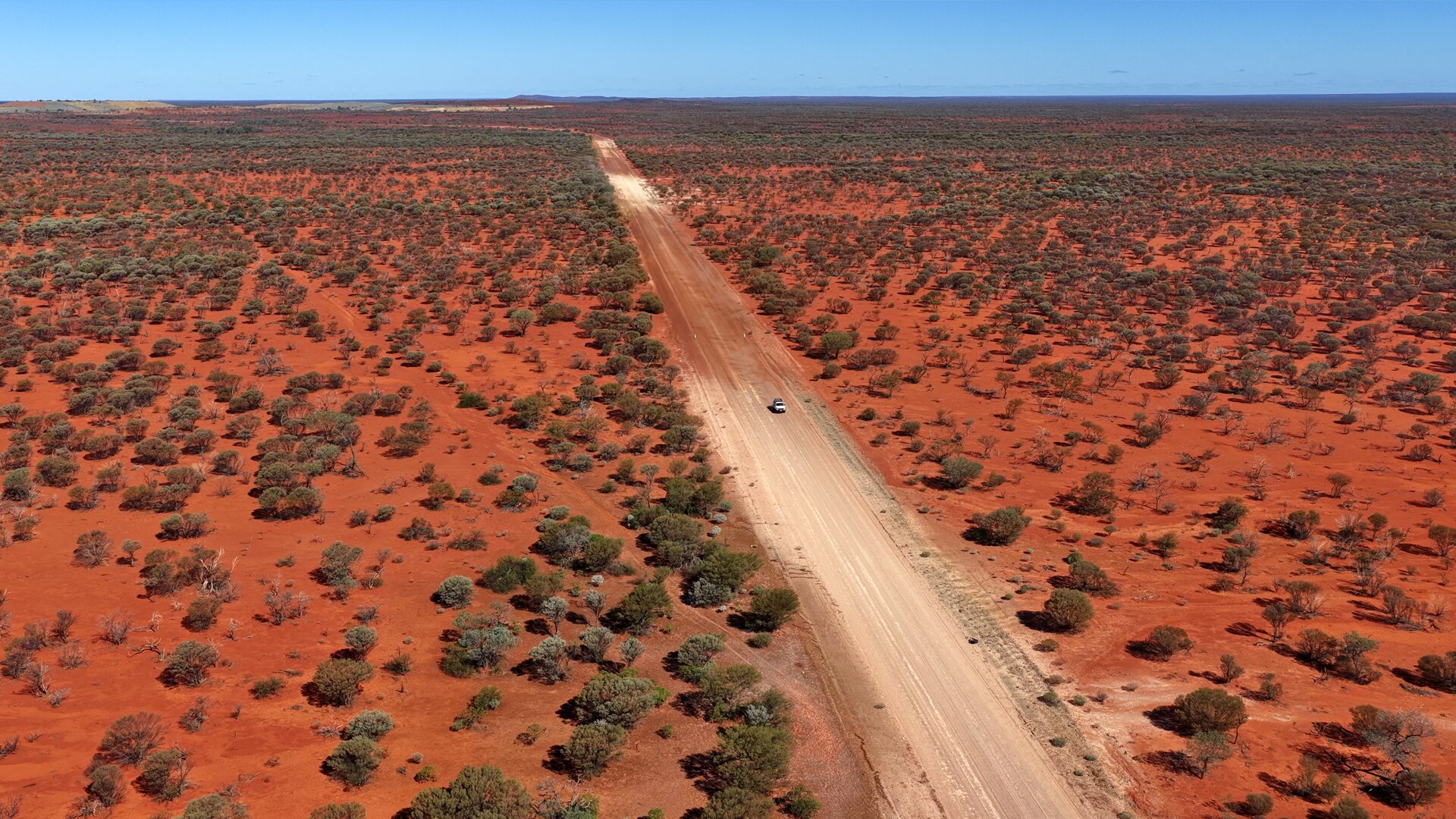
The vast, unforgiving Australian outback has claimed lives in preventable tragedies, prompting a grieving mother’s desperate plea for greater safety awareness. Kelly Townsend’s journey into the remote Murchison region of Western Australia is not a holiday, but a pilgrimage to the site where her son, James, and ex-husband, Ray, met their tragic end. The emotional weight of this trip is palpable.
“I’m feeling a bit anxious and overwhelmed,” Kelly admits, her voice tinged with the raw pain of loss. “This doesn’t feel good…it doesn’t feel good at all.”
James, aged 33, and Ray, 66, were on a prospecting trip in 2024 when their lives were cut short. Their abandoned campsite was reported to authorities, and three days later, searchers discovered their bodies two kilometres away. The stark reality is that they had set off on foot, became disoriented, and, without any means to call for help, succumbed to the harsh desert elements.
Kelly’s visit to their final campsite is an attempt to confront the unfinished business of two premature deaths that, she believes, could have been avoided. “I still haven’t got my head around the fact that they’re gone,” she confides, the words heavy with sorrow. “And the heartbreaking thing is that if the boys had a PLB with them, they could have set it off and had help. And my son would still be here with me today.”
She is referring to Personal Locator Beacons (PLBs) – compact, life-saving devices that can alert emergency services to your exact location. These crucial pieces of equipment, costing as little as $300, are at the heart of Kelly’s mission. Amidst her profound grief, she is determined to ensure that everyone venturing into the Australian bush carries a PLB. Her firsthand experience has taught her the deadly potential of the outback and the preventable nature of the nightmare she is living.
The Rising Tide of Outback Disappearances
Across Australia, the grim reality of people getting lost and perishing in the bush continues, despite the widespread availability of affordable and accessible emergency equipment. These incidents, authorities lament, are almost entirely preventable. National data reveals an 11 per cent increase in land searches over the past year. While many searches are conducted in urban areas for individuals with dementia or children who have wandered off, the most challenging, deadly, and avoidable searches are those in the remote bushland.
Alex Barrell, Chair of the National Search and Rescue Council, highlights that these incidents often involve locals rather than tourists. “It’s a combination of bushwalkers and hikers, to remote workers and farmers,” he explains. “We’ve also seen more people get involved in outdoor activities, so there’s an increase in 4WD’ing and camping, which is great that people are getting out there. But I think complacency is a big part of it – an over-reliance on familiar knowledge and not having a plan for what to do if things don’t go to plan.”
Heartbreak in the Wilderness
Each year, over 3,000 land searches are undertaken nationwide. While some individuals are successfully rescued, others are found deceased, and a distressing number, like South Australian prospector Alan Graham, Tasmanian man Peter Willoughby, and station worker Mark Sear, are never found at all.
“It’s a frustrating situation, and it’s also heartbreaking,” says Jim Armstrong of the WA Police Emergency Operations Unit. “It’s tragic when people have passed away because they’ve made basic mistakes.” Armstrong’s team has encountered individuals so dehydrated they hallucinate, and witnessed deaths mere metres from safety. He stresses that modern emergency communication technology means nearly every incident is avoidable.
“Every search is a race against time, because we have what we call a ‘time frame for survival’,” Armstrong states. “And these days every search and rescue should really just be a rescue – you let us know you’re in trouble, and we’ll come pick you up. We cannot emphasise enough – pack lots of supplies, stay with your vehicle if things go wrong, but most of all, carry a PLB with you at all times.”
Near-Death Encounters in the Bush
How do experienced travellers and locals find themselves in life-threatening situations in the bush? Fatalities are frequently linked to vehicle breakdowns, flat tyres, or taking a wrong turn on a scenic trail. Those who have narrowly escaped death recount how rapidly circumstances can deteriorate. Harrowing accounts emerge of painful blisters, a growing sense of dread, hallucinations, and the life-or-death decisions made as mental faculties decline. Yet, amidst these nightmarish scenarios, there is profound gratitude for the efforts of police and volunteers, and valuable lessons for those venturing outdoors.
“You Bloody Idiot”: A Brush with Disaster
Brian Brady never imagined he would become lost. His ordeal began in May 2023 while camping with friends in the Murchison region. “The fellas were cooking dinner and I thought, ‘there’s an hour of daylight, I’ll just take my metal detector and go for a short walk around the camp’,” he recalls.
Drawn by the promise of his detector, he ventured further than intended along a rocky wash-out. “I just kept going until I was further away than I thought, and then suddenly realised I wasn’t sure which way was back,” he admits. “I thought ‘you bloody idiot’ – I knew I’d left my safety gear back in my car. And I thought to myself, this isn’t good.”
In that critical moment, Brian made a fateful decision. Instead of staying put, he attempted to retrace his steps. “If I’d have stayed where I was, I’d have been found quickly – the guys had already called the police by 6pm,” he reflects. “But I just felt so bad about the trouble I was about to cause, inconveniencing all of those people, and I just thought, with an hour of moonlight, surely I can find a track.”
The first night was bitterly cold, forcing him to curl into a ball under a bush. The following day, he mistook a distant mirage for a caravan, only to realise it was a mine site too far to reach on foot. Blisters formed on his hands, and flies swarmed his face. “Towards the end of the third day I couldn’t stand up any more – I was too weak,” he says. “I was thinking about my family a lot, but I was pretty calm about the idea of passing away… if it’s going to happen it’s going to happen, and it’s my fault. So I camped under a bush and that’s as far as I got.”
A Lucky Rescue
On the fourth day, Brian Brady was found alive, but barely. Police technicians, installing a radio transmitter, spotted his legs protruding from beneath a tree. Video footage captured the moment police and paramedics swarmed him, providing vital warmth and hydration. He was mere hours from death. Sergeant Armstrong, involved in the search, described Brian as “extremely lucky,” noting he was “very weak and disorientated, and right on the cusp of what we call the ‘time frame for survival’.” The experience profoundly altered Brian’s perspective. “These days I won’t even go to the toilet without a bloody tracker,” he chuckles. “And I want people to know the police and the rescue people were absolutely amazing. The other thing I learnt the hard way was, if you get in trouble, stay where you are.”
One Careless Error
Experienced hiker Neil Campbell also narrowly escaped tragedy. Rescued from the WA Wheatbelt in November 2024, the 72-year-old retired forensic scientist had decades of orienteering experience. During a solo walk in the Helena and Aurora Range, he decided to take photos of the scenery. “I though, I’ll just take some photos of the scenery to show my wife,” he recounts. “But I walked down the wrong side of the ridge-line, and couldn’t find my car, and walked around for about five hours trying to find it.”
By 7 pm, his water supply was depleted. He assessed his options and decided to enter survival mode, creating a makeshift shelter under a fallen log. Crucially, Neil’s wife knew his plans, ensuring a search would commence within days. After three days of enduring the heat and reluctantly consuming his own urine, Neil was found by WA Police searchers who spotted a marker he had created with sticks and rocks. “To be honest the whole thing’s a bit embarrassing – it was a careless error,” he admits. “But the point is, I should have had my PLB and more water with me, not left it back in the car. These things can happen much more quickly than you think.”
‘A Hateful Land’
Back in the Murchison, Kelly approaches the desolate campsite where her son and ex-husband died. The sun beats down, and quartz shards glint against the stark red earth. Along the way, Kelly has shared poignant memories of James. “He was very caring, very loving, and he had this contagious giggle that he kept all his life,” she recalls. “I still miss that sound.” Kelly and Ray, though divorced, had maintained a cordial relationship. “Ray was a quiet person. He wasn’t good with crowds, but he loved spending time with his boys.”
As they retrace the pair’s final journey, a palpable sense of foreboding grows. Several wrong turns down isolated tracks serve as jolting reminders of their vulnerability. “It feels like a hateful land,” Kelly observes, her gaze sweeping across the rugged landscape. “It’s bringing back all those unanswered questions of what went so horribly wrong.” They ascend a final embankment and walk in silence to the clump of trees where James and Ray spent their last night.
The Final Camp
Kelly is visibly shaken to find remnants of their camp still present, faded and bleached by the sun. Their gazebo stands askew, a poignant, physical relic of two lives extinguished in this remote expanse. “Being here is hard, and I’ve got few words,” she says falteringly. “I don’t know whether to yell, scream, cry – I just don’t know.” She believes the men likely set off at night to escape the daytime heat. Their bodies were discovered three days into a large-scale search, located under trees approximately two kilometres from their camp.
Should PLBs Be Mandatory?
Amidst her grief, Kelly grapples with confusion and anger. She questions why James and Ray chose such a dangerously hot location for their camp, and why they invested in a $7,500 metal detector but not a $300 PLB. “This trip has put a real fire in my belly about safety,” she declares.
Kelly advocates for mandatory PLB use, drawing a parallel to the regulations requiring EPIRBs on boats in remote waters. This stance is supported by some local governments who witness the significant resources and emotional toll of search and rescue operations. However, state and territory agencies largely maintain a focus on personal responsibility for outback safety, with little indication of adopting mandatory PLB legislation.
The Final Chapter
Kelly remains undecided on where to scatter James’s ashes. She wishes to forge no lasting connection to the ancient landscape of his death, instead cherishing the happy memories of family gatherings and his 15 years working on cattle stations. “I think James would be proud of me, for trying to get the message out there,” she reflects. “Please, please, please, carry a PLB on your body, because it can make the difference between life and death. I don’t want anyone else to experience this heartache – there are no words for how this feels.”



Leave a Reply