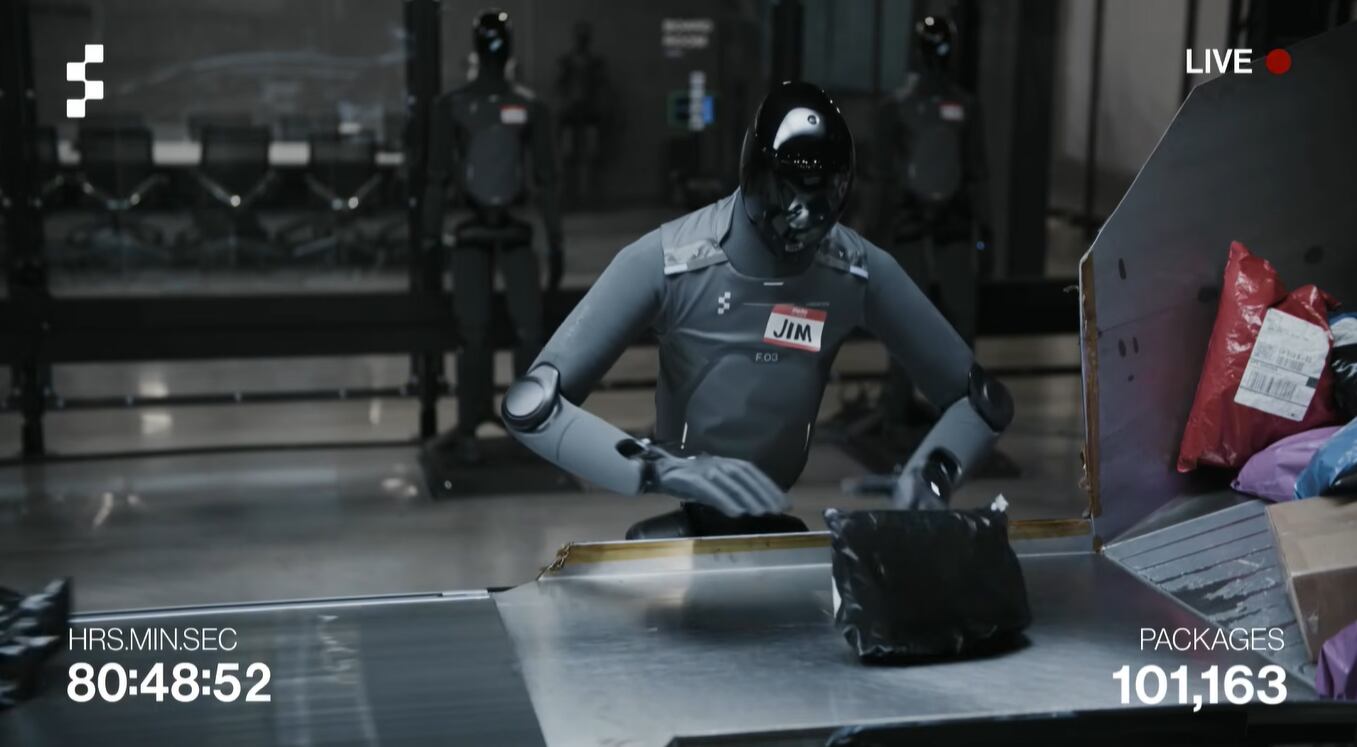
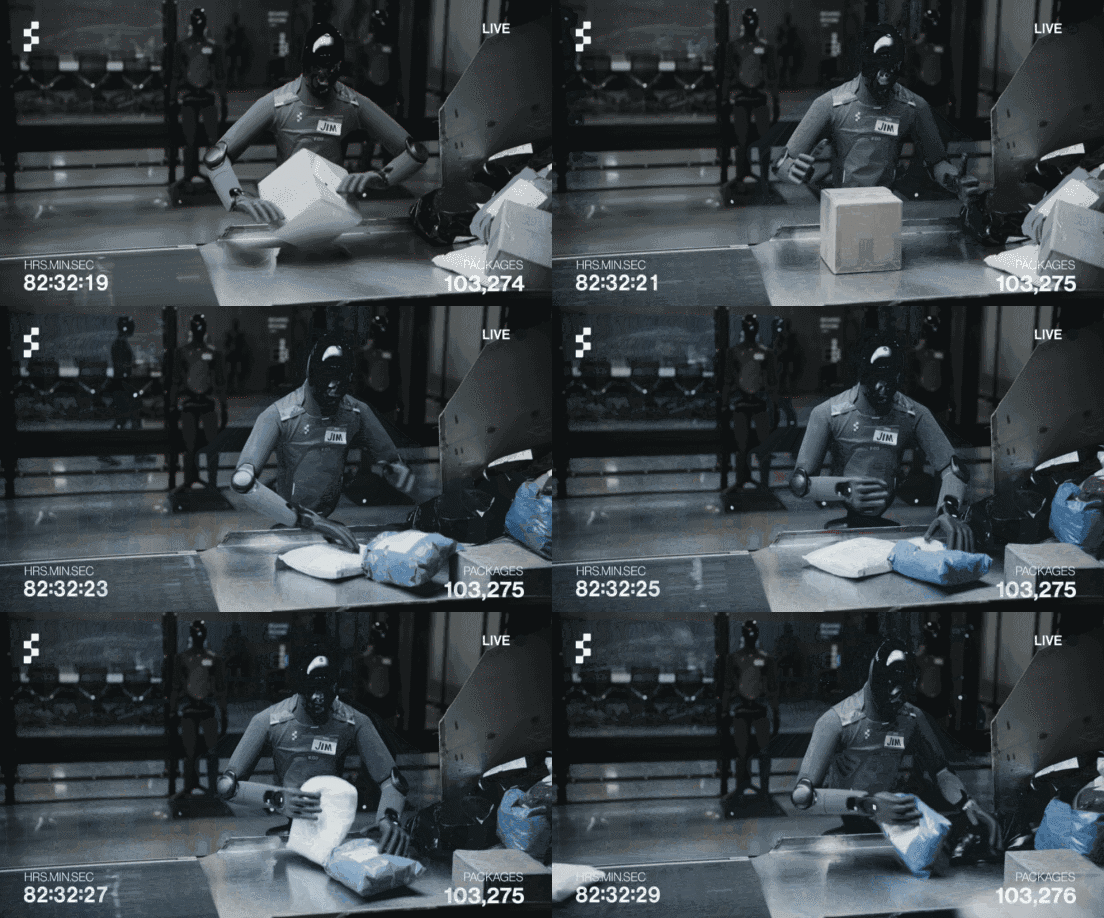
Figure AI, a U.S.-based company specializing in humanoid robots, has exceeded 81 hours of continuous live-streaming on YouTube since it started showcasing a human-shaped robot performing tasks in a logistics warehouse. The humanoid robot featured in the video, named “Jim,” has consistently sorted and organized packages moving along a conveyor belt without interruption. It made sure that multiple packages did not stack or overlap, arranging them so that label sides containing shipping information were facing downward. As of 11 a.m., the robot had handled 101,391 packages in the same location over the course of 81 hours.
Assessments indicate that Figure AI has shown the capability to bring humanoid robots into commercial use within industrial environments through continuous video streaming for four days. Despite being restricted to basic tasks, the robot initially operated during an 8-hour demonstration and kept running past that period, now exceeding 80 hours. Figure AI mentioned, “We will keep conducting the experiment and streaming live until the robot stops working.”
◇Robot Delivering Packages for the Fourth Day
The main aspect of this experiment is the robot’s “full autonomous functionality,” as stated by Figure AI. The robot functions using Figure AI’s exclusive artificial intelligence (AI) system, “Helix-02.” It can identify packages, lift them, and transport them to specified areas without any remote control or human input. Similar to a human employee who thinks and makes decisions independently, all the robot’s choices and operations are handled by its internal computer.
Specifically, Jim’s job is to identify label positions on boxes located on the conveyor or workbench and sort them into specified directions and locations by either picking them up or pushing them. In the real video, the robot “Jim” sorts and lifts packages almost every 3–4 seconds, arranging them along the conveyor belt. To reach distant packages, it extends its arms like a human worker, leans its upper body forward, and uses its five fingers to easily pick up objects. Despite variations in size, color, and shape of the packages, very few are overlooked. Depending on the scenario, it adjusts its actions, such as lifting vinyl-wrapped packages with one hand and large cardboard boxes with both hands.
As per Figure AI, the robot can handle one package every 3 seconds on average. This allows it to sort more than 28,000 items in a single day. The company stated that during the initial 24 hours, the process ran without any errors or disruptions.
◇Showing the Possibility of Dark Factories
Studies indicate that this showcases the viability of “dark factories,” which function around the clock by relying solely on artificial intelligence or robots without any human involvement. Unlike people, machines can operate continuously for 24 hours, which, if achieved, would boost the volume of work completed in manufacturing environments. Brett Adcock, CEO of Figure AI, posted on X, “Our goal is to keep it running until it fails,” and added, “Watch a robot working 24/7 with full autonomous operation.” When someone commented, “A human performing the same task is necessary for comparison,” he replied, “I’m thinking what you’re thinking,” implying that future trials comparing humans and robots might take place. This suggests a desire to clearly show higher efficiency compared to human labor.
This live stream, which appears to present a future industrial location, has attracted considerable online interest. On the fourth day of the live broadcast, the YouTube stream had approximately 6,400 viewers. It is also being broadcast live on various social media (SNS) platforms, with the number of viewers increasing. Audiences are observing the robot’s actions, success rates, and errors in real time, leaving comments such as, “Humans will all be replaced” and “Science fiction films were not just imagination but reality.”
Nevertheless, there are considerable doubts. Human employees can handle unique scenarios, respond to machine malfunctions, or follow instructions from other workers, which robots struggle with. Ayanna Howard, a U.S. robotics specialist, described this demonstration as “more of a scientific endeavor than a complete commercial service.” She highlighted accuracy as the main concern. While the robot operates swiftly, certain instances revealed it failing to position packages accurately. There are also critiques suggesting that in real logistics environments, precision is more crucial than speed, and human oversight might be required because of mistakes.
- Monday 5900 won membership, 2900 won for newspaper readers, Chosun membership
- 8 titles of newspapers and magazines worth 55,000 won, enjoy unlimited reading – Chosun Membership
- Receive 7000 points to use like cash, shop wisely, Chosun Membership