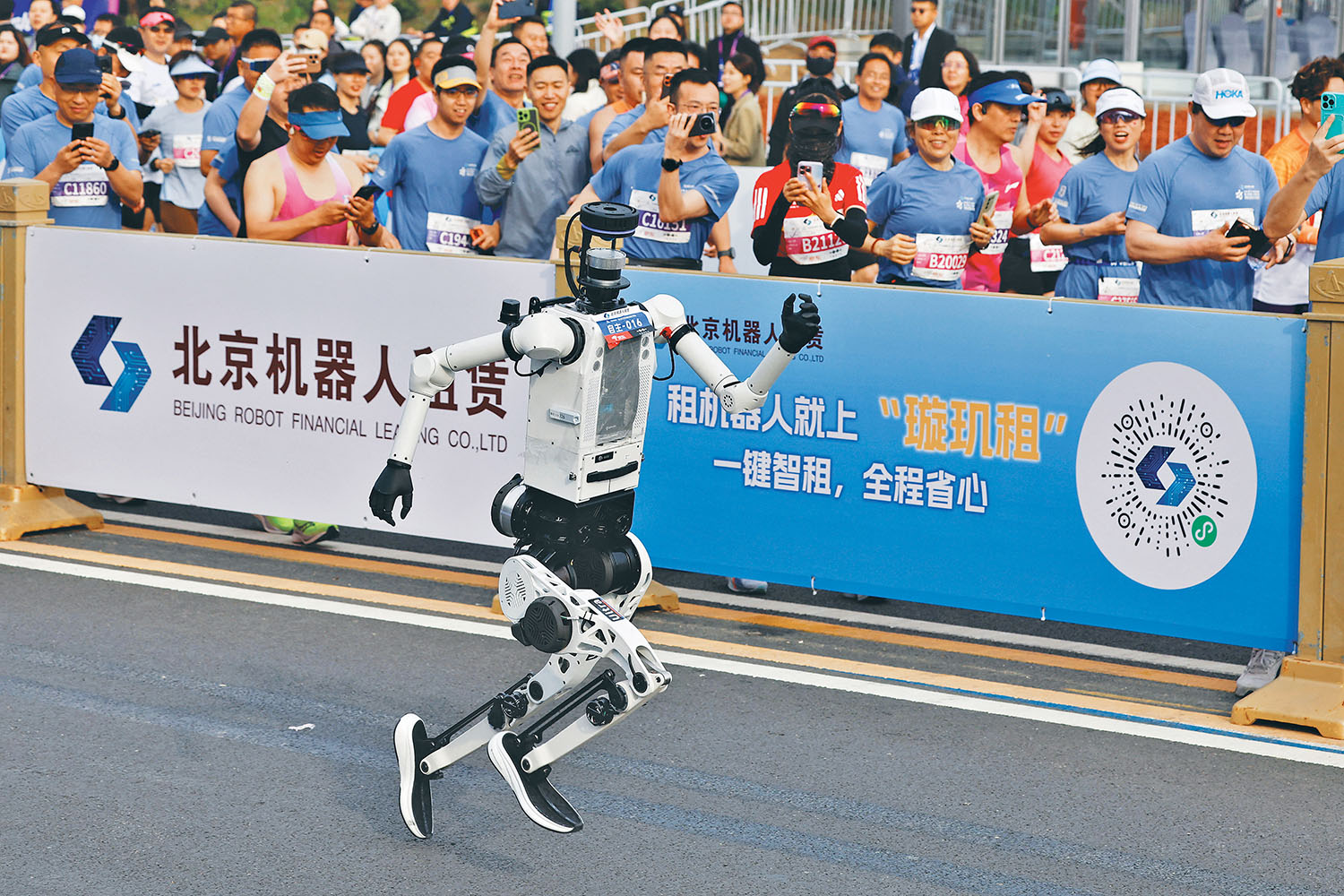
Kathmandu, May 17 — humanoid robots amazed attendees in Beijing last month as they ran a half-marathon, demonstrating significant progress in physical capabilities and self-directed movement, according to experts who believe these developments are quickly transforming the robotics landscape.
Currently, one of those machines might soon encounter an even more demanding task: ascending the slopes of Mount Everest, the tallest mountain on Earth.
At the Beijing half-marathon held on April 19, over 100 robot teams participated in the event.
A number of robots finished the 21-kilometre track quicker than elite athletes.
The victorious humanoid robot, created by the Chinese mobile phone manufacturer Honor, reached the finish line in 50 minutes and 26 seconds—quicker than the human champions and several minutes before the existing half-marathon world record established by Ugandan athlete Jacob Kiplimo in Lisbon on March 8, which was 57 minutes and 20 seconds.
Motivated by these developments, Geologic Dome, a non-profit organization registered in the United States, has partnered with Fourteen Peaks Expedition Pvt Ltd, based in Nepal, to plan the use of a humanoid robot on Mount Everest during the 2026 spring climbing period.
The initiative is called PEMBA.
The initiative seeks to explore if robots might one day aid in collecting trash, track ice formations, and support dangerous mountain tasks on Mount Everest, where significant amounts of waste are still present.
As per documents acquired by the Post, the team has sought approval from Nepal’s officials to deploy a Unitree G1 humanoid robot in the Everest area during a 52-day scientific mission.
Nevertheless, the suggestion has faced an unexpected challenge: Nepal does not yet have a legal system in place that regulates non-human climbers on Everest.
Immediately after receiving the proposal, we consulted the tourism ministry’s opinion,” stated Himal Gautam, director at the Department of Tourism. “The ministry has instructed us to develop a draft that includes its concerns, methods for collecting fees, and other elements. Upon the implementation of the fundamental guidelines, approval will be given.
As the regulatory procedure is still in progress, the project is expected to not proceed during the current spring climbing season, which concludes on May 29. Organizers are now aiming to carry out a trial expedition in the fall or during the winter.
Prajjwal Acharya, the manager of Fourteen Peaks Expedition, mentioned that the plan is still pending until the government completes distinct guidelines for non-human Everest climbs.
“Nevertheless, if everything proceeds as intended, the examination is expected to take place during the autumn season [September to November],” Acharya mentioned.
The robot at the heart of the plan is the Unitree G1, a 35-kilogram fully electric, zero-emission bipedal device created for enhanced movement and precise tasks.
Developed by Unitree, a robotics firm located in Hangzhou, China, this small humanoid robot is intended for research, artificial intelligence advancement, and consumer use, with costs varying between roughly $13,500 and $16,000.
Measuring approximately 1.32 meters (around 4.33 feet) in height, the robot has between 23 and 43 joint degrees of freedom, enabling it to perform dynamic actions like dancing, walking, and flipping.
According to the planned mission, team members would take apart the robot and transport it along Everest’s climbing path, then put it back together at different camps for evaluation. The device would be tested starting from Everest Base Camp, located at 5,364 meters, up to Camp IV at 7,920 meters.
At every site, the robot would function during monitored sessions that range from 20 to 40 minutes, operating within a distance of 100 to 200 meters from a central station.
Project records indicate that no two-legged land robot has ever functioned in the Himalayas at elevations exceeding 5,000 meters.
Scientists aim to gather the initial dataset focusing on humanoid robot movement, power consumption, and joint force in severe Himalayan environments.
The results are anticipated to be released as an open-access standard for the worldwide robotics field.
The suggestion also includes details about the robot’s ability to gather waste from multiple camps utilizing its three-fingered mechanical hands, which can each handle loads ranging from two to three kilograms.
Organizers state that the protests will back Nepal’s Clean Mountain Strategy for 2025-2029.
Pablo Berlanga Boemare, the chief executive officer of Geologic Dome, mentioned in an email to the Post that the organization is keen on sending a robot to Nepal and possibly using it in the mountainous regions.
“We believe we have reached a stage in history where it is crucial to increase awareness regarding the growing presence of these machines in daily life,” he stated.
We introduced the robot to Nepal, performed several tests in and near Kathmandu, and were thinking about taking it to Sagarmatha National Park. We had conversations with the government for two months, and the response we got was that it would be preferable to wait a year since Nepal currently does not have a legal structure for robotics.
He stated, “Certain legislation had to be approved by Parliament before that possibility could be explored, so we chose to abide by that process and proceed accordingly.”
Our objective is to bring new technology to Indigenous communities located near stunning parks worldwide, and teach them how to utilize these tools, enabling them to safeguard and maintain their territory.
The mission also seeks to place small sensor units at various heights to gather climate and glacial information. However, controlling a human-like robot in the death zone of Everest poses significant engineering difficulties.
As per the proposal, lithium-ion batteries may experience a reduction of 50 to 80 percent in their capacity when exposed to temperatures below -20 degrees Celsius. The group intends to tackle this problem by employing specially designed heated battery cases, rapidly replaceable warmed battery units, and insulated transport systems overseen by the expedition team.
The suggestion also highlights that regular lubricants solidify in very low temperatures, and precision gears may get out of alignment due to thermal shrinkage. To solve this issue, the group intends to employ high-performance fluorinated lubricants, akin to those utilized in Mars rovers and space vehicle components.
The creators mention that the Unitree G1 was tested in China’s Altay region during February 2026, where it reportedly took over 130,000 steps in temperatures as low as -47.4 degrees Celsius.
The landscape itself continues to be one of the biggest mysteries.
“No robot that walks on two legs has traversed Everest-style mixed rock, ice, and glacial debris,” the proposal states.
To address this issue, the group mentions that they are collaborating with researchers from Google DeepMind to create reinforcement-learning movement systems that can adjust to unpredictable surfaces instantly.
The suggestion also considers the impact of lower air density at high altitudes. At 8,000 meters, air density decreases to approximately 43% of that at sea level, significantly lowering the cooling effectiveness for internal computers.
The group states that it has developed a dual-zone temperature control system, which isolates heated battery sections from passively cooled electronic components, enabling processors to utilize the extreme cold around them as a natural cooling mechanism.
Another challenge arises from communication. As cellular networks are unavailable above Everest Base Camp, the project intends to employ a Starlink terminal at the base camp, while depending on fully autonomous onboard systems at higher elevations.
The suggestion states that the technology might one day assist Nepal in tackling various long-term issues in the Everest area, such as monitoring crevasses in the Khumbu Icefall, collecting waste, conducting search-and-rescue operations, and observing glaciers.
At the end of the journey, Geologic Dome mentions that it intends to give the robot along with all associated equipment—such as batteries, charging facilities, and thermal protection systems—to a local partner organization in the Khumbu area.
The group has also committed to educating Nepalese researchers and engineers to keep managing the robot during upcoming climbing seasons.
The journey is anticipated to result in a full-length film meant for global release, possibly establishing Nepal as a new hub for studying robotics in harsh environments.
If given the go-ahead, the project would signify not only the initial use of a human-like robot on Everest, but also the first instance where Nepal officially acknowledges the potential for a non-human climber to reach the world’s tallest mountain.