
AI Proficiency Matters: New Report Reveals Experience Drives Superior Performance
The effectiveness of artificial intelligence (AI) in completing tasks is not uniform, even when the AI model and the tasks themselves remain constant. A recent analysis of user data has illuminated a significant performance gap, directly correlated with the extent of an individual’s prior experience with AI. This phenomenon suggests a pronounced “learning-by-doing” effect, where familiarity and strategic engagement with AI tools lead to demonstrably better outcomes.
A comprehensive report, titled Economic Index Report: Learning Curves, published by AI company Anthropic, delved into one million user records of its AI assistant, Claude. The findings, released on the 24th, indicate that users with more extensive experience in interacting with AI achieved higher task completion rates. Specifically, the AI task completion rate for experienced users was found to be 6.4 percentage points higher than that of novice users. The task completion rate serves as a key metric, evaluating the AI’s success in accurately fulfilling user-requested tasks.
The report detailed that long-term users, defined as those who had engaged with Claude for six months or more, achieved an impressive task completion rate of 73.1%. In stark contrast, initial users, possessing six months or less of experience, recorded a rate of 66.7%. This translates to a tangible difference: experienced users receive satisfactory responses for approximately 73 out of every 100 tasks assigned to the AI, while less experienced users only achieve satisfactory outcomes for about 67 out of every 100 tasks.
This disparity in performance, amounting to roughly 4 percentage points, remained consistent even after researchers meticulously controlled for various influencing factors. These controlled variables included the specific type of task, the nationality of the user, and the version of Claude being utilized. The persistence of this difference strongly underscores the principle of learning-by-doing. It highlights how an individual’s level of comfort and understanding of AI can significantly shape the results obtained, irrespective of the AI’s inherent capabilities or the nature of the requested task.
Strategic Interaction: The Hallmarks of Experienced AI Users
The study further elaborated on the qualitative differences in how experienced and novice users interact with AI. Experienced AI users tend to formulate more precise and contextually rich instructions when posing questions or assigning tasks. For instance, when seeking information within specialized domains like semiconductors, a seasoned user might preface their query by assigning a specific persona to the AI, such as, “You are an engineer with 20 years of experience in the semiconductor industry.” This detailed framing prompts the AI to generate more in-depth and relevant responses.
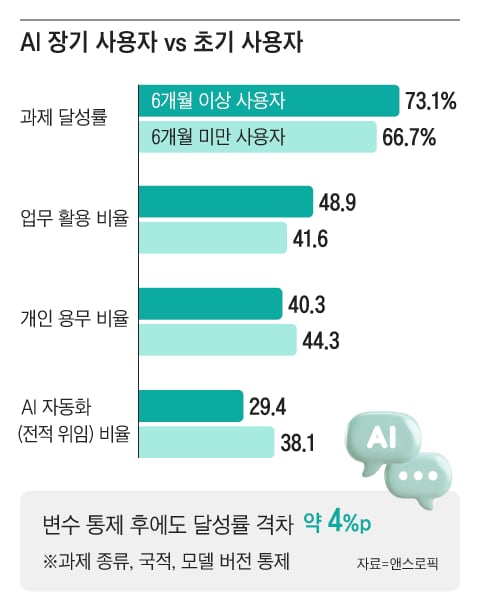
Beyond the specificity of prompts, long-term AI users also demonstrated a propensity for posing more challenging questions and leveraging AI more extensively for professional endeavors compared to their less experienced counterparts. The rate at which long-term users applied AI to their work activities stood at 48.9%, while their utilization for personal tasks was 40.3%. Conversely, new users exhibited a preference for employing AI for personal matters, with a rate of 44.3%, slightly exceeding their use for work-related tasks at 41.6%. Furthermore, the complexity of tasks assigned by experienced users was notably higher, correlating to an educational level of 12.3 years, whereas initial users typically assigned tasks equivalent to an 11.5-year educational benchmark.
Collaboration Over Delegation: The Nuance of AI Partnership
A crucial insight from the report is the evolving understanding of how to best partner with AI. Experienced AI users appear to recognize that a collaborative approach, where AI acts as a sophisticated assistant rather than a complete task delegator, yields superior outcomes. This is reflected in their automation rates. The percentage of tasks that long-term users fully automated, meaning they entirely delegated the task to the AI without significant human oversight, was lower at 29.4% compared to initial users at 38.1%.
Anthropic offered an analysis of this finding, stating, “This result contradicts last year’s hypothesis that more skilled AI users would utilize automation more extensively.” The company further posited, “Highly skilled long-term AI users gain greater benefits from AI, and these benefits can accumulate self-reinforcingly.” This suggests that advanced users are not necessarily seeking to offload all cognitive load but rather to augment their own capabilities, leading to a more productive and synergistic relationship with AI. The iterative process of learning, refining prompts, and understanding AI’s strengths and limitations appears to be the key to unlocking its full potential.