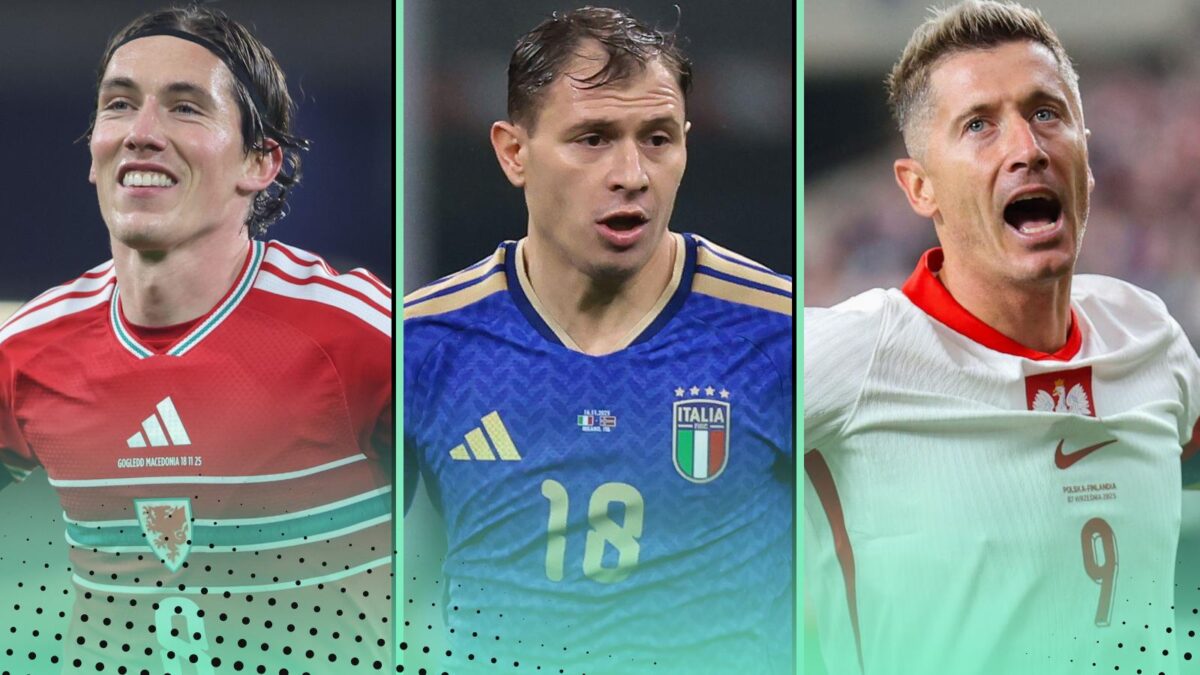
World Cup Play-Offs Ignite International Break with Star-Studded Combined XI
The often quiet international break is set to be electrified this month with a series of high-stakes World Cup play-off matches. Sixteen European nations are fiercely competing for just four coveted spots at the upcoming tournament in North America. Beyond Europe, other regions also feature crucial ties, with DR Congo awaiting the winner of New Caledonia vs. Jamaica, and Iraq preparing to face either Bolivia or Suriname. This compressed schedule means that some of the world’s top footballing talents will be in competitive action, with notable absentees from automatic qualification, such as Italy, adding to the drama.
To capture the excitement and the calibre of players involved, a combined XI has been curated, featuring standout performers from these crucial play-off encounters. To ensure a diverse representation and avoid an overly dominant national flavour, a strict limit of one player per nation has been applied.
The Combined XI: A Tactical Masterclass
Goalkeeper
- Stole Dimitrievski (North Macedonia)
The experienced custodian for Valencia, formerly of Rayo Vallecano, Gimnastic, Granada, and Rabotnichki, is anticipated to face a significant workload when North Macedonia confronts Denmark in Copenhagen. This fixture presents a monumental challenge for the North Macedonians, but with Dimitrievski in goal, an upset is certainly within the realm of possibility. Having earned 85 caps for his country, Dimitrievski was instrumental in North Macedonia’s shock victory over the reigning European champions, Italy, in the 2022 World Cup play-offs, though they were ultimately defeated by Portugal in the final.
Defenders
-
Right-Back: Aaron Wan-Bissaka (DR Congo)
The future international allegiance of Wan-Bissaka was a subject of much speculation, with uncertainty surrounding whether he would commit to DR Congo or continue to pursue an England call-up. Following a series of perceived snubs from the English national team, the former Manchester United right-back ultimately chose to represent the African nation, for whom he qualifies through his parents. This decision offers him the opportunity to help DR Congo reach the World Cup finals for only the second time in their history, having previously participated and lost all three group-stage matches in 1974. Wan-Bissaka’s commitment to DR Congo is considered a significant coup, and a potential duel with Leon Bailey, should Jamaica overcome New Caledonia, promises to be a captivating contest. -
Centre-Back: Illia Zabarnyi (Ukraine)
A highly-rated defender who made a significant move to Paris Saint-Germain from Bournemouth last summer, Zabarnyi is a cornerstone of the Ukrainian national team. While his club season in the French capital may not have been his most stellar, his importance to Ukraine’s World Cup aspirations cannot be overstated. A strong performance against Sweden, and potentially Poland or Albania in subsequent matches, could erase any lingering doubts and secure his nation’s place in the tournament. -
Centre-Back: Nathan Collins (Republic of Ireland)
Completing the central defensive pairing is the impressive Brentford star, Nathan Collins. His recent performances have reportedly attracted the attention of major clubs, including Manchester United. Collins has been a standout performer for Brentford, a team that continues to defy expectations with its remarkable campaign under manager Keith Andrews. His focus now shifts to international duty, where Ireland faces a formidable challenge, beginning with Czechia, followed by the winner of the Denmark vs. North Macedonia tie. However, inspired by the success of other nations, Ireland will be looking to make their mark. -
Left-Back: David Hancko (Slovakia)
Now plying his trade at Atletico Madrid after an impressive Euro 2024 campaign with Slovakia, the former Feyenoord defender Hancko offers remarkable versatility. He is adept at playing in the centre of a back three or four, as well as on the left flank. Hancko is arguably Slovakia’s most valuable player, although Stanislav Lobotka might present a strong counter-argument. Navigating the home fixture against Kosovo should be manageable for Hancko and his teammates, but a final against either Turkey or Romania is expected to be a far more arduous task.
Midfielders
-
Defensive Midfielder: Morten Hjulmand (Denmark)
The choice between Hjulmand and Pierre-Emile Højbjerg for this defensive midfield role was a close one, but Hjulmand’s current form and potential make him the more compelling selection. While Højbjerg has been a reliable presence for Marseille, he is arguably past his peak years. In contrast, Hjulmand is entering his prime. Having scored for Denmark at Euro 2024 against England, a move to the Premier League seems an inevitable next step for the Sporting CP midfielder. His immediate focus, however, is on helping Denmark secure a third consecutive World Cup appearance. -
Central Midfielder: Nicolò Barella (Italy)
The depth of Italian talent available for selection was immense, making the choice of Barella a difficult one. He can take pride in his inclusion over other prominent Italian players such as Sandro Tonali, Gianluigi Donnarumma, and Federico Dimarco. Barella is the driving force in Inter Milan’s midfield, possessing the ability to single-handedly influence the outcome of any match. Given Italy’s recent struggles in World Cup qualification, they will undoubtedly need Barella to perform at his absolute best. -
Central Midfielder: Arda Güler (Turkey)
Turkey boasts a wealth of exciting young talent, including Kenan Yıldız, Barış Yılmaz, Hakan Çalhanoğlu, and Ferdi Kadıoğlu. However, the most electrifying prospect among them is arguably Arda Güler, with Juventus starlet Yıldız a very close second. Güler has earned significant trust and playing time at Real Madrid this season, a testament to his exceptional talent and maturity on the pitch. He is a player of supreme quality.
Forwards
-
Attacking Midfielder: Harry Wilson (Wales)
One of the most in-form players in the current Premier League season, Wilson has emerged as the key figure for Wales in their quest to reach another major tournament. While he may not possess the legendary status of Gareth Bale, Wilson’s left foot is undoubtedly a potent weapon, capable of delivering moments of magic. Wales and Wilson face Bosnia and Herzegovina for a place in the final, where they could meet either Italy or Northern Ireland. While a Welsh victory is a reasonable expectation, Northern Ireland overcoming Italy to set up a home nations derby would be a truly sensational outcome. -
Striker: Viktor Gyökeres (Sweden)
Despite facing some criticism, there is no disputing the incredible goal-scoring prowess of Arsenal striker Gyökeres when presented with an opportunity. In the absence of Alexander Isak, Gyökeres becomes the focal point of Sweden’s attack. The Swedish team’s qualification for the play-offs was a consequence of their UEFA Nations League performance, following a disappointing World Cup qualifying campaign that yielded only two points from six matches. Gyökeres had a lean spell internationally in 2025, failing to score in four appearances, a stark contrast to his ten goals in seven games the previous year. The hope is that manager Graham Potter can reignite his scoring form for Sweden’s crucial semi-final against Ukraine. -
Striker: Robert Lewandowski (Poland)
Robert Lewandowski is a bona fide legend of the game. Widely regarded as perhaps the greatest Polish footballer of all time, he has consistently found the back of the net throughout his career, particularly during his highly successful spells in Germany with Borussia Dortmund and Bayern Munich. The 37-year-old Barcelona superstar has an impressive record of six international hat-tricks and has scored in Poland’s last two major tournament appearances against France, the 2018 World Cup winners. The reliance of nations on key individuals has been a recurring theme, and there is no clearer example than the Polish icon, Robert Lewandowski.
Should both Poland and Sweden emerge victorious in their respective semi-final ties, this formidable strike partnership would face off against each other on March 31st, with a place at this summer’s World Cup on the line.