
Last year, 289,368 cases of domestic violence were reported to the police. Of these, only 33,635 cases (11.6%) resulted in the arrest of the perpetrator. This is because victims often withdraw their reports out of fear of retaliation from the perpetrator or reach agreements with them during the investigation process. Consequently, 9 out of 10 victims remain trapped in the cycle of domestic violence. Victims of relationship-based crimes, such as domestic violence and stalking, also note that they often have to directly prove the facts of the crime even after reporting. Victims of economic crimes like fraud also point out that the police’s investigation speed falls short of expectations. Experts have called for the introduction of an immediate eviction order system for domestic violence perpetrators and a significant increase in police investigative personnel to speed up the handling of economic crimes.
“Immediate Eviction Measures for Domestic Violence Perpetrators Should Be Introduced”
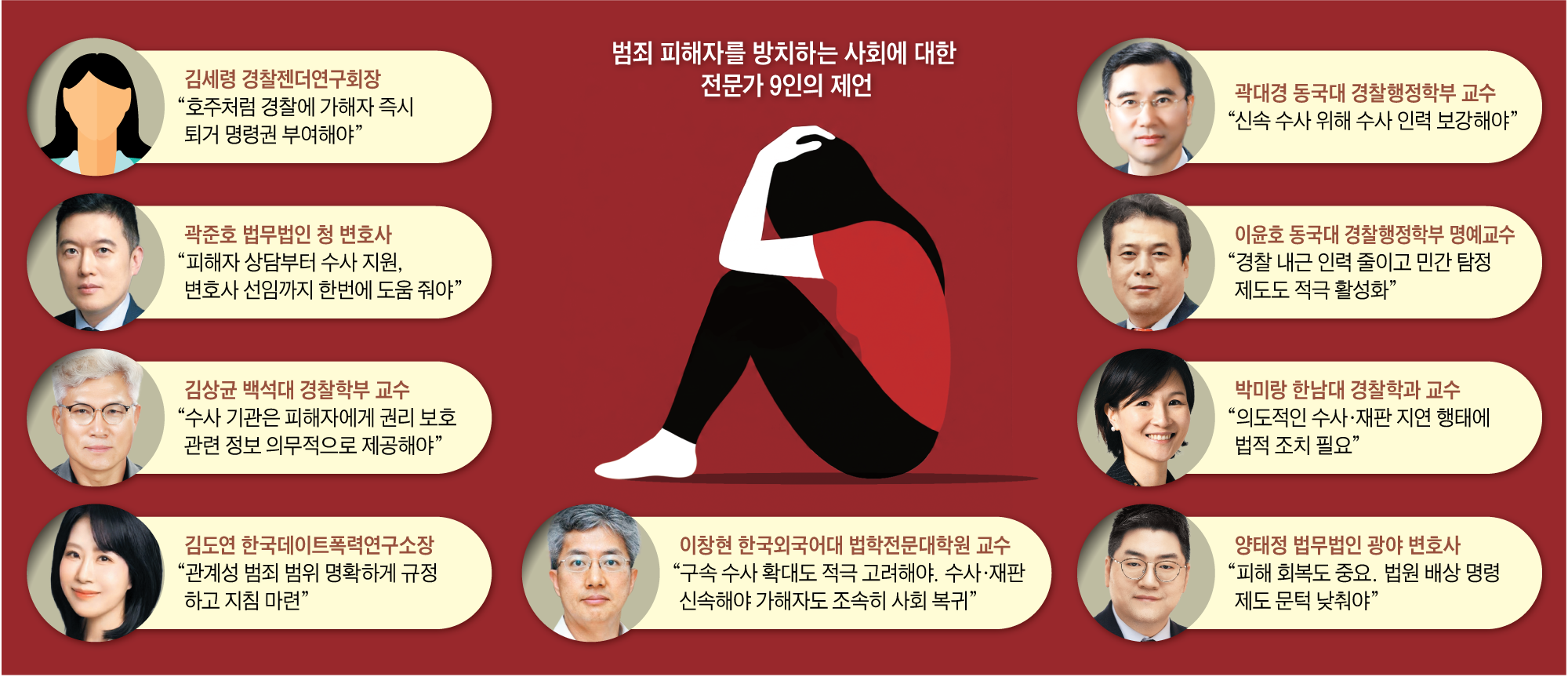
Experts emphasized the need for immediate and effective measures to protect victims of relationship-based crimes. Kim Se-ryeong, head of the Police Gender Research Association, said, “In domestic violence cases, swift separation from the perpetrator is necessary. However, police measures such as eviction orders or restraining orders against perpetrators require a court decision to remain valid beyond 48 hours, inevitably causing delays.” She added, “We should introduce measures, as in Australia, that immediately evict perpetrators from the scene and maintain the effectiveness of these measures until a court hearing.”
Kwak Jun-ho, a lawyer at Law Firm Cheong, stated, “A system should be established where victims of domestic violence can receive support—such as counseling, investigative assistance, and legal representation—from a single institution before reporting.” Kim Sang-gyun, a professor at Baekseok University’s Police Studies Department, said, “Investigative agencies should be obligated to provide victims with necessary information related to their rights.”
Kim Do-yeon, director of the Korean Dating Violence Research Institute, noted, “If domestic violence crimes are limited to legal or de facto spouses, victims of one-sided stalking crimes by former partners or acquaintances cannot receive legal protection.” She added, “The law should be revised to expand the scope of relationship-based crimes.”
“Investigative Personnel for Economic Cases Should Be Expanded”
Regarding the increase in economic crimes such as fraud and technology theft, Kwak Dae-kyung, a professor at Dongguk University’s Police and Justice College, said, “A significant expansion of veteran investigators with expertise is needed.” He explained that economic crimes have become more complex, increasing the difficulty of investigations, while veteran police officers increasingly avoid investigative units, opting for patrol duties instead—a vicious cycle.
Lee Yoon-ho, emeritus professor at Dongguk University’s Police Administration Department, said, “In the U.S., over 90% of police personnel are field officers primarily handling investigations, whereas in South Korea, 40% are administrative staff and 60% are field officers.” He added, “An increase in administrative staff leads to a focus on paperwork and heightened supervision of frontline officers. Reducing administrative roles and expanding investigative personnel is necessary.”
Lee Chang-hyun, a professor at Hankuk University of Foreign Studies Law School, said, “While investigations and trials for relationship-based crimes are delayed, victims face retaliation from perpetrators.” He noted, “There should be a societal discussion on expanding the use of detention investigations for certain relationship-based crimes.” Detention cases, he explained, tend to proceed more swiftly through investigations and trials. Park Mi-rang, a professor at Hannam University’s Police Studies Department, said, “Legal measures are needed against perpetrators who intentionally delay investigations or trials.”
“Criminal Justice System Should Shift to a Victim-Centered Approach”
Experts also argued that the criminal justice system’s focus should shift from suspects to victims. Lee Yoon-ho said, “The U.S. and Europe have established victim-centered justice systems by enacting ‘victim special laws.’ South Korea needs to supplement related systems.” Yang Tae-jeong, a lawyer at Law Firm Gwangya, said, “The court’s restitution order system should be activated.” This system allows victims to request compensation orders alongside guilty verdicts in criminal trials, enabling swift restitution without separate civil lawsuits.
Relationship-Based Crimes
These refer to crimes occurring in close relationships such as between spouses, lovers, or family members. They primarily include stalking, dating violence, child abuse, and domestic violence. A key characteristic is that the close relationship between the perpetrator and victim leads to the crime recurring.
월 5900원 멤버십, 신문 독자에게는 2900원, 조선멤버십
55000원 상당의 신문-잡지 8종 마음껏 보기, 조선멤버십
현금처럼 쓸 7000포인트 받아 알뜰한 쇼핑, 조선멤버십