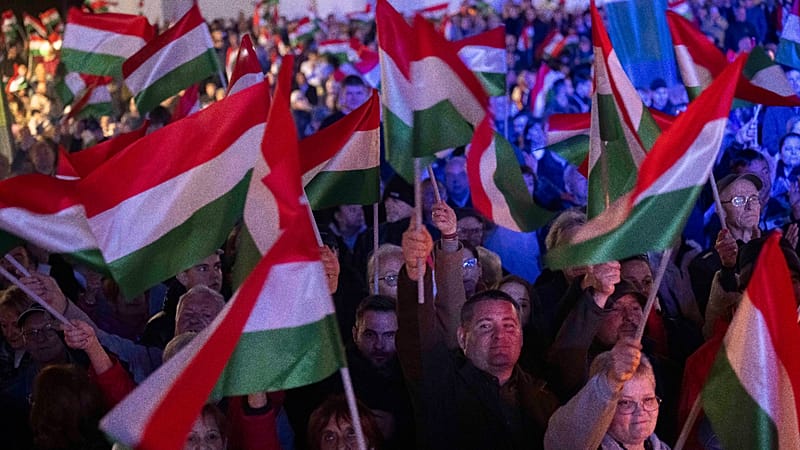
Accusations of Political Interference in Hungary’s Elections
Social media accounts linked to Hungary’s ruling right-wing populist party, Fidesz, have accused Meta, the parent company of Facebook and Instagram, of political interference in the country’s upcoming elections. The allegations suggest that the party and Prime Minister Viktor Orbán are being censored on the platform.
Fidesz campaign chief Balázs Orbán supported these claims, stating that users had reported difficulties in liking Fidesz-related content on Facebook. He made this statement on 29 March, adding that the issue had persisted for several days. However, The Cube, Euronews’ fact-checking team, was unable to find any credible evidence backing these claims.
Claims of Interference
The allegations gained traction after a post shared by Lebanese-Australian political commentator Mario Nawfal, known for his populist leanings. On 18 March, he claimed that Facebook was restricting posts from Hungary’s Prime Minister ahead of the crucial elections scheduled for 12 April. He suggested that the opposition Tisza Party, led by former Fidesz member Péter Magyar, had encouraged supporters to mass-report Orbán’s content.
These claims were later picked up by Polish conservative outlet wPolityce.pl and Mandiner, a Hungarian newspaper aligned with Fidesz. Mandiner identified the “opposition member” mentioned by Nawfal as Tisza MEP Dóra Dávid, a former legal adviser to Meta.
The Cube reached out to Nawfal for more information but did not receive a response. There is currently no public evidence indicating that Meta targeted or censored posts from Fidesz or Orbán.
A Meta spokesperson confirmed that there were “no restrictions on the [Hungarian] Prime Minister’s accounts” and that none of his posts had been removed. They added that their Community Standards apply equally to all users and that systems are in place to detect coordinated abuse of reporting mechanisms.
Video Taken Out of Context
The claims against Dávid appear to misrepresent some of her previous statements, including a video she posted in November 2025. In the video, Dávid addressed accusations from far-right groups that she was manipulating Meta’s algorithms. She denied the claims and explained how users can report content that violates Meta’s community standards.
Meta allows users to flag content that includes “hateful content” targeting individuals based on race, ethnicity, national origin, disability, religious affiliation, and other factors. Users in Europe can also flag content they believe to be fake news, which is then reviewed by independent fact-checkers.
In contrast, Meta has shifted to a “community notes” system in the US, allowing users to add notes to posts deemed misleading. This change aligns with the platform’s move away from professional fact-checkers. However, such a system faces challenges in Europe due to the Digital Services Act (DSA), which requires platforms to address risks to democratic processes.
Meta’s Fact-Checking Process
Meta maintains third-party fact-checking outside the US, including in Hungary, where it collaborates with AFP and the EU. A spokesperson emphasized that the company is improving the Community Notes system before expanding it to other countries.
Dávid’s call for users to report false and misleading content aligns with Meta’s guidelines and the DSA’s goal of mitigating disinformation. The Cube contacted Dávid for comment, but she declined to respond to the specific content from Fidesz she referenced.
Other Allegations Against Fidesz
Fidesz has faced multiple accusations of using underhanded tactics against its rivals. In recent months, the party has been accused of spreading AI-generated images and videos to discredit political opponents, including false footage of Tisza leader Péter Magyar and fake videos of Hungarian soldiers.
Despite Meta’s policies against content that interferes with political processes, researchers note that flaws in the filtering process still allow some harmful content to remain online.
Targeted Individuals
Dávid is not the only person accused of driving a campaign against Fidesz via Meta. Social media posts have also targeted Oskar Braszczyński, Meta’s government and social impact partner for Central and Eastern Europe. On 18 March, Philip Pilkington, a conservative commentator, shared an X post claiming that Braszczyński was suppressing Orbán’s social media presence.
None of the accounts that shared these claims provided evidence. Some X users described Braszczyński’s support for Ukraine and LGBT rights as signs of progressive liberal interference in European elections.
Pilkington told The Cube that he could not provide further details, citing a “senior government source in Budapest.” Braszczyński did not respond to requests for comment.
Meta did not comment on the allegations involving Braszczyński and Dávid.