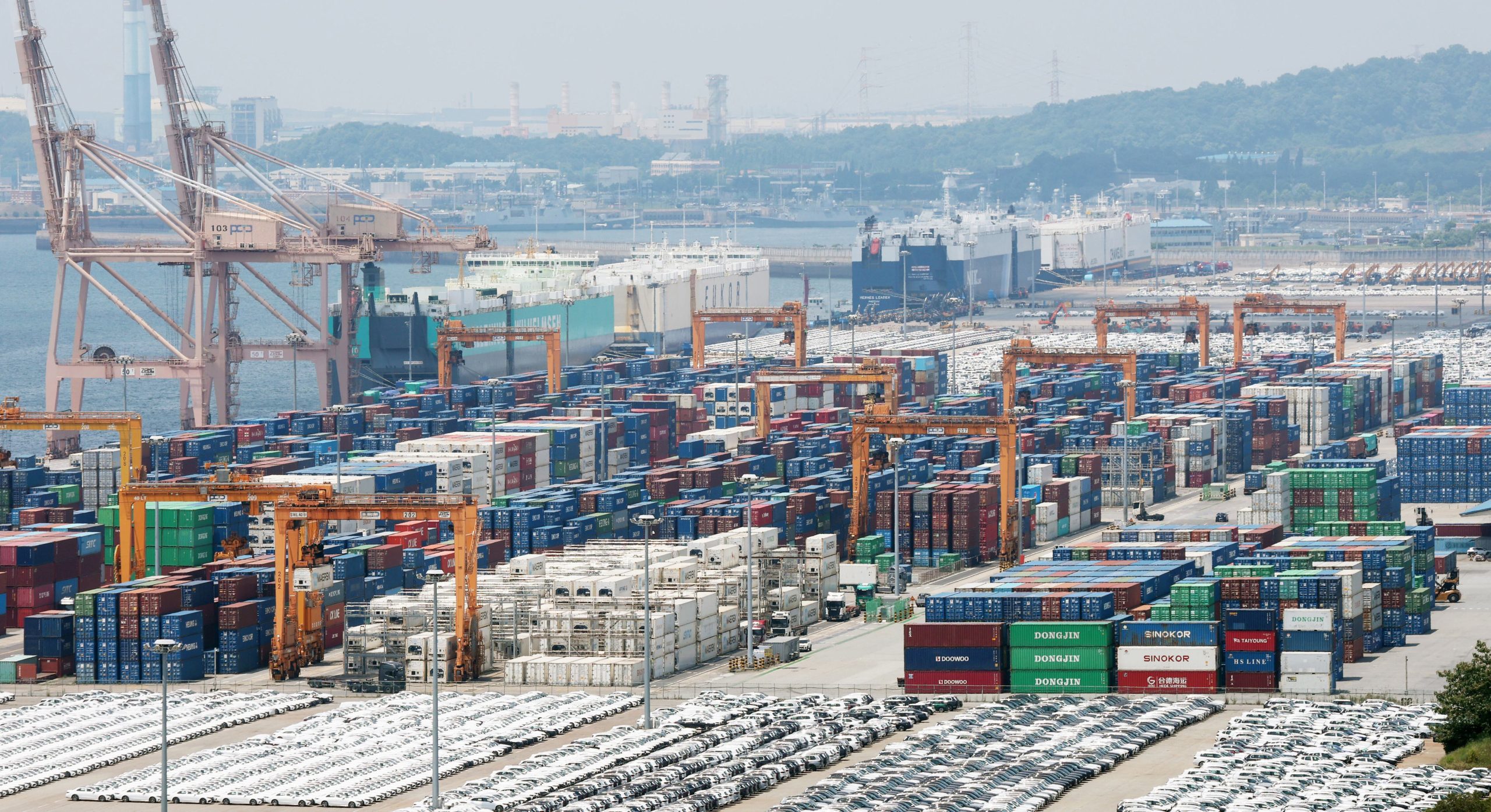
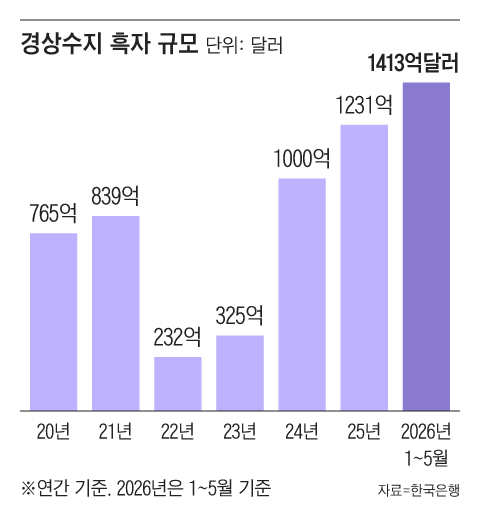
South Korea’s current account surplus has reached a new milestone, driven by a significant increase in semiconductor exports fueled by the U.S. artificial intelligence (AI) boom. In just five months, the country surpassed its previous annual record surplus. According to the Bank of Korea, the current account balance recorded a surplus of 38.61 billion dollars in May. This marks the 37th consecutive month of surplus and is the largest ever recorded, exceeding the previous high of 37.93 billion dollars set in March. The cumulative surplus from January to May totaled 141.28 billion dollars, surpassing last year’s annual record of 123.0528 billion dollars.
The goods account was the main contributor to this large surplus. Exports increased by 62.9% year-on-year, while imports rose by 22.2%, resulting in a goods account surplus of 37.86 billion dollars—the highest on record. This surpassed March’s previous high of 35.68 billion dollars. Semiconductor exports surged by 167.7% year-on-year, and IT-related goods exports jumped by 128.9%. Non-IT items also saw growth, including petroleum products, which rose by 49.1%, and chemical products, which increased by 11.0%. Overall, the cumulative goods account surplus from January to May reached 145.96 billion dollars.
The services account, which includes travel, recorded a deficit of 1.09 billion dollars in May, a narrowing from April’s 2.42 billion dollars. The travel account shifted to a 50 million dollar surplus from a 30 million dollar deficit in April, attributed to an increase in visitors to South Korea. The intellectual property royalty account turned to a 70 million dollar surplus from a 460 million dollar deficit. Meanwhile, processing services and transportation recorded deficits of 500 million dollars and 440 million dollars, respectively.
In May, foreigners’ net selling of Korean stocks amounted to 31.05 billion dollars, a sharp increase from April’s 1.24 billion dollars. They purchased 6.4 billion dollars in bonds. The Bank of Korea explained that foreigners expanded their net selling of stocks due to profit-taking amid rising stock prices, while bond purchases increased due to inflows from the WGBI (World Government Bond Index) inclusion.
During the same period, Koreans net purchased 7.6 billion dollars in overseas stocks and net sold 1.35 billion dollars in bonds. The net increase in securities investment assets reached 30.89 billion dollars, the second-highest on record after March’s 38.05 billion dollars. This was driven by foreigners’ large-scale stock sales and Koreans’ overseas stock purchases.
Direct investment assets, including corporate overseas investments, increased by 4.56 billion dollars. The total financial account net asset increase, combining securities and direct investments, was 31.08 billion dollars—the second-largest on record after March. According to the Bank of Korea’s balance of payments statistics, the financial account net asset increases when Koreans’ overseas investments (assets) grow or foreigners’ investments in Korea (liabilities) decrease. The cumulative financial account asset increase from January to May was 121.95 billion dollars, accounting for 86% of the current account surplus.
Despite the large current account surplus, high exchange rates remain entrenched due to persistent dollar outflows from foreigners’ stock sales and Koreans’ overseas stock purchases. In June, foreigners recorded a net sell-off of 48.6248 trillion Korean won in the Korean stock market, the largest monthly outflow on record. The average exchange rate in May was 1,491.3 Korean won per dollar, rising to 1,528 Korean won in June—the highest level since the 1998 financial crisis. In July, it has remained above the 1,500 Korean won mark.
월 5900원 멤버십, 신문 독자에게는 2900원, 조선멤버십
55000원 상당의 신문-잡지 8종 마음껏 보기, 조선멤버십
현금처럼 쓸 7000포인트 받아 알뜰한 쇼핑, 조선멤버십