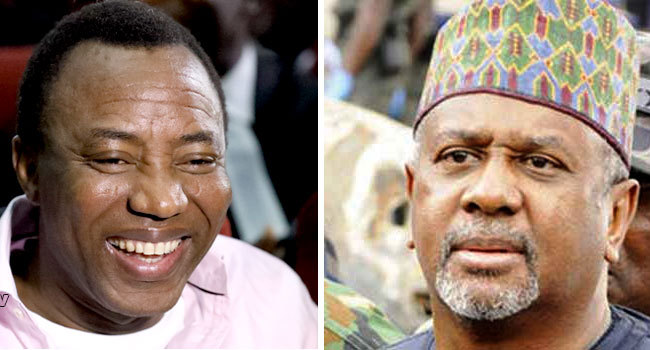
A Tale of Two Leaders: The Fates of Sambo Dasuki and Abubakar Malami
Nigeria’s political landscape is often shaped by the principle that what you do unto others shall, in time, be done unto you. Nowhere is this more evident than in the contrasting fates of two high-profile figures: Sambo Dasuki and Abubakar Malami. Their stories reveal a pattern of executive overreach, judicial disregard, and the consequences of political vendettas.
The Case of Sambo Dasuki
Sambo Dasuki, a former National Security Adviser (NSA), was arrested in late 2015 and charged with money laundering related to arms-procurement funds during the Jonathan administration. However, his story is not just about corruption—it is a tale of systemic abuse of power. During his tenure as NSA, Dasuki played a key role in reclaiming towns from terrorists, an achievement that went unacknowledged by his accusers. At the time, banditry had not yet become a major issue in the Northwest or North-Central regions, a problem that would later escalate under the Buhari administration.
Dasuki’s arrest was followed by a series of legal violations. Despite multiple courts granting him bail and him meeting all conditions, he was repeatedly re-arrested without new charges. This cycle continued until he became the only public official in Nigerian history to remain in detention despite bail orders from four different courts, including the ECOWAS Court.
One of the most troubling aspects of Dasuki’s case was the involvement of then-Attorney-General Abubakar Malami. In a VOA interview, Malami falsely claimed that Dasuki had killed 100,000 people and justified his continued detention on national-security grounds. This misinformation led to Malami being summoned before the Legal Practitioners Disciplinary Committee, where he eventually recanted.
President Buhari later made the administration’s stance clear, declaring that Dasuki would not be released regardless of court orders and labeling him a security risk. This marked a rare moment when executive contempt for judicial authority was openly acknowledged.
The Normalisation of Media Trials
The Buhari era also saw the normalisation of media trials, where individuals were effectively convicted in the court of public opinion before any judge had ruled. The EFCC and DSS were at the forefront of this strategy. One example was Colonel Nicholas Ashinze, a military intelligence officer who played a key role in operations against Boko Haram. He faced charges despite the EFCC issuing an inaccurate statement that provoked a judicial rebuke.
Justice Gabriel Kolawole condemned the EFCC’s conduct, calling it ‘scandalous and prejudicial to fair trial.’ He ordered the agency to apologise publicly and suspended the trial. The EFCC attributed the falsehoods to an internal ‘mix-up.’
Similarly, the arms probe panel under the ONSA, chaired by Air Vice Marshal Jon Odeh, was disbanded after members were indicted for receiving bribes from those they were investigating. These episodes highlighted the institutional impunity that defined the period.
The Tragic Fate of Dasuki’s Father
Perhaps the most heartbreaking aspect of Dasuki’s ordeal was the treatment of his father, Alhaji Ibrahim Dasuki, former Sultan of Sokoto and one of Nigeria’s most revered traditional and Islamic leaders. Despite repeated appeals, he was denied permission to visit his son in detention and died without seeing him. This act was widely condemned as unnecessary cruelty—an example of how political rivalry had crossed into something far more callous.
Contrast with the Treatment of Abubakar Malami
In contrast, when President Bola Ahmed Tinubu’s administration detained former Kaduna Governor Nasir el-Rufai over corruption charges, he was immediately released following his mother’s death. While this gesture was welcomed, it raised questions about the standard of decency applied to public officials.
Malami, who served as Attorney-General and Minister of Justice from 2015 to 2023, was arrested in 2025 on allegations ranging from corruption and acquisition of exotic properties to terrorism-related offences and illegal possession of firearms. The irony is unmistakable—Malami was the chief law officer who authorised and supervised the prosecution of Dasuki. Now, he sits where they once sat—on the receiving end of the same system he helped to shape.
However, there is a crucial difference. Within two months, Malami was granted bail by both the EFCC and the DSS. There were no sensational media trials, no re-arrests after meeting bail conditions, and no presidential declarations that he would remain detained regardless of court orders.
The Legacy of the Buhari Administration
The Buhari administration’s disregard for due process extended beyond political opponents. On June 9, 2016, the Nigerian Army summarily retired 38 senior officers without formal accusations, charges, or trials under military law. These were decorated officers who had played critical roles in counterinsurgency efforts. Despite the National Industrial Court ruling six times that the retirements were unlawful and ordering reinstatement with full benefits, the Army ignored them all. One officer, Ojebo Ochankpa, died in 2017 while awaiting justice.
Nearly a decade later, most remain unreinstated—vindicated by every court, yet denied the justice those courts prescribed. This is the legacy of the administration that Malami served and defended. By any honest measure, it was one of the most lawless periods in Nigeria’s democratic history.
The Principle of Reciprocity
What you do unto others shall be done unto you. The real question is whether, this time, we will do it better. While we must insist that Malami receive the fair trial that Dasuki was denied, we must also demand accountability for those who orchestrated past abuses—not through fresh lawlessness, but through the very institutions they once undermined.