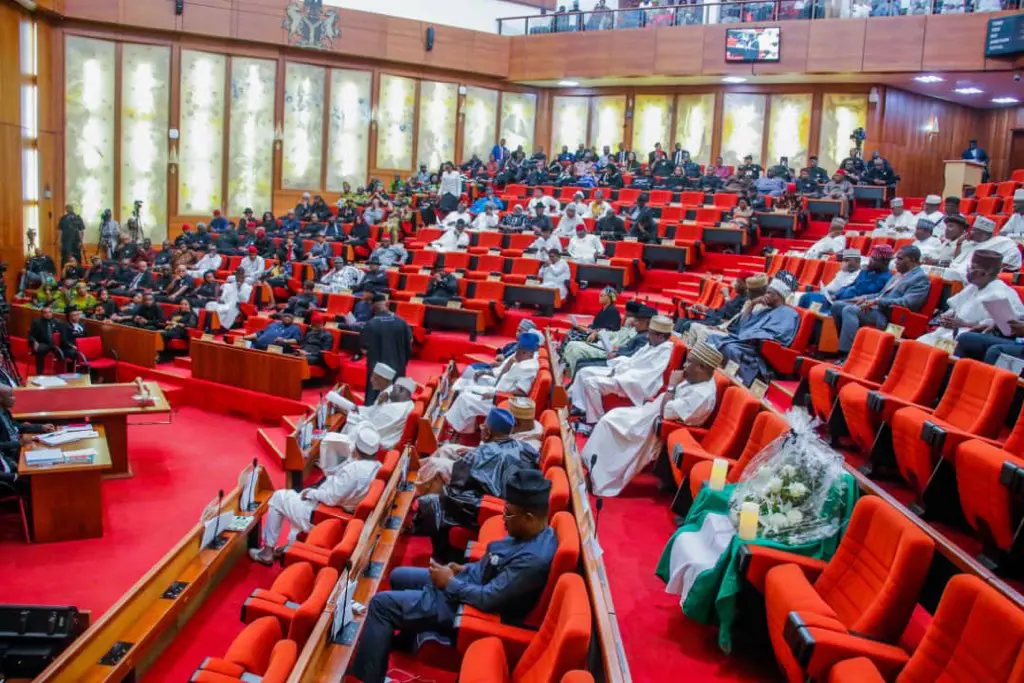
Senate Prioritizes Pragmatism in Electoral Reform: Electronic Result Transmission Made Discretionary
The Nigerian Senate has underscored that its decision to render the electronic transmission of election results discretionary, rather than mandatory, in the ongoing reform of the nation’s electoral governance framework was guided by empirical data and the stark realities on the ground. This move, the Senate asserts, was not driven by emotion or sentiment but followed extensive consultations and engagements with key stakeholders in the country’s vital communications and power sectors.
Senator Opeyemi Bamidele, the Senate Leader, clarified this position through his Directorate of Media and Public Affairs. He emphasized that lawmaking globally carries significant obligations, and the Senate is committed to fulfilling these responsibilities without compromising the welfare of the citizenry.
The Senate had initially deliberated on Clause 60(3) of the Electoral Bill, 2026. This clause proposed that the presiding officer “shall electronically transmit the results from each polling unit to INEC Result Viewing Portal (IReV) in real time…” While acknowledging the public’s desire to strengthen electronic transmission, the Senate subsequently reviewed this contentious clause. Their revision introduced a crucial caveat: in situations where internet connectivity fails, the traditional Form EC8A would serve as the primary instrument for result collation.
Senator Bamidele noted that Clause 60(3) of the Electoral Bill, 2026, as initially conceived, represented an initiative that any legislature worldwide would readily embrace due to its potential to foster greater trust in democratic institutions, particularly the National Assembly and the Independent National Electoral Commission (INEC).
However, the Senate’s deeper examination of the clause revealed critical shortcomings stemming from the nation’s existing communication and power infrastructure. These limitations, the Senate concluded, would likely prevent the guaranteed real-time electronic transmission of election results as envisioned by some stakeholders.
Data Underscores Infrastructure Challenges
To substantiate its decision, Senator Bamidele presented data from authoritative sources, highlighting Nigeria’s infrastructural deficits:
- Broadband Coverage: Citing figures from the Nigerian Communications Commission (NCC), Bamidele revealed that Nigeria had only achieved approximately 70% broadband coverage by 2025. Internet user penetration, within the same period, stood at a modest 44.53% of the total population.
- Internet Speed and Reliability: The Speedtest Global Index further illuminated these challenges. Nigeria was ranked 85th out of 105 countries for mobile network reliability and a concerning 129th out of 150 countries for fixed internet broadband reliability.
- Nigeria’s mobile network reliability was recorded at 44.14 megabits per second (mbps). This figure pales in comparison to countries like the United Arab Emirates (UAE) with 691.76 mbps, Qatar with 573.53 mbps, Kuwait with 415.67 mbps, Bahrain with 303.21 mbps, and Bulgaria with 289.41 mbps. The Index positioned Nigeria significantly below the global average.
- In terms of fixed internet broadband, Nigeria occupied the 129th position out of 150 countries, with a speed of only 33.32 mbps. This contrasts sharply with leading nations such as Singapore (410.06 mbps), UAE (382.35 mbps), France (346.25 mbps), Chile (348.41 mbps), and Hong Kong (345.25 mbps).
Power Infrastructure Deficiencies
The state of the nation’s power infrastructure presented another significant hurdle. Official data indicated that:
- At least 85 million Nigerians, approximately 43% of the population, still lacked access to grid electricity.
- While Nigeria’s power generation capacity fluctuates between roughly 12,000 and 13,500 megawatts, its distribution and transmission capabilities are severely constrained. The current capacity can only deliver around 4,500 megawatts to households nationwide. The Senate expressed optimism that the Electricity Act of 2025 would spur significant growth in the power sector from the current financial year.
Pragmatic Approach to Electoral Governance
Given these prevailing conditions, Senator Bamidele expressed doubt about the feasibility of mandatory, real-time electronic transmission of election results. He cautioned that imposing such a provision without adequate infrastructure could precipitate a crisis for the nation.
The Senate Leader asserted that, by global standards, the mandatory real-time electronic transmission of election results might not be practicable at Nigeria’s current stage of development.
“To avoid a situation that compounds our country’s woes, it is better we make it discretionary since Section 62(2) of the Electoral Act, 2022 has already established the National Electronic Register of Election Results,” Bamidele stated.
He reiterated that these factual considerations, not emotion or sentiment, underpinned the Senate’s decision to revise Clause 60(3) and (5) of the Electoral Act, 2022, prioritizing the interests and security of the people. “The data speak directly to the stark realities of our federation and not the emotion or sentiment,” he emphasized.
The Senate views lawmaking as a profound responsibility. As elected representatives, they are obligated to base legislation on concrete evidence and realities rather than mere public sentiment. Failing to align laws with the nation’s actual circumstances, they argue, risks ushering in anarchy or instability.
This analytical approach guided the Senate’s decision to redraft Clause 60(3) and (5), incorporating a crucial caveat while substantially addressing the concerns of Nigerians. The key modification involved the removal of the phrase “real time” from the clause, ensuring that the electoral governance framework remains adaptable to the nation’s current realities.