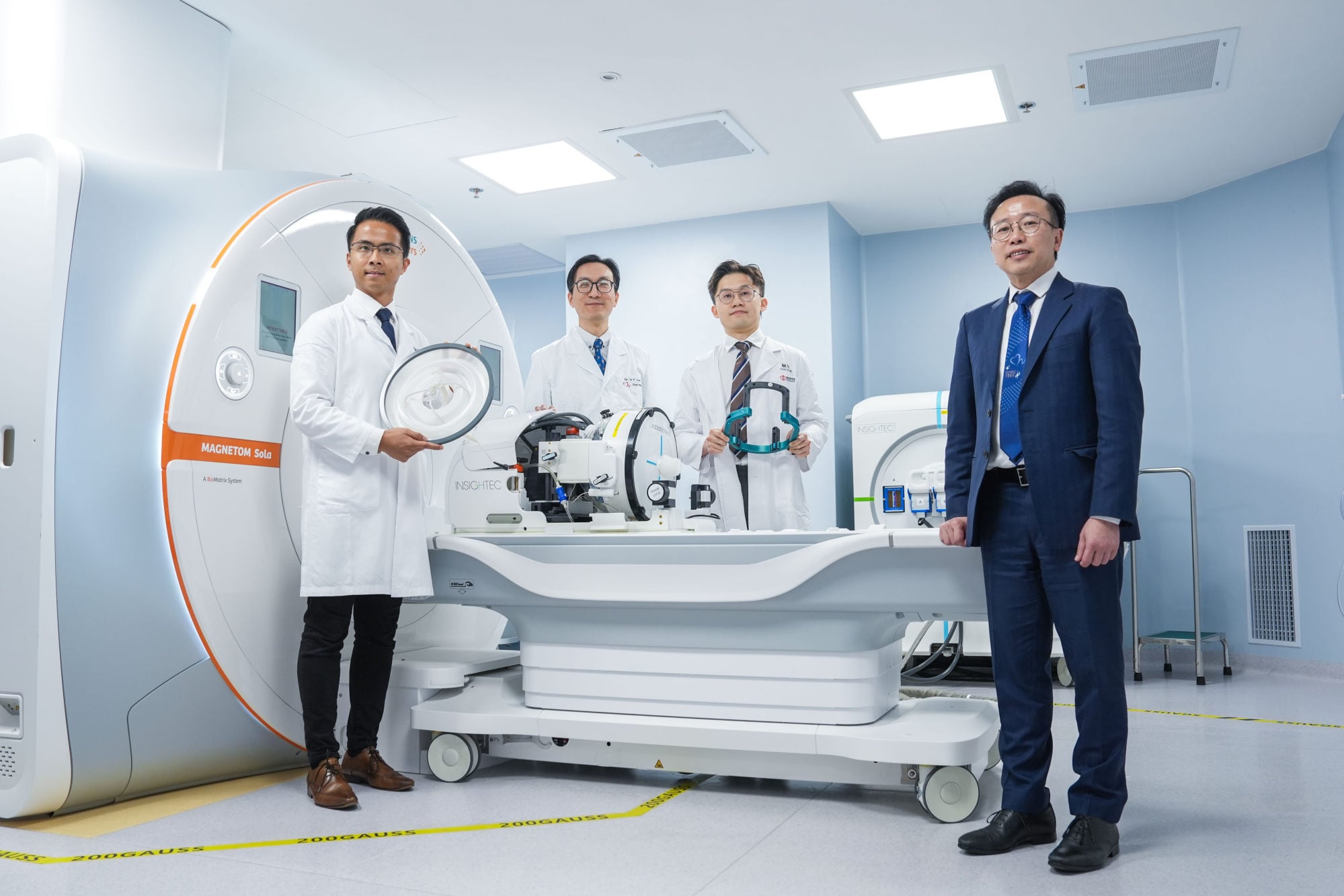
Groundbreaking Non-Invasive Tremor Treatment Debuts in Hong Kong
Tuen Mun Hospital has pioneered a revolutionary non-invasive treatment for Parkinson’s disease patients suffering from debilitating tremors, utilizing Magnetic Resonance-guided Focused Ultrasound (MRgFUS). This advanced procedure, performed for the first time in Hong Kong, offers a new horizon of hope for individuals battling uncontrollable shaking. The hospital anticipates extending this innovative therapy to approximately 40 patients over the next two years as part of ongoing research to further understand and refine its efficacy.
MRgFUS represents a significant leap forward in neurosurgical intervention. It is a non-invasive, incisionless technique that leverages the precision of Magnetic Resonance Imaging (MRI) to guide focused ultrasound waves. These waves are directed to specific targets within the brain tissue, precisely ablating the targeted areas responsible for tremors without the need for surgical incisions.
How MRgFUS Works
The procedure involves the following key steps:
- Target Identification: MRI is used to meticulously map the affected area in the brain.
- Ultrasound Delivery: High-intensity ultrasound beams are precisely focused on the identified target.
- Tissue Ablation: These focused beams pass through the scalp and skull, heating and destroying the targeted brain cells responsible for the tremors.
- Precision and Safety: The surrounding healthy brain tissue remains unharmed due to the focused nature of the ultrasound energy.
This method is primarily indicated for patients experiencing essential tremor and Parkinson’s disease with a significant tremor component.
A Beacon of Hope for Parkinson’s Patients
Dr. Jason Ho Man-kit, an associate consultant in neurosurgery at Tuen Mun Hospital, highlighted the advantages of the MRgFUS procedure. He noted that the treatment, which typically lasts around three hours, is non-invasive and delivers immediate results, distinguishing it from other available treatment options.
“We will meticulously analyze the local patient data and observe the treatment’s impact, with the aim of gradually broadening its application to benefit a larger number of Parkinson’s disease patients,” Dr. Ho stated.
The inaugural patient to benefit from this cutting-edge treatment was a 54-year-old man diagnosed with tremor-dominant Parkinson’s disease. His journey with tremors began in 2021, and the severity of his uncontrollable shaking unfortunately led him to cease working in 2024.
After exhausting conventional medication options without achieving satisfactory results, the patient was referred to Tuen Mun Hospital. He underwent the MRgFUS procedure on February 5th. Post-treatment, the hospital reported a significant and immediate reduction in his tremors.
Understanding Parkinson’s Disease
Parkinson’s disease is a neurodegenerative disorder characterized by the progressive deterioration of a specific brain region known as the substantia nigra. This degeneration leads to a diminished production of dopamine, a crucial neurotransmitter responsible for regulating body movements. The resulting dopamine deficiency impairs the brain’s ability to control motor functions effectively.
Common symptoms include:
- Hand tremors
- Joint stiffness
- Slower movement (bradykinesia)
- Unsteady gait and balance issues
In Hong Kong, over 12,000 individuals have been diagnosed with Parkinson’s disease, with the condition predominantly affecting those over the age of 60. Notably, Tuen Mun Hospital’s data indicates that approximately 30 percent of patients with tremor-dominant Parkinson’s disease do not experience adequate relief from standard medications.
Advancing Tremor Treatment in Hong Kong
Tuen Mun Hospital took a significant step in enhancing its treatment capabilities by introducing the city’s first MRgFUS system in December 2024. This acquisition immediately provided a novel therapeutic avenue for patients suffering from essential tremor.
The Hospital Authority New Territories West Cluster Hospitals Charitable Trust has provided crucial financial support, allocating approximately HK$1.5 million (US$191,474) to bolster the hospital’s research initiatives focused on evaluating the effectiveness of this new treatment.
Dr. Law Hing-yuen, a consultant in neurosurgery at the hospital, outlined the ambitious plan for the MRgFUS system. “We are committed to treating 40 patients with this method within the next two years,” he explained. “Our dedicated medical team will then provide comprehensive follow-up care for each patient over a period of five years.”
The research protocol includes rigorous assessment of treatment outcomes. This will involve evaluating:
- The degree of improvement in tremor symptoms.
- The impact of the treatment on mid- to long-term functional abilities in daily life.
- The influence of various factors, such as patient age, gender, bone density, and the duration since diagnosis, on treatment results.
This detailed analysis aims to establish standardized treatment protocols tailored to the local patient population, based on robust Hong Kong-specific data.
“Our aspiration is for this initiative to not only alleviate the suffering of these patients but also to build a valuable repository of local treatment data,” Dr. Law concluded. “This data will be instrumental in the future development and expansion of this vital service.”