
South Korea’s Debt Mountain: A Nation Grapples with Soaring Liabilities
South Korea is facing an unprecedented challenge as its combined national debt, encompassing government, household, and corporate liabilities, has surged past the 6,500 trillion won mark for the first time in history. While the overall debt continues its rapid ascent, a particularly concerning trend is the accelerating growth of government debt, sparking widespread unease among economic observers.
As of the close of the third quarter of the previous year, South Korea’s total debt had reached a staggering 6,500.5843 trillion won, according to data from the Bank for International Settlements (BIS). This figure represents a substantial increase of approximately 280 trillion won, or 4.5%, compared to the same period a year prior, when total debt stood at 6,220.577 trillion won. The nation’s debt burden has been on a relentless upward trajectory, breaching significant milestones: it surpassed 5,000 trillion won in the first quarter of 2021, climbed to 5,500 trillion won by the fourth quarter of that same year, and crossed the 6,000 trillion won threshold by the fourth quarter of 2023.
The sheer scale of this debt is further underscored by its ratio to the country’s gross domestic product (GDP). South Korea’s total debt now stands at 248% of its GDP, indicating that the nation’s liabilities are equivalent to two and a half times its annual economic output. This ratio has seen an uptick of 1.5 percentage points from the previous year, when it was recorded at 246.5%.
A Deep Dive into Debt Categories
An examination of the different debt categories reveals a concerning disparity in growth rates:
- Government Debt: This sector has experienced the most significant expansion, with liabilities reaching 1,250 trillion won. Its growth rate stands out at a remarkable 9.8% year-on-year.
- Corporate Debt: Corporate liabilities amount to 2,907 trillion won, showing a growth rate of 3.6%.
- Household Debt: This category accounts for 2,342 trillion won, with a growth rate of 3.0%.
The data clearly illustrates that government debt is escalating at more than double the pace of both household and corporate debt, highlighting a critical area of fiscal concern.
Government Debt-to-GDP Ratio Hits Record High
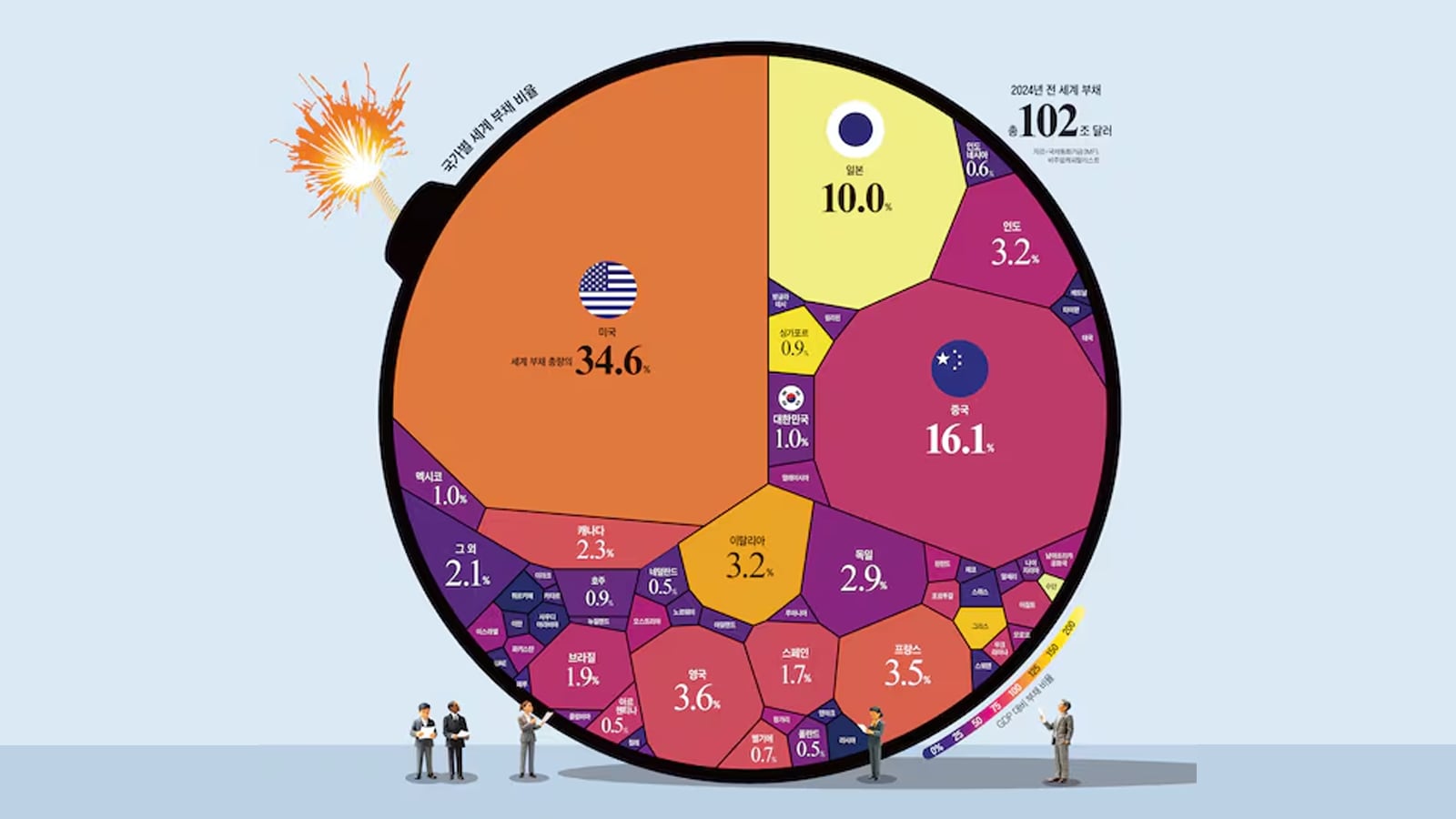
Further evidence of the escalating government debt is provided by the Institute of International Finance (IIF). Their data indicates that South Korea’s government debt-to-GDP ratio reached an all-time high of 48.6% by the end of the fourth quarter of last year. This represents a substantial increase of 5 percentage points from the 43.6% recorded a year earlier. The ratio had remained relatively stable, hovering around 45% until early 2024, before embarking on a sharp upward trend from the second quarter of the previous year, now nearing the 50% mark.
While South Korea’s current government debt ratio remains lower than that of several major global economies – including the United States (122.8%), Japan (199.3%), France (110.4%), the United Kingdom (81.1%), and Germany (62.5%) – the sheer speed of its acceleration is a significant cause for concern. This rapid increase suggests potential fiscal vulnerabilities and the need for prudent financial management.
Household Debt: A Persistent Challenge
In contrast to the rapid rise in government debt, the household debt ratio has seen a slight decrease, standing at 89.4%. However, this figure still positions South Korea with the second-highest household debt ratio among the 62 countries tracked by the IIF, trailing only Canada at 100.4%.
Economic analysts widely concur that a household debt-to-GDP ratio exceeding 80% can act as a drag on economic growth and heighten the risk of recession. South Korea has been persistently above this threshold since 2014. This contrasts sharply with major advanced economies like the United Kingdom, the United States, and the Eurozone, which have managed to reduce their household debt ratios over the same period. The sustained high level of household debt in South Korea presents a persistent risk to economic stability and consumer spending power.