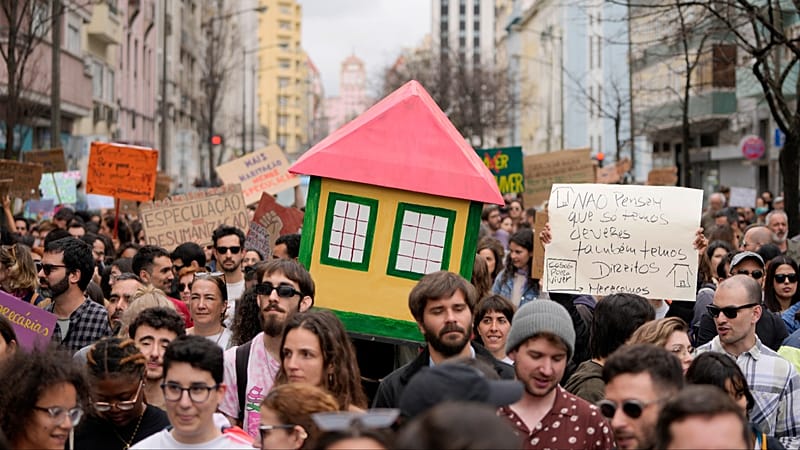
Europe’s Deepening Housing Crisis: A Generation Priced Out
Across Europe, millions are finding themselves unable to afford safe and stable housing, propelling the housing crisis to the forefront of public concern. This pervasive issue is not merely an economic statistic; it is fundamentally reshaping lives, delaying crucial life milestones, and placing immense pressure on public finances. The most significant burden, as is often the case, falls disproportionately on those with the fewest resources.
The Demographic Bearing the Brunt
The most acutely affected demographic in this escalating crisis comprises individuals aged 18 to 34. Alarmingly, over a quarter of this group are spending more than 40 percent of their disposable income on housing. This threshold is widely considered by economists to represent severe financial strain. Furthermore, nearly one in four young Europeans are living in overcrowded conditions, and they experience housing-related stress at a rate two to three times higher than their counterparts over the age of 65.
This pervasive housing insecurity is forcing young people to postpone critical life decisions, including gaining independence, starting families, and achieving financial stability. The psychological toll is also considerable, with mental health taking a significant hit as a direct consequence of this instability.
European Commissioner for Housing, Dan Jørgensen, has underscored the profound implications of this crisis, not only for individuals but also for the very fabric of European democracy. He articulated during an interview that “A roof over your head gives a base in your life and if you don’t have it, a lot of other things will not be possible. It’s a problem for the individuals that are hurt by the crisis, but it’s also a problem for our societies. It hurts our economies. It’s not good for the labour market, it is not good for mobility, it is not good for the education of our people.”
Commissioner Jørgensen also issued a stark warning about the political ramifications of inaction. He cautioned that “If we don’t, as policymakers, take this seriously, then there’s a risk that populism might rise in Europe even more than it’s already doing. Populists will exploit a social crisis like this.”
The geographical disparities are also stark. In Greece, a staggering 30 percent of young households allocate more than 40 percent of their income to housing, the highest proportion within the European Union. Denmark and Luxembourg also report similarly concerning figures. The impact is not confined to those with lower incomes; even middle-income young adults are feeling the squeeze, as evidenced by a sharp decline in homeownership rates for the 45-54 age group across the continent.
The Widening Chasm: Wages vs. Rents
Compelling data paint a clear and concerning picture: housing costs across Europe have outpaced wage growth significantly, a trend that has been particularly pronounced since the onset of the pandemic. Borja Giménez Larraz, a Member of the European Parliament (MEP) and leader of the European Parliament’s Special Committee on the Housing Crisis, elaborated on the scale of the challenge.
“During the last 15 years, the prices of houses have increased 60 percent and for rents 30 percent. We need to build 10 million houses to meet current demand. And what we are observing is that the number of building permits has decreased by 20 percent,” MEP Giménez Larraz informed Euronews.
Private renters are experiencing the sharpest end of this widening gap. Approximately 20 percent of private renters are dedicating an excessive portion of their income to housing, a stark contrast to the mere 5 percent of individuals with mortgages facing similar financial burdens. For low-income families, the situation is even more dire, with roughly one in three spending over 40 percent of their earnings on accommodation, leaving precious little for essential needs and other expenditures. The European Union currently faces a deficit of approximately 2.25 million homes, and the pace of new construction is failing to keep up with demand.
MEP Giménez Larraz highlighted another critical aspect of the problem: the existing housing stock is not being allocated to those who need it most. This is leaving essential workers in a precarious position. “There are today so many policemen, firefighters, and teachers that cannot afford the rent to live in the place where they work. So maybe we have to put a solution also for those people,” he told Euronews.
The repercussions of families dedicating an oversized portion of their budget to housing extend beyond individual households. It curtails spending on other goods and services, dampens economic activity, and reduces the likelihood of individuals relocating for better employment opportunities. Consequently, the gap between property owners and renters continues to widen year after year.
Unequal Burdens: Who Suffers Most?
The housing crisis does not affect all segments of society equally; it disproportionately impacts the most vulnerable groups. Non-EU citizens are more than twice as likely as local residents to spend an excessive amount of their income on housing, and over a third live in overcrowded conditions. Ethnic minorities and individuals with disabilities are also more prone to residing in substandard living conditions. Single-parent households, too, contend with some of the highest housing costs within the EU.
MEP Irene Tinagli, Chair of the Special Committee, argues that this crisis is not an unforeseen event but rather the predictable outcome of decades of treating housing primarily as a financial asset rather than a fundamental social need. She stated, “If the objective is to guarantee access to decent and affordable housing for everybody, then that objective has failed. We have stopped thinking and acting on housing with public policies.”
MEP Tinagli was unequivocal in her assessment of responsibility: “Many people have become convinced that if you can’t afford it, it’s your fault. But when salaries go up only the minimum needed to catch up with inflation, and the real estate market has pushed prices up 60 percent in 10 years, that is not your fault. That is a lack of public policy.”
Middle-income families increasingly find themselves caught in the “Generation Rent” dilemma. Their earnings are too high to qualify for social housing, yet insufficient to attain homeownership. Public budgets are often strained by rising housing costs, with housing allowances primarily benefiting private landlords. This scenario results in taxpayers bearing additional financial burdens without achieving any substantial improvement in housing affordability.
Addressing the Crisis: A Multifaceted Approach
European governments are attempting to respond to this complex challenge, but the progress achieved thus far is varied. The EU’s 2025 Affordable Housing Action Plan identifies an annual investment gap of €275 billion. This plan advocates for increased public and private investment, reforms to planning regulations, and the development of more effective tools for local authorities to manage short-term rental markets.
Commissioner Jørgensen is urging member states to address the issue of vacant and speculative properties. He points to Denmark’s policy, which mandates that homes must be occupied, as a potential model. The primary hurdle now lies in translating these policy aspirations into tangible actions. With a new EU budget on the horizon, it is imperative for national governments to ensure that the strategic plans formulated in Brussels translate into a concrete increase in the availability of affordable housing.