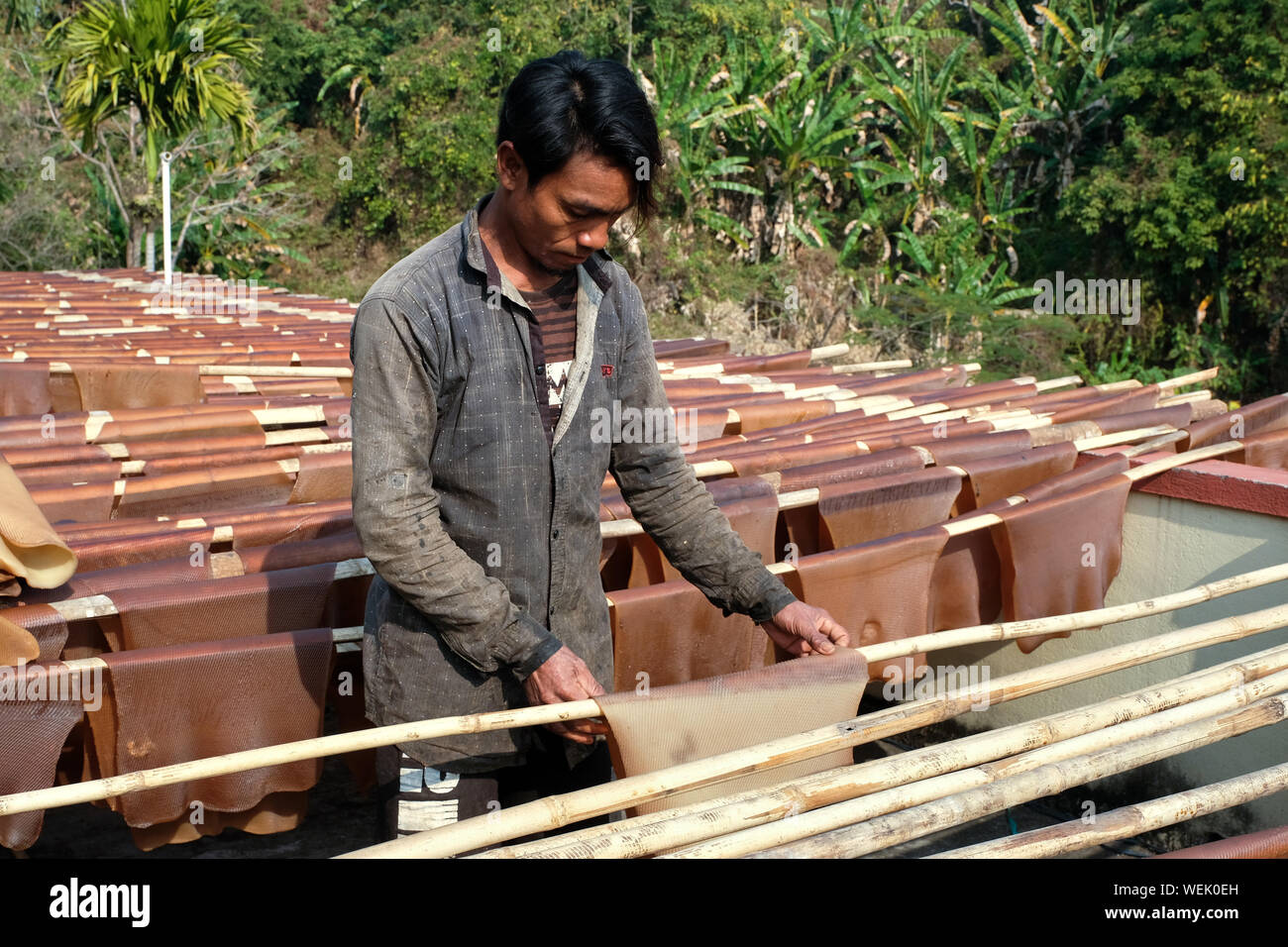
Liberian Rubber Farmers Honour Businessman for Sustaining Sector Through Market Volatility
Liberian rubber farmers have publicly expressed their deep appreciation for businessman Upjit Singh Sachdeva, affectionately known as “Jeety,” recognizing his steadfast dedication to supporting the nation’s vital rubber sector during a period of significant market challenges. The Rubber Planters Association of Liberia (RPAL) and the Rubber Development Fund Incorporated (RDFI) recently bestowed this honor upon Mr. Sachdeva, acknowledging the crucial role his company, Jeety Rubber LLC, has played in bolstering smallholder rubber farmers. This support proved particularly vital when other major buyers temporarily halted their purchases following the Liberian government’s implementation of a regulated farm-gate pricing system for rubber.
The ceremony, imbued with cultural significance, saw Mr. Sachdeva robed in traditional Liberian attire and bestowed with the Liberian name “Kolleh,” a designation signifying “a bright and good man.” This symbolic gesture, according to the organizers, underscored the profound respect and gratitude felt by the farming community for his invaluable contributions to the industry.
A Beacon of Support in Uncertain Times
During the presentation, RPAL President Wilhelmina Mulbah Siaway and RDFI Chairman J. Tokpah Mulbah lauded Jeety Rubber as an exceptionally reliable partner for Liberia’s rubber farmers. The Certificate of Honor presented to the CEO of Jeety Rubber explicitly cited “exceptional contributions to Liberia’s rubber sector and unwavering support for rubber farmers, particularly during critical periods of limited market access.” The leaders emphasized that the company’s sustained commitment has been instrumental in safeguarding the livelihoods of thousands of farmers who depend on rubber cultivation for their economic survival. “Your commitment to sustaining farmer livelihoods and promoting community welfare is highly commendable,” they stated.
This recognition arrives amidst a landscape of significant transformation within Liberia’s rubber pricing structure. In June 2025, the Liberian government introduced a regulated farm-gate price system. This move was a direct response to longstanding farmer complaints regarding unfair pricing practices prevalent under the previous market system, where prices were largely dictated by buyers. Under the new regulations, the government initially set the price of rubber at US$690 per ton. However, after government taxes and fees to the RDFI and RPAL, farmers currently receive approximately US$657 per ton.
Market Disruptions and Jeety Rubber’s Steadfast Role
The implementation of this new pricing framework generated considerable debate and disruption within the rubber sector. Notably, shortly after the policy’s announcement, Firestone Liberia, a dominant purchaser of smallholder rubber, suspended its buying operations. The company cited the government-imposed price as unsustainable and insufficient to cover its operational costs and social responsibilities. The status of Firestone’s resumed purchasing activities from smallholder farmers remains unclear.
In stark contrast to this market paralysis, Jeety Rubber maintained its purchasing activities, thereby providing a critical and consistent market outlet for farmers during this period of uncertainty.
A Cornerstone of Liberia’s Rubber Processing Industry
Jeety Rubber operates a substantial rubber processing facility in Weala, Margibi County, valued at over US$75 million. This facility stands as one of Liberia’s largest rubber processing plants. To maintain its operational capacity, the plant requires between 200 and 250 tons of raw rubber daily, translating to an annual demand ranging from 25,000 to 40,000 tons. Smallholder farmers constitute the primary source of this vital raw material. Industry observers highlight that this consistent demand positions Jeety Rubber as a crucial buyer in the domestic market, offering a reliable avenue for farmers to sell their produce.
Minister of Agriculture Urges Increased Production
During the recognition ceremony, Dr. Alexander Nuetah, Liberia’s Minister of Agriculture, seized the opportunity to call upon farmers to significantly boost their rubber production. He emphasized that the nation’s rubber processing infrastructure and market access are now robust enough to absorb substantially larger volumes, yet current production levels fall considerably short of their potential. Minister Nuetah revealed that Liberia’s total rubber output last year approximated 180,000 tons, a figure that falls short of the government’s ambitious production targets.
“The factories are ready. The price regime is fair and transparent,” Minister Nuetah stated. “What we now need is production–more tapping, more output, more commitment from every farmer with rubber on their land.”
The Minister also reaffirmed the government’s unwavering commitment to strengthening Liberia’s domestic rubber processing capabilities. He reminded farmers and cooperatives of the government’s strict policy prohibiting the export of unprocessed rubber. “The policy has not changed,” Minister Nuetah stressed, warning that farmers who engage with roadside or informal buyers operating outside the regulated system not only undermine the sector’s integrity but also weaken the enforcement of government regulations. This directive is underpinned by Executive Order No. 151, issued in August 2025, which explicitly bans the export of raw rubber, aiming to foster local processing, create employment, and enhance national revenue. Violators are subject to penalties as stipulated by the order.
Beyond Purchasing: Investing in Farmer Growth
Jeety Rubber’s commitment to the sector extends beyond its role as a consistent buyer. The company has also implemented initiatives aimed at fostering long-term growth and sustainability within the farming community. Since 2025, Jeety Rubber has extended interest-free loans to over 100 farmers, specifically to facilitate farm replanting and expansion projects. These loans enable farmers to revitalize aging plantations and enhance their productivity. The repayment structure is designed to be manageable, with gradual deductions made from farmers’ future rubber sales to the company. Industry leaders have pointed out that this initiative provides farmers with access to crucial financing that is often difficult to secure through conventional channels.
A Symbol of Partnership and Gratitude
For the Rubber Planters Association and the Rubber Development Fund, the honor bestowed upon Mr. Sachdeva transcended mere ceremony. It represented a tangible acknowledgment of what they described as a genuine and mutually beneficial partnership between the private sector and Liberia’s smallholder rubber farmers. By conferring the name “Kolleh,” the associations aimed to recognize a businessman who has demonstrably combined economic commitment with a strong sense of social responsibility towards the communities that form the backbone of Liberia’s rubber industry. The ceremony also recognized the contributions of Agriculture Minister Dr. Alexander Nuetah and the Liberia Agriculture Company to the sector’s development. However, for many farmers present, the spotlight was firmly on the man they now affectionately refer to as “Kolleh”—a name that, for them, embodies profound gratitude for his unwavering support during a period of significant market uncertainty.