
Bulla Park Deposit Shows Promising Antimony Grade Increase After Re-analysis
Recent re-analysis of drill core from West Cobar Metals’ Bulla Park deposit in New South Wales has revealed a significant increase in antimony grades, suggesting that previous assessments may have underestimated the concentration of this valuable commodity. The findings indicate a potential upside for the project, particularly given the growing global interest in antimony.
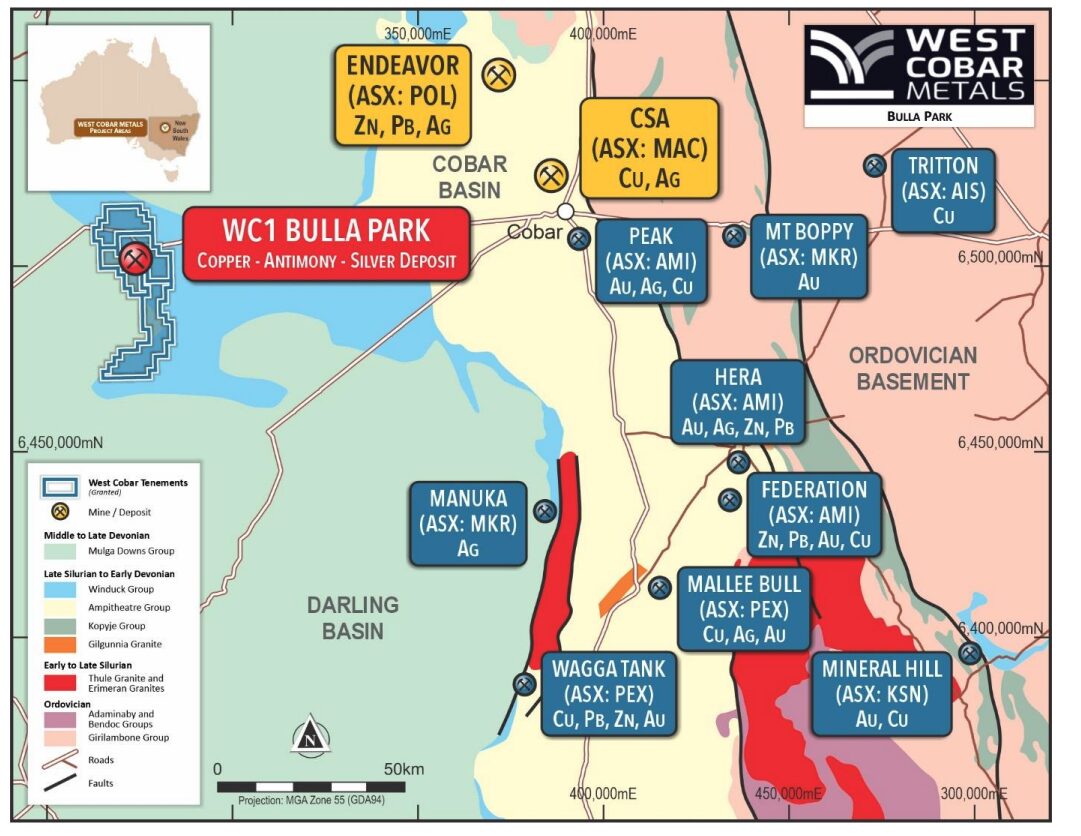
The Bulla Park deposit, situated west of the established Cobar Mining hub, is a notable copper-antimony-silver occurrence benefiting from the region’s robust infrastructure. Historically, the deposit has been assessed using a standard four-acid digest method, a technique generally considered effective for analysing copper and antimony. However, this method has a known limitation: certain elements, including antimony, can volatilise and escape during the digestion process, leading to potentially lower reported concentrations.
Uncovering Higher Antimony Values
Recognising the increasing market demand for antimony, West Cobar Metals undertook a proactive approach to address this potential analytical discrepancy. The company initiated a re-analysis program on a selection of 19 core samples from two drill holes, BPD08 and BPD09, employing a peroxide fusion digest method. This advanced technique is less susceptible to antimony volatilisation.
The initial results from this re-analysis were encouraging, showing an average increase of 14% in antimony concentrations when compared to the figures obtained through the conventional four-acid digest method. This promising outcome prompted a more comprehensive re-analysis of all pulps from the mineralised intersections within the aforementioned drill holes.
Following this expanded re-analysis, the overall reported antimony grades at the Bulla Park deposit have shown a consolidated increase of 6%. This suggests that the standard four-acid digest method, while a common analytical tool, has likely provided an underestimation of the true antimony concentrations at Bulla Park, with the results showing variability across different antimony levels within the analysed drill holes.
A Boost for Project Economics
Matt Szwedzicki, Managing Director of West Cobar Metals, expressed optimism about these findings. “The underreporting is seen across a range of antimony values in the two drill holes (BPD08 and BPD09) and indicates that we have more antimony in the system than previously thought,” he stated.
Szwedzicki further highlighted the strategic advantage of Bulla Park’s mineral assemblage. “Along with the current bullish outlook on copper and silver market fundamentals, Bulla Park provides a unique mix of these sought-after metals,” he noted. The company is committed to continuing its analysis of the remaining mineralised intervals, with the expectation that the ultimate antimony content will positively impact the project’s overall economic viability.
Bulla Park: A Resource Overview
The Bulla Park deposit currently hosts an inferred resource of 20 million tonnes (Mt) grading 0.58% copper equivalent. This translates to an estimated contained metal of 60,000 tonnes of copper, 20,000 tonnes of antimony, and 3 million ounces (Moz) of silver.
A key characteristic of the Bulla Park deposit is that its mineralisation remains entirely open along strike and downdip. This offers substantial scope for future exploration and resource expansion. Based on an assessment of exploration to date, an exploration target has been defined, projecting a potential resource of between 30Mt and 50Mt. The anticipated grade ranges for this target are 0.23-0.33% copper, 0.08-0.12% antimony, and 4-6 grams per tonne (g/t) of silver.
This exploration target has been formulated by incorporating several critical parameters. These include the extrapolation of mineralisation beyond the current resource boundaries, informed by drill hole density and interpreted continuity derived from high-quality geophysical surveys that cover the broader exploration area.
A notable observation from the geophysical surveys is the extent of the gravity survey results, which reflect a siderite-barite alteration signature. This signature extends significantly beyond the current resource area and appears to correlate with geological structures similar to those associated with mineralisation within the existing resource.
Future Exploration and Analysis
West Cobar Metals has outlined a strategic plan to further delineate and potentially expand the Bulla Park resource. The company believes that approximately 5000 metres of reverse circulation (RC) and diamond drilling will be required to adequately test the defined exploration target. This comprehensive drilling program is planned to be staged, with commencement anticipated in 2026.
In addition to the planned drilling, the company is actively re-assaying all available mineralised samples from historical drilling activities. This re-assaying effort will also utilise the peroxide fusion digest method, aiming to provide a more accurate representation of antimony grades. West Cobar Metals expects to receive the results from this ongoing re-analysis program by early in the second quarter of 2026. These combined efforts are expected to provide a clearer picture of the Bulla Park deposit’s potential and further enhance its economic prospects.