Security Alert Disrupts Operations at Vandenberg Space Force Base
A suspicious vehicle prompted the temporary closure of the main gate at California’s Vandenberg Space Force Base on Friday, leading to a swift security response and the detainment of one individual for questioning. The incident, which began around 10:10 AM local time, necessitated the deployment of specialized units to assess the potential threat.
Officials confirmed that personnel from the 30th Security Forces Squadron were the first responders. As a precautionary measure to ensure public safety, a military working dog team and members of the 30th Civil Engineer Squadron’s Explosive Ordnance Disposal (EOD) unit were dispatched to thoroughly examine the vehicle. The closure extended beyond the base perimeter, with Highway 1 in the vicinity also being shut down by authorities to secure the area.
By midday, officials reported that no immediate threats or explosives had been identified. The situation highlighted the critical nature of Vandenberg Space Force Base, a vital hub for the United States’ defense and space exploration initiatives.
A Critical Nexus for National Security and Space Exploration
Vandenberg Space Force Base holds significant strategic importance for the United States. It serves as the primary testing site for intercontinental ballistic missiles (ICBMs), regularly conducting launches of unarmed Minuteman III missiles. These tests are crucial for maintaining the nation’s nuclear deterrent capabilities. In recent years, the base has seen a substantial increase in launch activity, with over 70 launches recorded in 2025 and plans to expand capacity to over 100 annually.
Beyond its role in missile testing, Vandenberg is also the United States’ West Coast spaceport. It is responsible for launching satellites into polar orbit for various entities, including the U.S. Space Force, NASA, and commercial partners such as SpaceX. This dual function underscores the base’s multifaceted contribution to national security and technological advancement.

The security alert on Friday saw the California Highway Patrol Santa Barbara issue a public advisory. “State Route 1 is currently CLOSED between California Blvd and Timberlane at the Vandenberg Space Force Base main gate for an unknown duration,” the statement read. “Please avoid the area and use alternate routes. Updates will be provided when available. Drive safe.”
Key Units and Strategic Importance
Several key units are stationed at Vandenberg Space Force Base, reflecting its diverse operational responsibilities. These include Space Delta 5, the 21st Space Operations Squadron, and the 576th Flight Test Squadron. Additionally, tenant agencies such as NASA and the Missile Defense Agency operate from the base, further emphasizing its role as a collaborative center for defense and space activities.
In recent years, Space Force units have become increasingly integral to military operations globally. They provide essential space-based intelligence, navigation, and communication support, particularly during conflicts involving adversaries like Iran and others. The base’s status as one of the most critical testing and launch sites in the U.S. means that any security alert there invariably draws national attention.
Recent Missile Tests and Global Deterrence
The strategic significance of Vandenberg was underscored by a critical test launch of a nuclear-capable missile on March 3rd. This ICBM undertook a journey of approximately 4,200 miles, reaching its target near Kwajalein Atoll in the Pacific Ocean in about 22 minutes. The test was designed to evaluate the missile’s multiple reentry vehicles, which are engineered to enhance effectiveness and help the weapon penetrate enemy defenses.
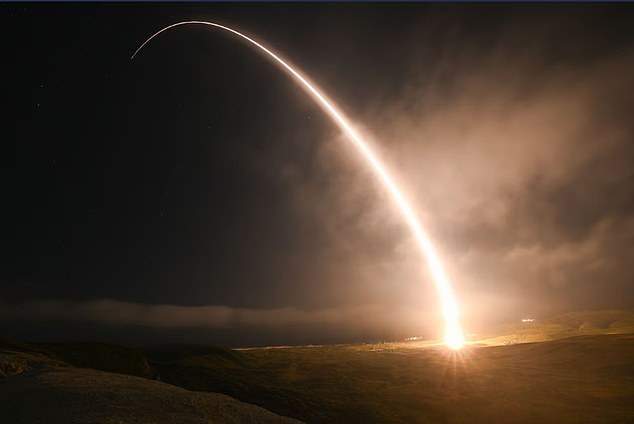
This event occurred in the context of broader geopolitical discussions surrounding nuclear capabilities. In late October 2025, President Donald Trump ordered the U.S. military to resume nuclear weapons testing, citing the need to keep pace with alleged testing by Russia and China. A separate ICBM test subsequently took place the following month.
The Minuteman III arsenal represents a crucial component of the U.S. nuclear deterrent triad, designed for use only in response to a nuclear attack. The weapon’s capabilities allow it to target any location worldwide within 30 minutes of launch. The geographical distances to potential adversaries, such as Iran (approximately 7,600 miles), Russia (about 6,000 miles), and China (around 6,300 miles), highlight the global reach and strategic importance of these missile systems. Discussions around Iran’s nuclear program have been a recurring theme, with assertions made about efforts to prevent the nation from acquiring nuclear weapons.