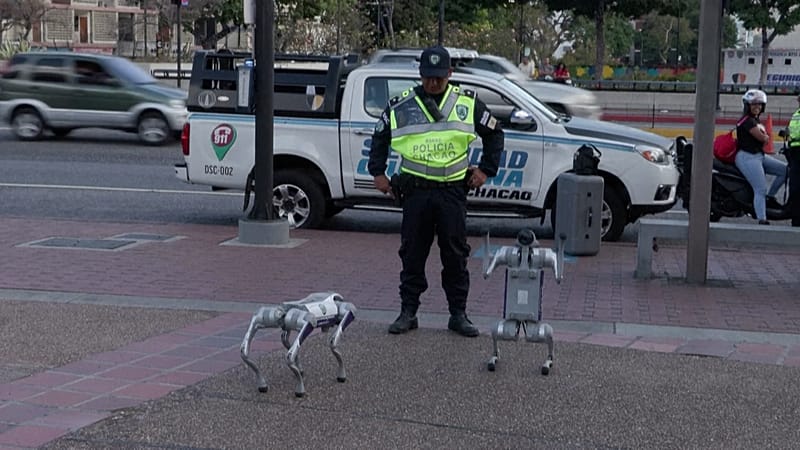
Robotic Patrols Usher in New Era of Public Safety in Caracas
Caracas, Venezuela – The municipality of Chacao, a bustling district in eastern Caracas, has embarked on an ambitious initiative to enhance public security by deploying two advanced robotic dogs, named Turbo and Voltio. Launched in March 2026, this groundbreaking program leverages artificial intelligence and sophisticated surveillance technology to patrol public spaces, signalling a significant step towards “smart city” policing in Latin America.
These AI-powered canine units are designed to operate primarily in plazas and other public areas, with a particular focus on nighttime surveillance. Equipped with high-resolution cameras and advanced motion sensors, Turbo and Voltio are capable of transmitting live imagery directly to the municipal command centre. This real-time data stream allows security personnel to monitor activity, identify potential threats, and respond swiftly to incidents.
Mayor Gustavo Duque, who presented the robotic duo, emphasized that these machines are intended to augment, not replace, human law enforcement and traditional canine units. Their primary functions include detecting unusual or suspicious movements, monitoring vehicle license plates for security checks, and providing an additional layer of support during routine patrols. The integration of these robots aims to create a more visible and technologically advanced security presence within the community.
Chacao: A Pioneer in Smart City Policing
The introduction of Turbo and Voltio positions Chacao as a leading innovator in the adoption of smart city solutions for public safety within the Latin American region. As one of the five municipalities that constitute Caracas, Chacao is a vital economic hub, hosting significant financial institutions, prominent hotels, and popular shopping centres. The municipality’s commitment to embracing cutting-edge technology underscores its dedication to maintaining a secure environment for residents and visitors alike, particularly in areas where safety remains a critical public and political concern.
Enhancing Urban Surveillance Capabilities
The deployment of robotic dogs represents a broader trend towards integrating overt policing strategies with advanced surveillance technology in urban environments. This approach seeks to proactively address safety challenges by:
- Deterring Crime: The visible presence of robotic units, coupled with their surveillance capabilities, can act as a deterrent to potential criminal activity.
- Improving Incident Response: Real-time data from the robots allows for faster and more informed decision-making by security forces, leading to more efficient incident response.
- Gathering Intelligence: The high-resolution cameras and motion sensors can collect valuable data, including license plate information and patterns of movement, which can be used for intelligence gathering and crime analysis.
- Supporting Human Officers: By taking on tasks such as perimeter monitoring and initial observation, the robots can free up human officers to focus on more complex policing duties and community engagement.
Officials have highlighted that the robots’ advanced sensors are specifically programmed to identify anomalies in movement and behaviour that might indicate suspicious activity. This intelligent detection capability is crucial for preemptive security measures. Furthermore, their ability to operate effectively during periods of low visibility, such as at night, significantly enhances the overall security coverage of the municipality.
The initiative in Chacao reflects a global shift in how cities are approaching public safety, moving beyond traditional methods to incorporate digital solutions. The success of Turbo and Voltio could pave the way for similar implementations in other municipalities, both within Venezuela and across Latin America, as urban centres increasingly look to technology to ensure the well-being of their populations. This forward-thinking approach aims to create a more secure, efficient, and responsive urban environment for the future.