Henri Rousseau: An Exhibition Unveiling the Ambition of a Self-Taught Master
Paris is currently hosting a significant exhibition dedicated to the works of Henri Rousseau (1844-1910), a visionary artist whose unique perspective is being celebrated at the Musée de l’Orangerie. Titled “Henri Rousseau: The Ambition of Painting,” the exhibition delves into the rich oeuvre of the artist affectionately known as “Le Douanier” in France, a moniker derived from his former profession as a customs officer. Despite facing considerable derision and being labelled as “naive” by critics during his lifetime, largely due to his status as a self-taught painter, Rousseau’s artistic journey is now being re-examined through the lens of his ambition and profound creative spirit.
The exhibition, a collaborative effort between major French and American institutions, has facilitated an exceptional assembly of approximately 50 of Rousseau’s works. Claire Bernardi, the director of the Musée de l’Orangerie, highlighted the rarity and significance of this collection. “I have to say that we’ve been very lucky, we’ve had an incredible opportunity. By working with two major institutions, one American and one French, we were able to pool our strengths, and as a result of this international cooperation, we’ve had some fabulous loans,” she stated, underscoring the importance of this cross-border artistic exchange.
Juliette Degennes, a co-curator of the exhibition, further elaborated on the initial reception of Rousseau’s art. “The first critics to see his works at the Salon des Indépendants referred to his naivety,” she explained. “He was mainly a self-taught painter, but he did benefit from an education, even if he didn’t follow an art course.” This distinction is crucial, as it points to a self-directed learning process that ultimately forged a distinctive artistic voice.
The Genesis of a Visionary: From Customs Officer to Master Painter
Rousseau’s artistic career began in earnest shortly before his 50th birthday, a significant pivot after concluding his tenure at the Paris Customs office. His creative wellspring was tapped through a fascination with illustrated albums of exotic wildlife and immersive visits to the ‘Jardin des Plantes,’ a renowned botanical garden in Paris. These experiences ignited his imagination, leading him to explore the untamed and the extraordinary.
Driven by a desire to establish himself and earn a living from his art, Rousseau consciously sought to differentiate his work from that of his contemporaries. “He diversified genres and techniques to carve out a place for himself on the Parisian art scene,” Bernardi noted, emphasizing his strategic approach to navigating the art world. This ambition translated into a diverse body of work that defied easy categorization.
The Allure of the Exotic and the Power of the Dream
Rousseau’s signature style is perhaps most vividly expressed in his captivating jungle scenes, teeming with vibrant flora and fauna. These canvases, rich with imagination, portray a world both fantastical and intensely felt. A prime example is the painting “The lion, hungry, pounces on the antelope,” a piece that embodies the raw energy and dramatic tension characteristic of his wilder subjects.
The poet Apollinaire once encapsulated Rousseau’s unique appeal, describing him as “the most exotic of exotic painters.” This sentiment resonates with the immersive quality of his work, transporting viewers to realms far removed from the everyday.
Bernardi also touched upon the enduring appeal of Rousseau’s art, suggesting its relevance extends beyond its historical context. “It’s a work that speaks to children because it’s so direct. I think that today, more than ever, we will see in these works their strength and their modernity,” she observed. “It comes out of the dream, but it also comes out of something that touches us, I was going to say, quite directly in our dreams, but also our anxieties.” This duality, the blend of dreamlike wonder and an undercurrent of psychological depth, contributes to the lasting impact of his paintings.
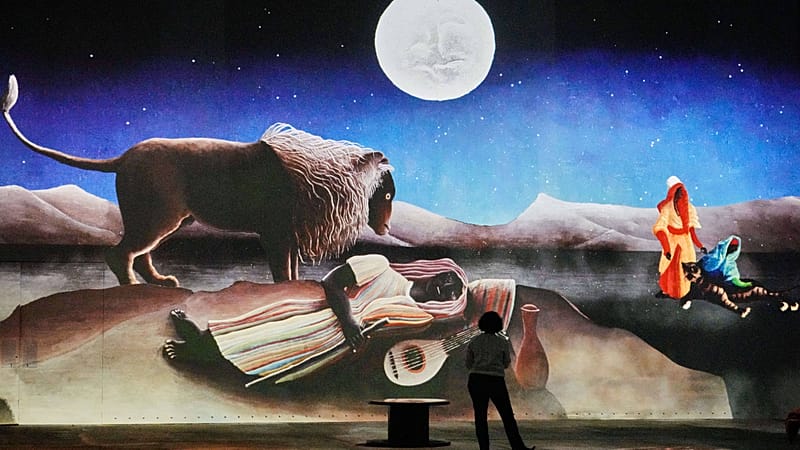
Among the exhibition’s highlights is the iconic painting “The Sleeping Gypsy,” a profound masterpiece on loan from the Museum of Modern Art (MoMA) in New York. This enigmatic canvas, one of Rousseau’s most celebrated, continues to captivate audiences with its mysterious narrative and striking imagery.
American Acclaim: Early Recognition for a Unique Talent
While Rousseau may have faced skepticism in his homeland, his work found a receptive audience across the Atlantic, particularly in the United States. Albert C. Barnes, a prominent collector and influential figure in the art world, was an early and ardent admirer of Rousseau’s paintings. He famously remarked, “His paintings have the charm of a child’s fairy tale, but there is nothing childish or uneducated about the skill with which they are executed.” This assessment acknowledges the apparent simplicity of his style while recognizing the underlying mastery of his craft.
Degennes further elaborated on the significant recognition Rousseau received in America. “There are some very fine loans from American institutions, because Rousseau was very quickly noticed in the United States,” she explained. The painter Max Weber played a pivotal role in introducing Rousseau’s work to American audiences. Upon his return to the United States in the 1910s, Weber organized an exhibition at the renowned Galerie 291, bringing Rousseau’s distinctive vision to a new market.
“American collectors were also quick to take an interest in his work,” Degennes continued. ” ‘La Bohémienne endormie’ (The Sleeping Gypsy), for example, was acquired by MoMA in 1939. It was very early on and a major monographic exhibition was devoted to it in 1942. So there really was early attention paid to Rousseau on the American side,” she concluded, underscoring the crucial role of American institutions and collectors in championing Rousseau’s artistic legacy.