Nigeria’s Debt Crisis Intensifies with $6 Billion Loan Request
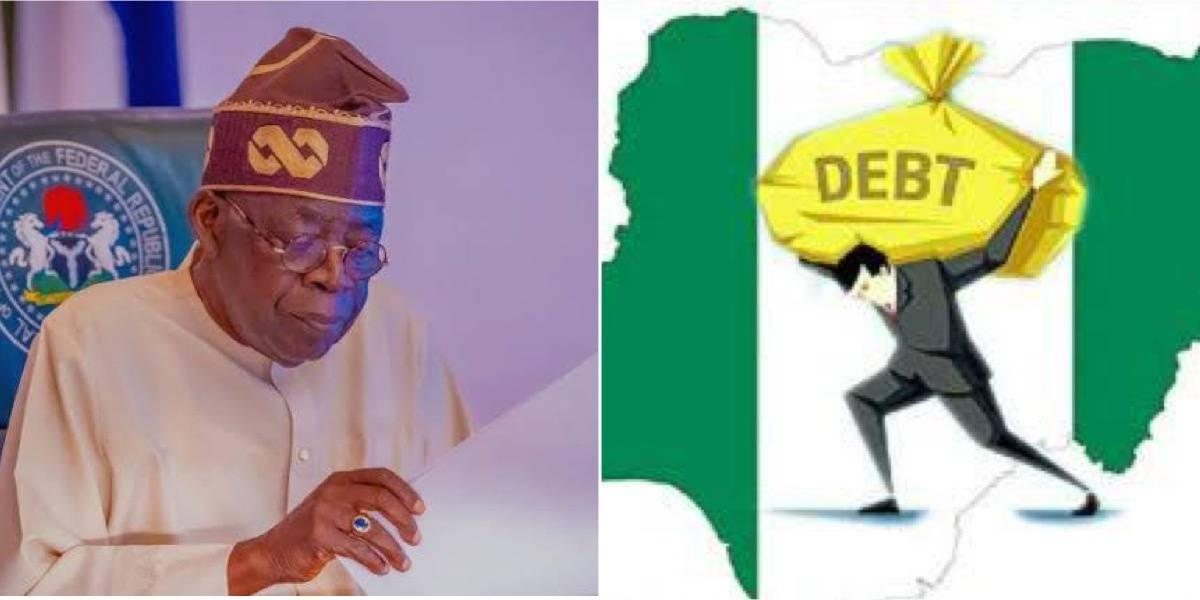
President Bola Ahmed Tinubu has requested the National Assembly to approve a $6 billion foreign loan, which could push Nigeria’s debt stock beyond N195 trillion. This move comes as the International Monetary Fund (IMF) raises concerns about high debt vulnerabilities in low-income countries.
In two separate letters addressed to the Senate President, Godswill Akpabio, and the House of Representatives Speaker, Abbas Tajudeen, the president outlined the purpose of the loans. The funds would be used for infrastructure development, debt repayment, and the rehabilitation of ports. These letters were read and approved during the Tuesday plenary session.
One of the requests involves a $5 billion loan from the First Abu Dhabi Bank in the United Arab Emirates (UAE). If approved, this loan would increase Nigeria’s debt stock from $110.3 billion to $115.3 billion. The collateral for the loan includes Naira-denominated securities. The president urged the National Assembly for “urgent approval,” emphasizing the need for immediate action.
Another letter sought an additional $1 billion for the rehabilitation of Lagos Port Complex and Tin Can Island Port. This facility, arranged by Citibank London and covered by UK Export Finance (UKEF), aims to modernize the two ports to improve functionality, safety, and efficiency. The loan would have a repayment tenure of 14 years, including a 48-month additional availability period, with a 1.1 percent availability fee and a 1.07 percent UKEF premium.
The Senate Committee on Foreign and Local Loans, chaired by Senator Wamakko Magatarkada Aliyu, had previously deliberated on the proposed loans before submitting its report to the plenary for approval.
As of September 30, 2025, Nigeria’s total public debt increased to N153.29 trillion ($103.94 billion), driven by rising domestic and external obligations. According to the Debt Management Office (DMO), this reflects an increase from N152.40 trillion in June 2025, with the debt consisting of N81.82tn domestic and $48.46bn external debt. The latest borrowing, if converted to Naira, would amount to N8.3 trillion at the prevailing exchange rate.
The Central Bank of Nigeria (CBN) had projected a debt-to-GDP ratio of 34 per cent; while foreign reserves are expected to rise to $51 billion in its 2026 macroeconomic outlook report. Public debt as a percentage of GDP is projected at 34.68 per cent by end-2026, compared with 33.98 per cent as at June 2025, predicated on expected new borrowings.
The Northern Elders Forum (NEF) has called on Nigerians to speak out against what it described as ‘reckless and unsustainable’ borrowing by the federal government, warning that the country’s economic future is being dangerously mortgaged. In an open letter addressed to Nigerians, the elders said silence in the face of mounting public debt amounted to complicity, stressing that the nation was no longer dealing with routine fiscal decisions but a pattern of borrowing marked by weak accountability and democratic neglect.
IMF Raises Concerns Over Debt Vulnerabilities
The International Monetary Fund (IMF), in a report titled ‘Macroeconomic Developments and Prospects in Low-Income Countries-2026,’ expressed concerns over high debt vulnerabilities among Low-Income Countries (LICs). The report highlighted the challenges faced by LICs navigating a fluid global environment marked by high uncertainty and shifting policies in major economies.
The report noted that while internal and external imbalances have been narrowing in recent years, macroeconomic outcomes remain highly divergent across LICs. GDP growth averaged 4.8 percent in 2025, but remained highly heterogenous across LICs. Inflation continues to ease but hotspots remain.
Fiscal consolidation has supported modest reductions in public debt, yet debt vulnerabilities remain high, and the significant increase in domestic borrowing is raising new concerns. Many LICs with thin foreign exchange reserves remain vulnerable to changes in commodity prices, global interest rates, and further aid cuts.
National Assembly Passes N68.3tn 2026 Budget
The National Assembly passed N68.3 trillion as aggregate budget profile for 2026 fiscal year, an amount which is N9 trillion above the N58.472 trillion earlier proposed by President Bola Ahmed Tinubu in December last year. The adjustments affected in the budget include outstanding unfunded capital obligations and capital for priority projects across multiple sectors and locations nationwide.
The N68.3 trillion budget has N4.79 trillion as Statutory Transfer, N15.4 trillion as recurrent expenditure, N32.2 trillion as capital expenditure, and N15.8 trillion for debt servicing. The committee’s report recommended addressing bureaucratic bottlenecks to achieve the theme of the 2026 Appropriations Bill ‘From Budget to Impact.’
Extension of 2025 Budget Spending
At the plenary yesterday, both chambers of the National Assembly approved a bill to amend the 2025 Appropriation Act to further extend the implementation of the capital components of the Act from March 31 to June 30. This followed a request by President Tinubu, seeking a three-month extension to give room for further implementation of the capital budget by MDAs.
Analysts have noted that the extension of the 2025 budget when the 2026 budget had already been passed shows that the present administration is still running a multiple budget regime contrary to a pledge by President Tinubu to stop such practice with effect from March 31, 2026.
Concerns Over Borrowing Without Scrutiny
The Centre for Fiscal Transparency and Public Integrity (CEPTI) has raised concerns over the approval of a $6 billion external loan, warning that borrowing without adequate scrutiny could be detrimental to Nigeria’s economy. The organization emphasized the need for careful review, transparency, and robust legislative oversight.