Delta Goodrem Celebrates Australia’s Fourth-Place Finish at Eurovision 2026
Delta Goodrem has expressed immense pride in Australia’s fourth-place finish at the 70th annual Eurovision Song Contest, which concluded with Bulgaria winning the competition. The result came after a four-hour telecast and a week of celebrations in Vienna, Austria, where Australia played a central role in the event.
In a close race, Australia, Israel, France, and Italy were among the top contenders until the final votes were tallied. Bulgaria ultimately secured victory with the upbeat and catchy song Bangaranga performed by Dara. The Wiener Stadthalle erupted in applause and cheers as the results were announced. With 516 points, Bulgaria claimed first place, followed by Israel (343), Romania (296), Australia (287), Italy (281), Finland (279), Denmark (243), Moldova (226), Ukraine (221), and Greece (220).
The final moments of the contest were tense, with Israel briefly leading before Bulgaria overtook them with a strong audience vote. The crowd’s reactions, including boos, were audible during the broadcast. Five countries withdrew from the competition in protest against Israel’s participation following the war in Gaza.
Historically, this is Australia’s second-best performance, following Dami Im’s second-place finish in 2015. More than a dozen European countries did not make it to the grand final due to the challenging semi-finals.
A Stellar Performance and Emotional Reaction
Speaking backstage after the grand final, Goodrem said: “I’m absolutely stoked… I am honoured to have hit the stage, that iconic Eurovision stage. I am so blown away by the love and support. I don’t even know how to say thank you. I felt the country with me.”
Goodrem described her journey to the Eurovision stage as an unforgettable adventure. “I led with passion, and it’s been more incredible than I could have possibly imagined,” she said. “Coming off stage, the emotional part was getting that release after the pressure cooker. Now I just feel I will take a moment to enjoy what this adventure was.”
The 41-year-old Sydney-born star also mentioned that the experience would influence her future performances. “I feel like the past few years, I have been hitting the road a bit more. That’s my favourite thing to do. We like to have emotion, but we like to have a lot of fun, standing on a piano… but now I am thinking in my next shows, there’s going to have to be a lift out of my piano,” she added.
A Show of Excellence
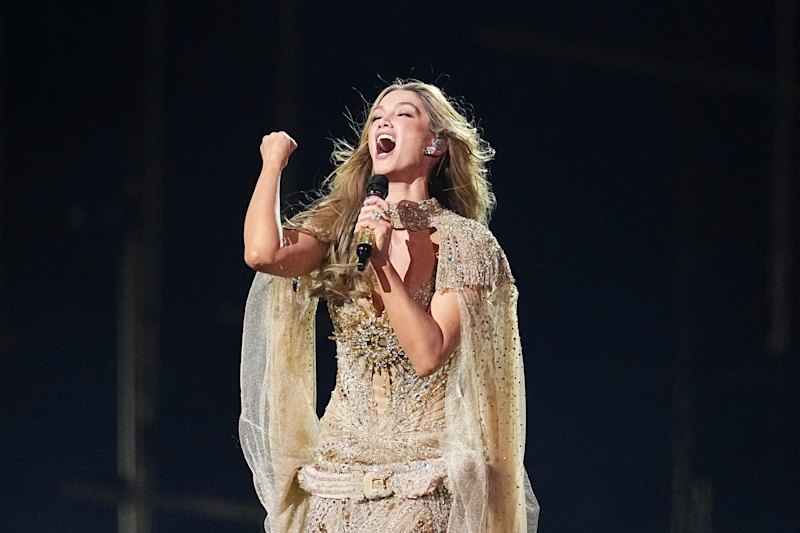
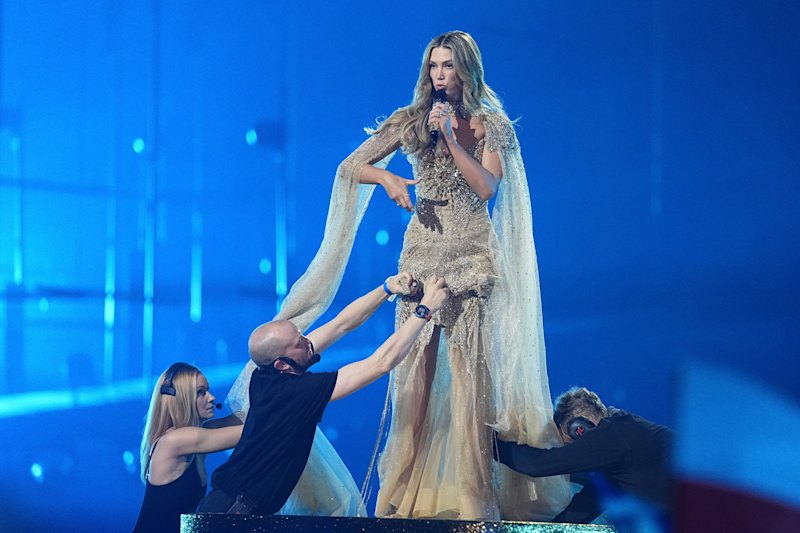
Goodrem’s performance, titled Eclipse, was a masterclass in stagecraft, combining explosive energy with majestic visuals. The show featured a hand-crafted gold gown adorned with 7,000 Swarovski crystals, designed by Nicky Apostolopoulos for the Sydney label Velani. The dress was paired with innovative technology known as a Versa Ribbon Lift, similar to what Beyoncé has used.
The performance took the audience through layers of moon shadow, into an intersection of moon and sun, and finally into a dazzling explosion of gold. The effect was extraordinary, leaving the crowd in awe. Even journalists in the media centre applauded and cheered.
Global Recognition and Support
Goodrem’s performance reached an estimated 150 million viewers worldwide, marking the largest audience of her career. Her performance exceeded expectations, blending acoustic and visual artistry seamlessly.
Prime Minister Anthony Albanese praised Goodrem on Instagram, writing: “Well done, Delta Goodrem. You did Australia proud.” Courtney Act, co-host of SBS’ Eurovision coverage, also shared their admiration, calling her performance “even better than the semi – perfection.”
Dami Im, who represented Australia in 2016, echoed similar sentiments, stating that Goodrem’s performance was “perfection.”
Australia’s Place in Eurovision
Australia’s participation in Eurovision remains a topic of debate, though it reflects the country’s European heritage and the European Broadcasting Union’s efforts to globalize the event. This year’s campaign silenced critics who had questioned the nation’s presence in the competition.
The contest featured 35 countries performing in 20 languages. The grand final included 20 nations, alongside the “Big Five” — France, Germany, Italy, the UK, and host country Austria — who automatically qualify.
Spain withdrew in protest, joining Iceland, Ireland, the Netherlands, and Slovenia in boycotting the event. This highlighted a growing challenge for the EBU in balancing soft diplomacy with the perception of Eurovision as a political platform.
The Future of Eurovision
The Eurovision Song Contest is a four-hour marathon of music, spectacle, and intricate scoring. Despite its antiquated system, the contest remains one of the most beloved events globally.
SBS will replay the Eurovision grand final tonight at 7.30pm AEST. All semi-finals and the grand final are available via SBS on Demand.
Read more of our 2026 Eurovision coverage.