A Revolutionary Theory: Unlocking the Secrets of the Great Pyramid’s Construction
For millennia, the sheer scale and precision of the Great Pyramid of Giza have captivated the world, leaving archaeologists to ponder the extraordinary feat of its construction. Traditional explanations, largely based on external ramps and a painstaking, layer-by-layer assembly, have struggled to reconcile the immense weight of the stone blocks – some exceeding 60 tons – with the relatively short construction period of approximately two decades. Now, a groundbreaking new study proposes a radical departure from these long-held beliefs, suggesting that the pyramid was built from the inside out, utilizing a sophisticated internal system of counterweights and pulley-like mechanisms.
The research, published in the esteemed journal Nature, was led by Dr. Simon Andreas Scheuring of Weill Cornell Medicine in New York. Dr. Scheuring’s calculations indicate that ancient builders could have achieved an astonishing pace, potentially lifting and positioning blocks at a rate of one per minute. This remarkable speed, he argues, would have been impossible without a system that leveraged the power of sliding counterweights rather than relying solely on brute-force hauling. This innovative approach would have provided the necessary force to elevate the colossal stones to the pyramid’s upper echelons.
The Great Pyramid of Khufu, standing as the oldest and largest of the Giza pyramids, was erected as the magnificent tomb for Pharaoh Khufu around 2560 BC, making it approximately 4,585 years old. Despite extensive searches, the pharaoh’s mummy and his associated treasures have never been unearthed. For centuries, the pyramid held the title of the world’s tallest structure and remains the sole Ancient Wonder of the World that is still largely intact. Its renown stems from its meticulous construction using millions of precisely cut stone blocks and its intricate network of internal passages that culminate in the King’s Chamber.
Rethinking Internal Architecture: Ramps, Galleries, and Lifting Stations
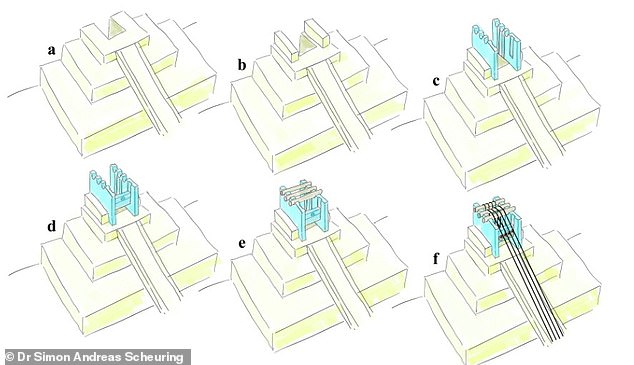
Dr. Scheuring’s hypothesis gains traction from his reinterpretation of key architectural features within the pyramid. He posits that the Grand Gallery and the Ascending Passage, long considered ceremonial routes, were in fact functioning as sloped internal ramps. Along these inclines, heavy counterweights could have been strategically dropped, generating the kinetic energy required to lift blocks upwards.
Furthermore, the Antechamber, a small granite room situated just before the King’s Chamber, has been re-examined. Traditionally viewed as a defensive element designed to deter tomb robbers, Dr. Scheuring proposes it served a far more active role as a sophisticated pulley-like mechanism. This system would have been instrumental in lifting even the heaviest of the pyramid’s stones.
The study highlights compelling evidence supporting this internal construction model:
- Wear Marks on the Grand Gallery: Scratches, visible wear patterns, and polished surfaces along the walls of the Grand Gallery are interpreted as indicators of repeated movement of large sledges. This suggests significant mechanical stress consistent with the sliding of heavy loads, rather than the wear associated with foot traffic or ritualistic activities.
- Functional Design of the Antechamber: The Antechamber exhibits several features that point towards a functional machine rather than a purely decorative or ceremonial space. These include:
- Grooves cut into its granite walls, likely for ropes.
- Stone supports that may have once held wooden beams to guide ropes or machinery.
- Unusually rough workmanship in certain areas, suggesting a focus on utility over aesthetics.
In Dr. Scheuring’s proposed reconstruction, ropes would have been threaded over wooden logs positioned within the Antechamber. This arrangement would have allowed workers to efficiently lift stones weighing up to an estimated 60 tons. The system could have been adjusted for increased lifting power, akin to changing gears on a modern machine. Evidence such as oversized rope grooves and an uneven, inlaid floor further supports the idea that this chamber was once connected to a vertical shaft, which was subsequently sealed after construction concluded.
Engineering Compromises and Structural Anomalies
Beyond individual chambers, Dr. Scheuring argues that the overall internal layout of the pyramid reflects practical engineering constraints rather than purely symbolic design choices. The clustering of major chambers and passages around a central vertical axis, yet their notable offsets from perfect symmetry, is a key piece of evidence. For instance, the Queen’s Chamber is centered on a north-south axis but not east-west, while the King’s Chamber is noticeably south of the pyramid’s central axis.
These irregularities are difficult to account for in a model where the pyramid was built symmetrically from the ground up using external ramps. In such a traditional scenario, builders would have had the freedom to position chambers with perfect alignment. Instead, the offsets suggest that the placement of these internal spaces was dictated by the limitations and requirements of the internal lifting systems.
Explaining Exterior Puzzles and Future Implications
The internal construction theory also offers plausible explanations for perplexing exterior features of the pyramid. The slight concavity observed on the pyramid’s faces and the intricate pattern of stone layers, which gradually change height, may be directly related to the shifting positions of internal ramps and lifting points as the structure ascended and the weight of blocks decreased at higher levels.
Crucially, this new model is not merely theoretical; it makes testable predictions. One significant prediction is that there are unlikely to be any large, undiscovered chambers hidden within the pyramid’s core, a notion that aligns with findings from recent muon-scanning surveys. However, the possibility of smaller corridors or remnants of internal ramps existing within the outer portions of the structure, particularly at higher elevations, cannot be ruled out.
If further archaeological discoveries lend support to Dr. Scheuring’s proposal, it could fundamentally reshape our understanding of not only the Great Pyramid of Giza but also the broader practices of pyramid construction throughout ancient Egypt. This revolutionary perspective offers a compelling new lens through which to view one of humanity’s most enduring architectural marvels.