Semiconductor Companies Navigate Challenges with Strong Performance
Despite a range of adverse factors, including the ongoing U.S.-Iran conflict, the blockade of the Strait of Hormuz, and Google’s TurboQuant technology—which compresses memory usage to one-sixth—global semiconductor companies have experienced significant stock price fluctuations. However, semiconductor firms that have concluded their first-quarter operations this year remain relatively calm. This is due to the expectation of robust performance, which is as solid as concrete, despite the volatile stock prices.
The securities market and semiconductor industry are confident that Samsung Electronics and SK Hynix will achieve record-high operating profits this year. Recent external variables have not altered the current structure of explosive demand and supply shortages, leading to the expectation that memory semiconductor companies will enter an unprecedented “super-prosperous period” this year. Samsung Electronics is set to announce its preliminary first-quarter results on the 7th.
Combined First-Quarter Operating Profit Expected to Reach Up to 80 Trillion Korean Won
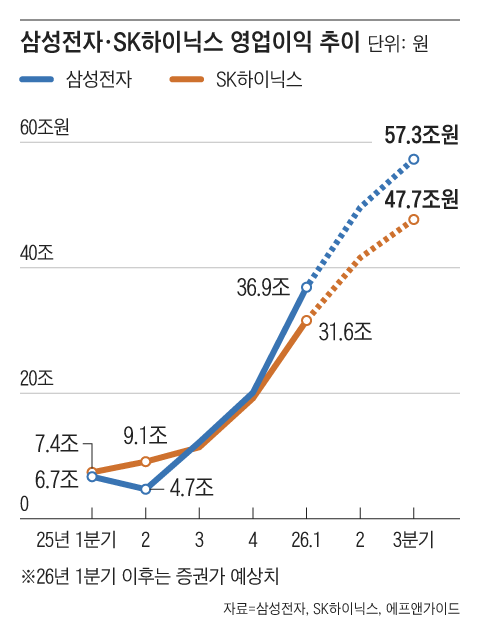
The securities industry and semiconductor sector are certain that Samsung Electronics and SK Hynix will achieve record-high quarterly operating profits in the first quarter. The focus is on whether their combined first-quarter operating profit will exceed their entire operating profit from last year. According to the securities industry consensus, Samsung Electronics’ expected first-quarter revenue for this year is 116.1378 trillion Korean won, a 46.75% increase from a year ago, with an operating profit of 36.8902 trillion Korean won, up 461.8%. This surpasses the entire operating profit of 32.7260 trillion Korean won recorded for the whole year of 2024 and approaches last year’s annual operating profit of 43.6011 trillion Korean won. The same applies to SK Hynix. The revenue consensus for SK Hynix’s first quarter is 46.6252 trillion Korean won, a 164% increase from a year ago, with an operating profit of 31.5627 trillion Korean won, up 324%. Together, the two companies are expected to generate 68.5 trillion Korean won in operating profit in the first quarter alone.
Recent expectations suggest that these market forecasts may be exceeded. Meritz Securities projected Samsung Electronics’ first-quarter operating profit for this year at 53.9 trillion Korean won on the 3rd, while Citigroup estimated it at 51 trillion won. Hana Securities also raised its first-quarter operating profit forecast for SK Hynix by 47% from previous estimates on the 2nd, suggesting it could reach 37 trillion won. This implies that the combined operating profit of the two companies could exceed 80 trillion won. Based on this trend, projections also suggest that Samsung Electronics’ annual operating profit this year could reach up to 320 trillion won (Meritz Securities), and SK Hynix’s could reach up to 230 trillion won (Hana Securities). Together, they could generate 75% of South Korea’s annual budget for this year (727.9 trillion won). Just two months ago, the combined expected operating profit for the two companies was estimated at 200 trillion won, but with semiconductor prices surging, this figure has grown by 2.75 times.
Unabated Demand and Persistent Supply Shortages
The reason for expecting explosive performance from Samsung Electronics and SK Hynix despite external variables is that the structure triggering this year’s semiconductor supercycle remains entirely unchanged. This supercycle is driven by explosive demand for memory semiconductors due to the spread of artificial intelligence (AI) and supply shortages. Although the U.S.-Iran war is prolonging, U.S. big tech companies’ investments in AI infrastructure have not decreased. The four major U.S. tech firms—Alphabet (Google’s parent company), Amazon, Meta, and Microsoft—have announced plans to invest $665 billion (approximately 1,001 trillion won) in AI infrastructure this year, a 75% increase from a year ago.
DRAM prices are also expected to continue rising. Market research firm TrendForce analyzed that DRAM prices in the second quarter of this year could jump 58–63% compared to the previous quarter. Although the fixed transaction price of DRAM used in business-to-business deals, which had shown double-digit growth for 11 months, recorded 0% growth in March, the industry views this as not indicative of a downward trend. Instead, the industry explains that quarterly volume price negotiations concluded earlier than usual, in January–February, which is why March prices remained unchanged.
Although semiconductor companies have expanded production, it remains insufficient to meet demand. Last year, global semiconductor companies, including Chinese firms, expanded production facilities by only 1% of total output: 156,000 DRAM wafers and 46,000 NAND wafers. This year, memory semiconductor demand is estimated to grow by around 30%, a rate far exceeding the current supply expansion. Kim Young-geon, an analyst at Mirae Asset Securities, stated, “For Samsung Electronics and SK Hynix, full-scale capacity expansion is expected to be possible only by 2027 due to spatial limitations.” U.S.-based Micron increased its facility investment for this year from $23.8 billion to $25 billion and next year’s investment from $30.4 billion to $35 billion. However, considering the time required for mass production, supply shortages are expected to persist until 2027. Currently, memory semiconductors sell out as soon as they hit the market. Samsung Electronics’ memory inventory is currently only about 1–2 weeks’ worth. Kim Dong-won, head of KB Securities’ research division, noted, “Samsung Electronics recently began second-quarter memory price negotiations, and customer order intensity has been stronger than expected.”
Current external variables, such as the U.S.-Iran war, are manageable in the short term. Although concerns arose that the war could lead to a helium shortage—critical for semiconductor production—Samsung Electronics and SK Hynix hold 4–6 months’ worth of helium inventory, mitigating significant impact. Google’s recently announced TurboQuant technology, which reduces memory usage to one-sixth, could pose short-term challenges but is analyzed to expand the AI industry in the long run, thereby influencing increased memory demand.
However, the prolonged U.S.-Iran war and the sustained rise in raw material and logistics costs due to the extended blockade of the Strait of Hormuz could negatively impact the semiconductor industry. A semiconductor industry official stated, “The industry must always consider the possibility of big tech companies suddenly scaling back AI investments.”
월 5900원 멤버십, 신문 독자에게는 2900원, 조선멤버십
55000원 상당의 신문-잡지 8종 마음껏 보기, 조선멤버십
현금처럼 쓸 7000포인트 받아 알뜰한 쇼핑, 조선멤버십