From Coconut Waste to Eco-Friendly Innovations: A Young Entrepreneur’s Vision
In the bustling suburb of Aladjo, Accra, a significant environmental challenge once plagued the area around Polo Junction: the indiscriminate dumping of coconut waste. What was once perceived as mere refuse, however, is now being meticulously transformed into a source of opportunity, innovation, and environmental hope, largely thanks to the vision of a young entrepreneur.
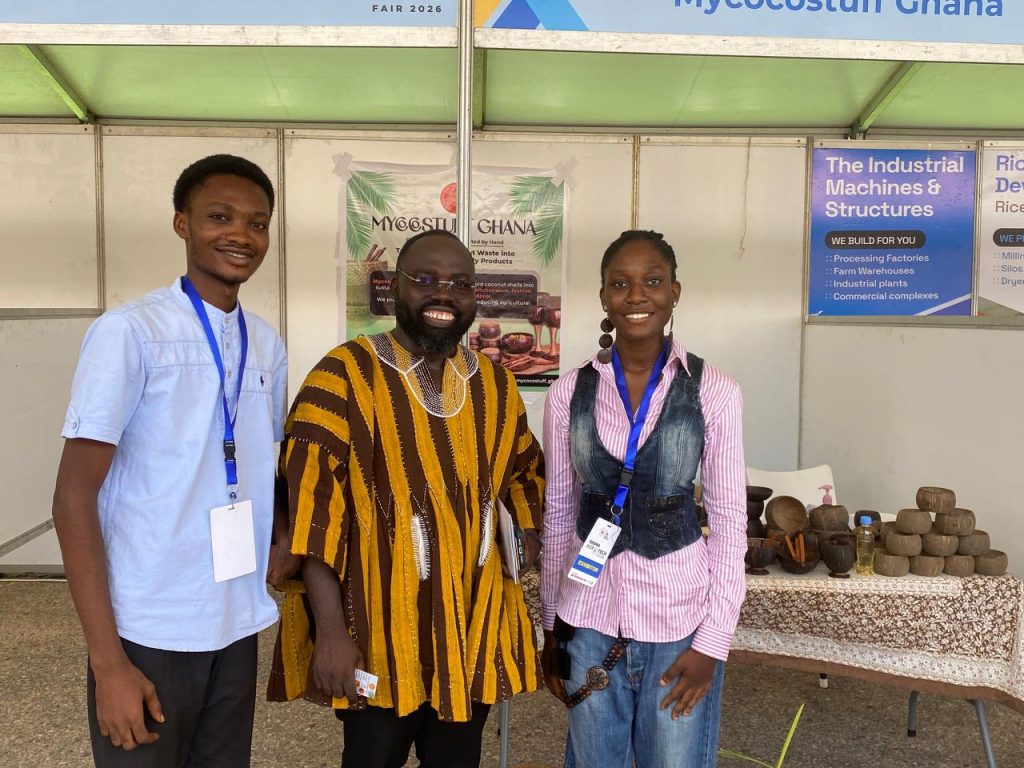
Elisha Kofi Foli, a determined individual living with a disability, sees beyond the scattered coconut shells littering streets and markets. For him, these discarded husks are not refuse but the foundational raw materials for a burgeoning sustainable industrial future. As the founder of MyCocoStuff Ghana, Elisha is at the forefront of converting coconut waste into a range of eco-friendly and biodegradable products, including cups, bowls, and spoons. His initiative powerfully demonstrates how youth-led innovation can serve as a dual engine for environmental protection and economic growth.
Turning Waste into Wealth: Overcoming Adversity
Elisha’s entrepreneurial journey is a compelling narrative of innovation interwoven with resilience, as he navigates significant structural and personal challenges. “The journey hasn’t been easy,” he shares. “Operating machinery as a person living with disability is not easy. Accessing funds to expand production is also a major challenge, and getting people to understand and accept eco-friendly products takes time.”
What began in 2022 with a single machine has steadily grown into an evolving enterprise, despite considerable limitations in resources and persistent market barriers. His inspiration was sparked by a stark observation: the sheer volume of coconut waste generated in local communities. “When you go to these neighbourhoods, you see coconut vendors everywhere. The waste is often discarded,” Elisha explains. “I asked myself, why not transform this waste into something useful?”
Through a meticulous process that separates the coconut into its shell, fibre, and cocopeat, his company ingeniously converts this waste into practical, everyday products. The coconut fibre is also finding applications in the construction industry, further diversifying the value derived from this abundant resource.
A Microcosm of Broader Sector Challenges
Elisha’s story is emblematic of a growing cohort of young Ghanaians who are harnessing innovation to tackle real-world issues. This theme resonated strongly at the recent Ghana AgroTech Fair 2026, a significant event held in Accra. This maiden three-day fair, organised by the Ministry of Trade, Agribusiness and Industry in collaboration with the Ghana Export-Import Bank (EXIM Bank), was aptly themed: “Transforming Agribusiness through Local Innovation and Technology.”
The fair provided a vital platform for various institutions to showcase locally manufactured agricultural machinery, agro-processing equipment, and cutting-edge technologies specifically designed to enhance productivity and strengthen value addition within Ghana’s agricultural sector.
Elisha’s personal experiences mirror a wider reality within Ghana’s agro-processing and innovation ecosystem. At the AgroTech Fair, numerous stakeholders consistently highlighted critical barriers hindering the scaling of local innovations. These included limited access to funding, inadequate infrastructure, and insufficient policy support.
Mr. Patrick Quansah, Director of Engineering at the Gratis Foundation, underscored the pivotal role of locally manufactured agro-processing equipment in boosting productivity. “These machines help reduce time, labour, and energy consumption during processing. They are meant to improve efficiency and increase productivity for agro-processors,” he stated. He further noted that a significant portion, 60 to 70 per cent, of the components used in these machines are sourced locally. This not only makes them more affordable but also facilitates easier maintenance.
However, Mr. Quansah also pointed out persistent challenges, such as the procurement of essential materials like food-grade stainless steel, which must be imported, consequently driving up production costs. “We need policies that will promote Made-in-Ghana machines so that farmers across the country can easily access them,” he urged.
Technology Revolutionising Agriculture
Beyond processing, technology is fundamentally reshaping the practice of agriculture itself, making it more efficient and increasingly appealing, particularly to younger generations. Mr. Dan Mensah, a Senior Technician specializing in drone technology at the Kwame Nkrumah University of Science and Technology Learning Centre, elaborated on how drone technology is transforming farming practices.
“With this technology, farmers can spray large areas in a short time. It makes farming easier and more attractive, especially to the youth,” he explained. He highlighted the impressive capability of drones to cover up to 20 hectares within an hour, a significant leap in efficiency compared to traditional manual methods. Complementing these technological advancements, training programmes in drone technology, coding, and agribusiness are actively equipping young individuals with the essential skills needed for employment in Ghana’s evolving agricultural sector.
Innovation Blossoming from the Classroom
Educational institutions are also emerging as key contributors to this agricultural transformation. At the Bedeku Technical Institute, students have engineered a milling machine capable of processing sorghum leaves into tea bags and cooking powder. This innovative project serves as a powerful testament to the potential of practical, skills-based education to foster tangible solutions.
Madam Faustina Okai, the Principal of the institute, confirmed that the initiative has garnered encouraging feedback. However, she lamented the current lack of necessary facilities to scale up production. “We have just started producing the product and the response has been encouraging, but we need support to expand,” she stated. She emphasised the critical need for investment in workshops and equipment to empower students to transform their innovative ideas into viable commercial enterprises.
Sustainable Agriculture and Environmental Stewardship
Other stakeholders are actively leveraging technology to address pressing environmental challenges while simultaneously enhancing agricultural productivity. Mr. Harry Bernard Wryter, Managing Director of the Hydroponics and Agri-Tech Group of Companies, highlighted how innovations like hydroponics and aquaponics are making farming more efficient and accessible. “With a small space, you can produce significant yields,” he remarked, underscoring the suitability of these systems for urban farming.
Furthermore, Mr. Wryter pointed to the innovative use of agricultural waste, such as rice husks, for the production of biochar and organic fertilizers. These solutions not only improve soil health but also offer a viable pathway for reclaiming degraded lands. “With biochar, we can reclaim degraded lands faster and make them suitable for planting within about a year,” he noted, showcasing a promising approach to environmental restoration.
Youth, Inclusion, and the Future of Innovation
Central to these discussions is a widely shared recognition: the future of Ghana’s agricultural transformation hinges crucially on its youth, and this transformation must be inherently inclusive. Elisha’s story stands out not merely because he is a young innovator, but because he is navigating the complexities of entrepreneurship as a person living with a disability. His journey powerfully underscores the imperative for robust systems that champion inclusive participation in innovation, ensuring that physical challenges do not become insurmountable barriers to opportunity.
A Call for Policy Direction and Collaborative Action
Echoing the sentiments of many stakeholders, Elisha is a vocal advocate for stronger policy interventions to bolster local innovation. He specifically calls for the reduction or outright ban of single-use plastics to create a more robust market demand for eco-friendly alternatives. “It is high time Ghana moves from plastic to natural and authentic products,” he asserted. He also stressed the vital need for strategic partnerships with financial institutions and organisations like the Ghana EXIM Bank to facilitate expansion and unlock export opportunities.
Stakeholders at the AgroTech Fair echoed these calls, urging the government to prioritise investment in research, actively promote locally manufactured technologies, and foster stronger collaborations with the private sector.
A Future Within Reach
Elisha’s dedicated work, coupled with the diverse innovations showcased at the AgroTech Fair, paints a hopeful picture of a future where waste is transmuted into valuable resources, agriculture is propelled by technological advancements, and young people are firmly positioned at the vanguard of positive change. However, realising this future will necessitate deliberate and sustained investment, the implementation of enabling policies, and unwavering support for nascent enterprises and innovative ideas. For now, from a modest workshop in Aladjo, a young man is quietly demonstrating that profound transformation is indeed possible, turning discarded coconut shells into potent symbols of resilience, inclusivity, and a brighter agro-industrial future for Ghana.