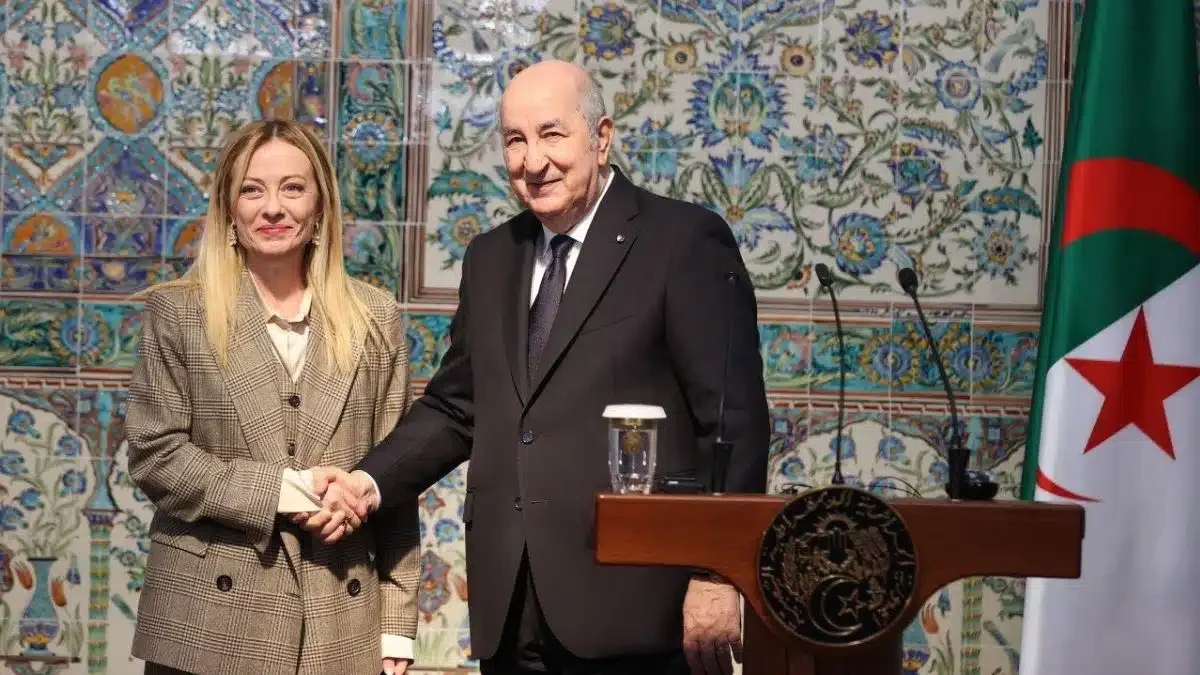
Italian Prime Minister Giorgia Meloni’s recent visit to Algiers underscored the strategic importance of energy security and regional stability, as discussions centred on bolstering gas imports from Algeria amidst a complex geopolitical landscape. The visit, which took place on February 28, also saw a careful navigation of the sensitive Western Sahara issue, with Italy advocating for a resolution aligned with United Nations frameworks.
Energy Diplomacy and Geopolitical Currents
Prime Minister Meloni’s brief but significant trip to the Algerian capital was largely dominated by discussions concerning Italy’s energy diversification strategy, with Algeria a key partner in securing natural gas supplies. The backdrop of ongoing geopolitical tensions, particularly those stemming from the Middle East conflict, lent an added layer of urgency to these deliberations.
Following bilateral talks with Algerian President Abdelmadjid Tebboune, Prime Minister Meloni offered a concise statement regarding the long-standing Western Sahara dispute. She indicated that the matter had been a subject of discussion with her Algerian counterpart, stating, “We have called for a solution” that is “in line with the vision of the United Nations.”
A Nuanced Stance on Western Sahara
While the Western Sahara issue was addressed, Prime Minister Meloni appeared to place a stronger emphasis on other pressing regional concerns, including the escalating instability in the Sahel region and the persistent challenge of irregular migration across the Mediterranean Sea. Notably, her remarks notably omitted specific references to the “self-determination of the Sahrawi people” or the necessity for “direct negotiations” between Morocco and the Polisario Front. This differentiated her approach from that of Italian President Sergio Mattarella, whose largely ceremonial role saw him previously highlight these positions during a visit to Algiers in November 2021.
Algeria’s Position on Self-Determination
In contrast, President Tebboune articulated Algeria’s firm stance on the Western Sahara conflict. He stated that both Algeria and Italy share a common objective of supporting a “just solution” to the issue. This solution, he emphasized, must guarantee “the Sahrawi people’s inalienable right to self-determination, in accordance with the principles of the United Nations Charter and Security Council resolutions.”
Furthermore, the Algerian president reaffirmed the mutual commitment of both nations to support the ongoing efforts of the UN Secretary-General’s Personal Envoy for Western Sahara, Staffan de Mistura. This endorsement signals a shared desire to facilitate a diplomatic process towards resolving the protracted dispute.
Italy’s Consistent Diplomatic Framework
The diplomatic posture adopted by Italy in Algiers appears to be consistent with previous joint communiqués, including that issued after the fifth session of the Italy-Algeria intergovernmental summit. This summit, co-chaired by Prime Minister Meloni and President Tebboune, took place in Rome on July 23, 2025.
Within the framework of that joint communiqué, specifically Paragraph 29, both parties conveyed their reiterated support for the endeavours of the UN Secretary-General’s Personal Envoy. The objective, as outlined, is to:
- Restart direct negotiations between the involved parties.
- Achieve a political solution that is just, lasting, and mutually acceptable.
- Ensure that any resolution is in full accordance with the goals and principles enshrined in the United Nations Charter.
- Adhere to the relevant Security Council resolutions.
Italy’s engagement with the Western Sahara issue has also previously acknowledged Morocco’s contributions. In July 2023, following discussions between Moroccan Foreign Minister Nasser Bourita and his Italian counterpart Antonio Tajani, Rome reiterated its support for a UN-led political process. This process aims to secure a resolution that is characterized as:
- Just
- Realistic
- Pragmatic
- Durable
- Mutually acceptable
This approach is predicated on compromise and aligns with the principles articulated in Security Council Resolution 2654. The emphasis on a pragmatic and mutually acceptable solution underscores Italy’s commitment to fostering stability and finding a resolution through established international diplomatic channels.