White House Ballroom Expansion Faces Public Backlash and Delays
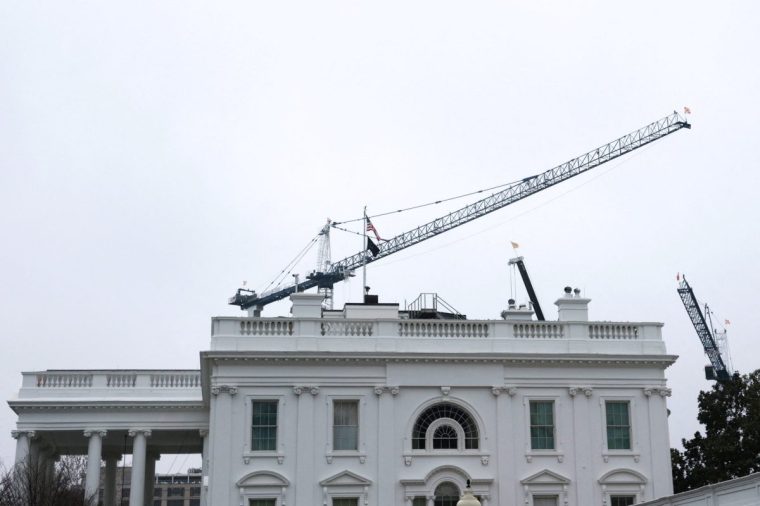
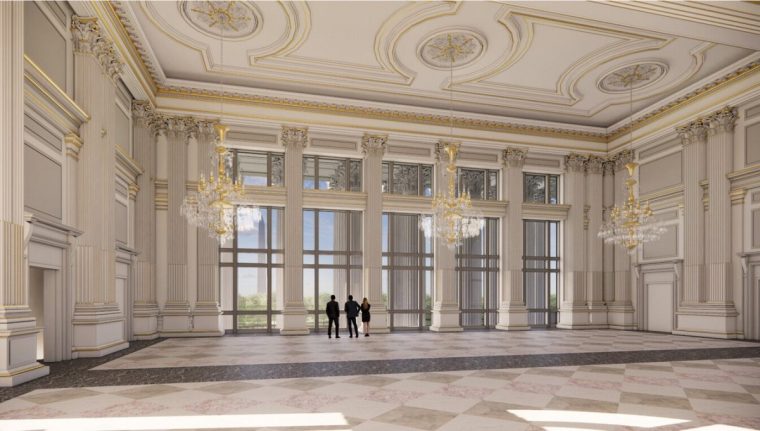
A highly ambitious expansion project at the White House, featuring a new grand ballroom, has been met with a torrent of public disapproval, leading to significant delays. The proposed design has drawn sharp criticism, with many comparing it unfavourably to a “brothel” and a “Vegas casino.”
The National Capital Planning Commission (NCPC), the body responsible for overseeing such developments, was scheduled to hold a final vote on the expansion plans. However, this vote has been postponed to April 2nd, a move prompted by an overwhelming response from the public, with over 32,000 submissions, the vast majority of which voiced opposition to the project.
The original East Wing of the White House was demolished in October of the previous year to make way for this opulent new ballroom. Reports indicate that the project is expected to cost a staggering $400 million (£300m) and will encompass an expansive 90,000 square feet.
This latest setback for the ballroom project occurs against a backdrop of increasing domestic challenges for the President. His declining approval ratings have reportedly caused growing unease among Republicans, particularly in anticipation of the upcoming midterm elections in November. The outcomes of these elections are crucial, as they will significantly influence the latter half of his term in office. These elections will see critical contests for both House and Senate seats. A victory for the opposition Democratic Party in these races could substantially impede the President’s capacity to implement his political agenda.
Following a period of near-complete political dominance in the initial year of his presidency, the President has encountered mounting resistance to his policy initiatives in recent weeks. His signature tariff policy, for instance, was thrown into disarray when the Supreme Court, a body where a third of its justices were appointed by the President during his first term, invalidated his “liberation day” tariffs in the preceding month. Concurrently, his assertive foreign policy actions in Venezuela and Iran have proven unpopular with voters, particularly among his core “America First” supporters, who are advocating for a greater focus on domestic issues. A recent poll conducted by Fox News revealed that 57 percent of Americans disapprove of the President’s current job performance, with six out of ten voters indicating that he is concentrating on the wrong priorities.
Ballroom Delay as a “Perfect Metaphor” for Presidential Challenges
Experts have characterised the postponement of the ballroom project as a “perfect metaphor” for the President’s declining public approval and his weakening hold on political power. Dr. Louis Bromfield, a commentator from Swansea University, suggested that there is a clear “conflation between general negative sentiment towards the President and the ballroom.” He elaborated that the ballroom’s design is perceived as “transparently grand, expensive and ostentatious,” and its proposed construction stands in stark contrast to the pressing cost-of-living concerns faced by many Americans. Dr. Bromfield highlighted a “depressingly comical contrast” between the lavish spending and opulent decorations associated with the White House expansion and the financial realities confronting millions of citizens.
During the recent commission meeting, only one individual spoke in favour of the President’s ballroom plans, according to reports. Conversely, numerous experts and members of the public expressed their strong opposition to the proposals. An analysis of approximately 9,000 pages of public comments revealed that an overwhelming 97 percent of the feedback was against the project.
Public Outcry Against “Authoritarian Self-Aggrandisement”
Objectors have vehemently criticised the project, labelling it as “authoritarian self-aggrandisement” and a “Trumpification” of the White House. They have described the designs as a “complete razing of American history.” One critic expressed outrage, stating, “I am outraged that this monstrous ballroom was designed and the construction of the original without any approval. This is the people’s house and should have been authorised by the people.” Another individual likened the ballroom to a “gold, gilded edifice to one man’s ego, an architectural ascent to his self-identification as a royal monarch.”
The chair of the commission, Will Scharf, acknowledged the need for further deliberation, informing the meeting that a final vote would be conducted in April. Prior to this meeting, the executive director of the NCPC had recommended approval for the preliminary and final site and building plans for the East Wing Modernisation Project. It is noteworthy that the President has recently appointed several loyalists to serve on the NCPC, a body that plays a pivotal role in key planning decisions within Washington D.C. Ultimately, final approval for such projects rests with the federal Commission of Fine Arts, where the President has also placed political allies. The President has maintained that the ballroom project will be financed through private donations.
White House Press Secretary Karoline Leavitt, in remarks to The New York Times, dismissed the critical public feedback as stemming from “an organised campaign of Trump-deranged liberals who clearly have no style or taste.”
Slipping Grip on the Party and Declining Popularity
Dr. Bromfield further commented on the broader political landscape, stating his belief that “Trump’s grip on the GOP is slipping, and the ballroom is a perfect metaphor for this.” He observed that while the President is often a polarising figure, eliciting either complete condemnation or unwavering support from his MAGA base, the ballroom project has not garnered the latter. Dr. Bromfield asserted that the President is currently in his weakest position since taking office in 2016, with a splintering base, historically low popularity, and actions that appear to contradict campaign messages that resonated with voters.
Several factors are contributing to the President’s diminishing favourability, according to Dr. Bromfield. These include perceived failures in addressing the cost of living, the controversial release of the Epstein files, and his intervention in Iran, which he argues undermines his promise to end “forever wars.” He questioned whether the decision to engage militarily with Iran, in conjunction with Israel, serves as a distraction from a “catastrophically dire domestic political situation,” suggesting it is unlikely to be motivated by positive domestic developments.

Dr. Georgios Samaras of King’s College London suggested that if this trend persists, “no one should be surprised if Trump resorts to bombing other countries whenever domestic pressure mounts. This is a distraction through violence.” While the MAGA base has often been associated with isolationist sentiments, Professor Angelia Wilson of the University of Manchester noted that “public opinion about the President shifts over time and is fluid depending on the topic.” She added that as long as military actions are geographically constrained, do not involve ground troops, and are framed by conservative media as “winning,” the base may tolerate them.
Recently, Senate Republicans voted against an attempt to compel the President to seek congressional permission before continuing military action against Iran. Dr. Dafydd Townley from the University of Portsmouth’s Military Education Team indicated that this vote suggests the President still largely commands control within his party. However, he cautioned that many Republicans might alter their stance if military engagement becomes protracted. Dr. Townley identified a division within the party between “hawks” eager to reduce Iran’s regional influence and “MAGA Republicans” concerned about being drawn into prolonged conflicts. He advised that to improve his job approval ratings, the President should address public dissatisfaction with his handling of the economy, particularly regarding job creation and the cost of living. The potential for increased oil and gas prices resulting from such actions is unlikely to be welcomed by the American public.