
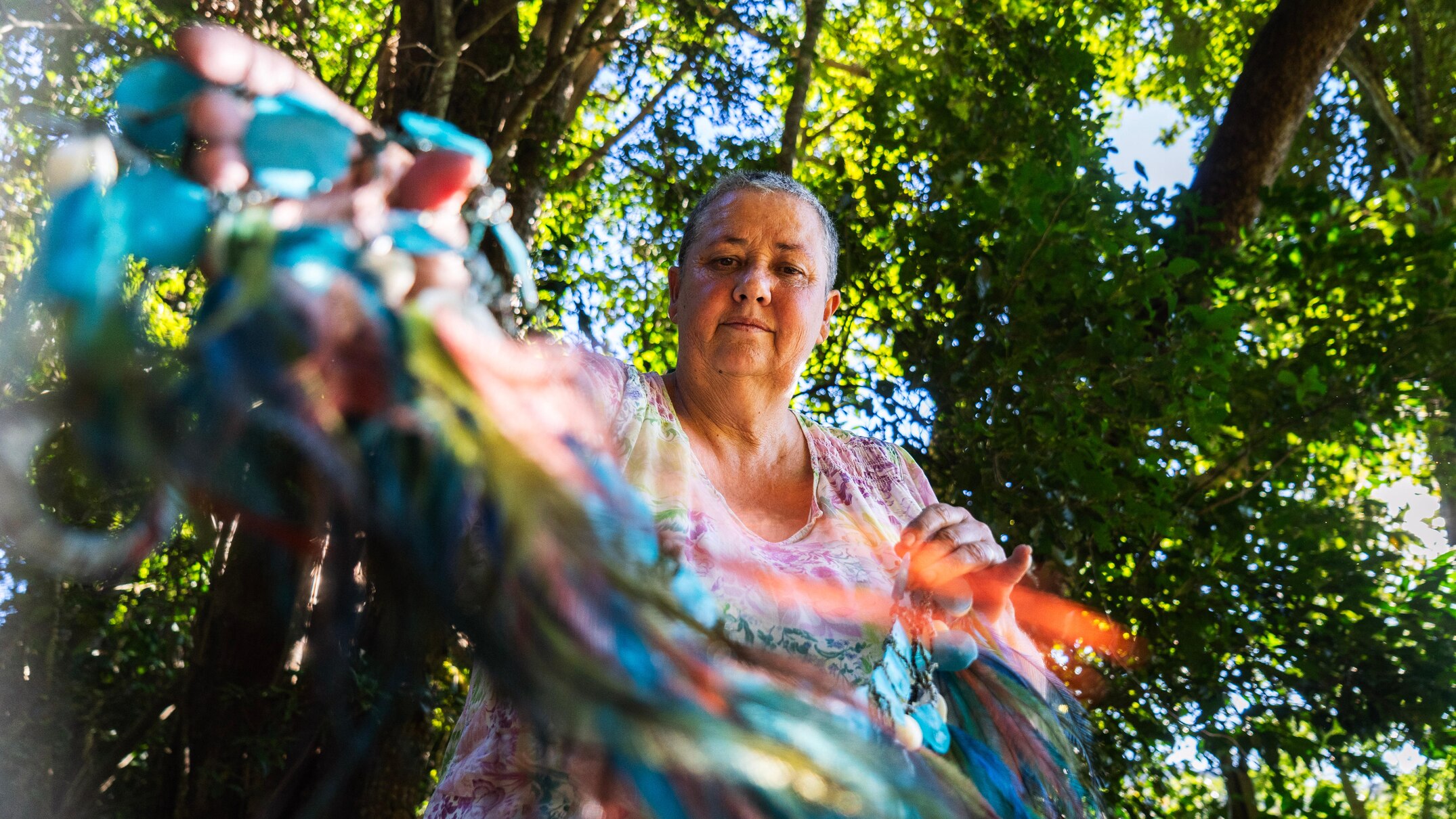
In the sun-drenched Whitsundays, amidst the vibrant hues of her home’s front yard, Felicity Chapman meticulously works on a strip of barramundi skin. With a steady hand, she removes the last vestiges of flesh and sinew, her movements precise and deliberate. “You want to keep the tension really tight, otherwise it just tears,” she explains, her voice calm amidst the focused silence. She deftly switches between a large-handled knife for broader strokes and a scalpel for the finer, more intricate details, a process honed through countless hours of trial and error. Her ultimate aim? To breathe new life into discarded fish skins, transforming them into striking pieces of wearable art. “I work with fish skins that are destined for the garbage bin,” Ms Chapman states, highlighting the remarkable metamorphosis of her chosen medium.
Beyond skin, Ms Chapman also ingeniously repurposes barramundi scales, crafting them into dazzling dance overskirts, elaborate headdresses, and unique jewellery. This dedication to sustainable artistry will be showcased at the upcoming Cairns Indigenous Art Fair, where her collection, aptly named “Skintight,” will be unveiled. The collection features an array of garments, including tops, skirts, and pants, all fashioned from the surprisingly versatile leathers of fish, kangaroo, and crocodile.
Discovering a New Artistic Path
The genesis of Ms Chapman’s innovative approach stemmed from a fundamental challenge: how to transform raw fish skins into a viable material for her artistic vision. “I know that there was preservation [among] Aboriginal and Torres Strait Islanders for kangaroo skins, possum skins, but I couldn’t find anything particularly for fish skins,” she recalls. This knowledge gap presented a significant hurdle.
Adding another layer of complexity, Ms Chapman, as a woman, could not employ the traditional tanning techniques of the Ngaro people in the Whitsundays. To do so would have been a breach of deeply ingrained cultural law. Instead, she sought inspiration from First Nations communities across the globe, particularly those in the Northern Hemisphere. She ingeniously adapted their methods, tailoring them to suit the unique environmental conditions of north Queensland’s humid climate.
“For me, it’s always about caring for country, and through caring for country is reconnecting with culture,” Ms Chapman articulates, her words carrying a profound personal significance. “My parents didn’t allow us to be brought up with our culture. There was a lot of fear about being the next stolen generation. So, for me, it guides everything.” This deeply personal connection to her heritage fuels her artistic endeavours, imbuing each piece with a powerful narrative of reclamation and resilience.
Reimagining Market Waste
The journey of Ms Chapman’s materials begins at a local fish market in nearby Airlie Beach, managed by Callum Patience. It was a chance encounter that sparked this unique collaboration. “It was a random one. Felicity came in one day, and she wanted to know if fish skins were available,” Mr Patience recounts. He revealed that despite the market’s best efforts to utilise all off-cuts, a substantial amount of fish skins – an estimated 20 to 30 kilograms daily – would typically be discarded and end up in landfill.
“So, we give her barramundi skins and coral trout skins, which are normally a by-product that goes into landfill anyway,” he explains. The team at the market has been consistently impressed by Ms Chapman’s innovative work. “Felicity has brought in quite a few different samples for us to have a look at, and she dyes them with different pigments, and it’s quite textural, it’s very strong, it’s quite sturdy,” Mr Patience shares, his admiration evident. “It’s quite amazing the stuff she does.”
The Rising Tide of Biomaterials in Fashion
The burgeoning interest in sustainable and ethically sourced materials is a global trend, and biomaterials are at the forefront of this movement. Kamyar Shirvani Moghaddam, an associate professor in fashion and textiles at RMIT University, views biomaterials as a “unique opportunity” to significantly reduce waste within both the food and textile industries.
Dr. Moghaddam highlights that fish leather is just one of many alternative materials gaining traction in the fashion world. He points to the growing popularity of products derived from mushrooms and pineapples as other examples of this innovative shift. “We are definitely going to see growing interest in alternative and bio-based materials in Australia, especially from consumers who care about sustainability,” he predicts, underscoring the increasing demand for eco-conscious fashion choices.
Honouring Tradition Through Complete Utilisation
For Felicity Chapman, her artistic practice transcends mere fashion design; it is a profound act of cultural reconnection and environmental stewardship. “Art is such a powerful tool to solve problems,” she asserts, her conviction clear. “One of the traditional foundations of all First Nations’ culture is that you fully utilise the resources that you harvest, hunt, gather. We have very little waste traditionally. So it’s trying to go back to that practice of ‘how do we utilise everything?’” This philosophy, rooted in the ancestral wisdom of minimising waste and maximising resourcefulness, guides her every creation, transforming discarded materials into powerful statements of cultural heritage and a sustainable future.



Leave a Reply