The Rise of “Brain Rot” and the Fight to Reclaim Attention Spans
In today’s digital age, the concept of “brain rot” has taken on a new meaning. Once a term used to describe the mental decline associated with excessive consumption of trivial content, it now represents a growing concern among parents and educators. Young children like nine-year-old Anaqi are increasingly exposed to short, engaging videos that appear automatically on their screens, capturing their attention with flashy visuals and rapid transitions. These videos, often blamed for eroding attention spans, have become a common part of daily life for many young users.
Firdaus Omar, a Malaysian civil servant and father of two, is one of many parents worried about the impact of such content on his children. He noticed that his sons, Anaqi and his six-year-old brother, struggle with focus and fine motor skills after spending too much time watching these short-form videos. “If they watch for too long, they struggle to focus,” he said. “Writing becomes difficult. Even lifting heavier things becomes difficult.”
This concern has led to a broader discussion about how digital media is shaping the way children learn and interact with the world. In 2024, Oxford University Press named “brain rot” its word of the year, highlighting the growing anxiety around the effects of online content on cognitive development. The term saw a 230% increase in usage between 2023 and 2024, as younger users began using it more frequently, often in a half-joking manner.
BookXcess’ Innovative Approach
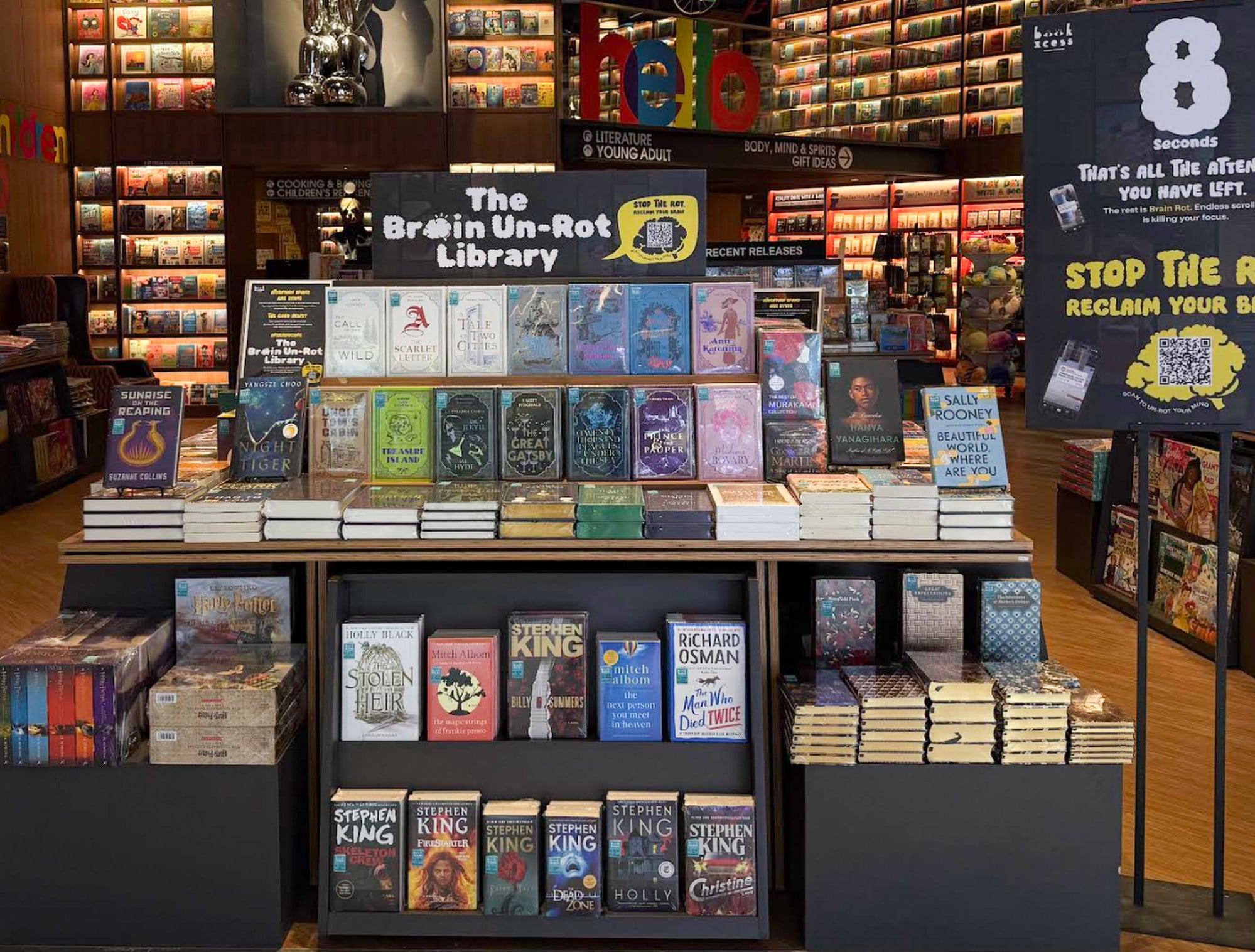
In response to this challenge, a local bookshop in Kuala Lumpur, BookXcess, has launched a unique campaign called the “Brain Un-Rot Library.” This initiative aims to counteract the negative effects of short-form content by turning 100 books into TikTok videos that mimic the format of the very videos parents fear. The idea is to catch viewers’ attention with the same style of content they are already used to, then gradually transition them toward longer texts and, ultimately, physical books.
The campaign features a mix of classic and modern titles, including well-known works like Animal Farm, Wuthering Heights, and 1984, as well as newer hits such as The Hunger Games and Foul Lady Fortune. These videos will be rolled out on TikTok over the next few weeks, while “Brain Un-Rot Islands” featuring the same titles will also appear in BookXcess stores nationwide.
Jacqueline Ng, co-founder and executive director of BookXcess, emphasized that the goal is not to eliminate social media use but to introduce a new habit. “We’re not trying to take them away from social media or from their phone,” she explained. “We’re just trying to introduce another habit.”
The Role of Social Media in Reading Trends
TikTok has emerged as a powerful force in the book industry, with #BookTok posts generating millions of views and driving significant sales. According to data from TikTok, there were nearly 53 million #BookTok posts globally in 2024, and about 59 million print book sales could be tied to BookTok-related creators or content. In Europe alone, #BookTok helped sell over 50 million books in 2025, generating 800 million euros in revenue.
Despite these positive trends, Malaysia’s reading habits remain mixed. A 2022/2023 report by the National Library found that Malaysians read an average of 24 books per year, up from just two in 2005. However, a 2025 survey of 1,168 primary and secondary school students revealed a gap between reading for school and reading for pleasure. More than a quarter of students said they did not read as a hobby, and nearly one in three had fewer than 10 books at home.
The Challenge of Attention and Focus
While the rise of short-form video content has sparked concerns about attention spans, experts caution against oversimplifying the issue. Stijn Massar, a research assistant professor at the National University of Singapore, noted that while people may be less tolerant of boredom, attention itself is not a single entity. Short-form videos excel at training what he calls “bottom-up attention”—a reflexive type of focus driven by visuals and sounds. In contrast, reading and other slower forms of concentration rely on “top-down attention,” which requires deliberate focus and sustained effort.
Catherine Lee, an associate professor at Sunway University, observed similar patterns among her students. “They don’t come in with books. They come in with their smartphone,” she said. However, she stressed that this does not mean students have stopped reading; rather, they now access information differently. Social media, she argued, has become a gateway to reading, not just a distraction.

Building Safer Online Habits
To address these challenges, TikTok has launched the #ThinkTwice Training program in Malaysia. This initiative includes workshops for parents, educators, and creators aimed at promoting safer and more informed online habits. The program expands the wider #ThinkTwice initiative, which has already generated 26.2 million views on educational safety content and attracted around 300,000 visits to its resource hub in Malaysia.
BookXcess’ Ng sees the “Brain Un-Rot Library” as a nudge rather than a cure. “It’s not either/or,” she said. “It’s not like you either are on social media or you read.” The company is working to bridge the gap between digital and physical reading, helping users rediscover the value of immersion and deep engagement.
“At least there’s no notification that comes through the book,” she added. “If you hold a book and just want your ‘me time’ for that half an hour, you actually can have a very meaningful half an hour because you are holding a book and not your phone.”