Rising Trend of Bench Warrants
Courts have been increasingly issuing bench warrants on their own authority, with annual figures showing a steady rise. As prosecutors file more non-detention indictments and defendants or witnesses fail to respond to summonses, courts are directly intervening to secure custody. Legal experts predict that if the prosecution’s right to supplementary investigations is abolished, poor investigations will increase, leading to more cases where judges issue warrants for defendants during trials.
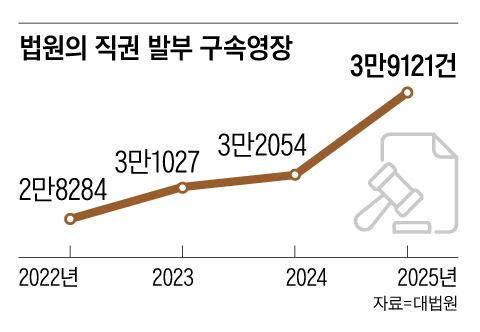
Judges issue detention or arrest warrants ex officio when sentencing non-detained defendants to prison terms or when defendants or witnesses fail to appear in court. According to court statistics, the number of bench warrants issued by judges last year reached 39,121 cases, the highest in nine years. The figure, which stood at 35,420 cases in 2017, has fluctuated annually but has risen steadily since 2022 (28,284 cases), increasing to 31,027 cases in 2023 and 32,054 cases in 2024. Approximately half of these cases involve judges sentencing non-detained defendants to prison terms and detaining them in court. The number of such detentions also grew from 13,354 people in 2022 to 15,561 people in 2023 and 15,818 people in 2024.
Factors Contributing to the Increase
The growing trend of courts directly issuing bench warrants is attributed to “poor investigations” by law enforcement. Legal experts argue that the 2021 adjustment of investigative powers between prosecutors and police, followed by the recent separation of investigation and prosecution, has destabilized the criminal justice system and increased poor investigations. This is compounded by heightened emphasis on suspects’ defense rights and a spreading disregard for the law.
The number of non-detained suspects in criminal cases rose from approximately 250,000 people in 2022—the year after the investigative power adjustment—to between 270,000 and 280,000 people annually from 2023 to 2025. A current deputy prosecutor stated, “The disappearance of the system where prosecutors directed and supplemented police investigations has led to poorer police work. In cases led by police, courts often need to re-examine evidence during trials, and judges frequently issue bench warrants for defendants in the process.”
Cases where defendants openly refuse trials or fail to appear, leading to detention, are also increasing. YouTuber A, charged with defamation and threats for uploading a video alleging that Tzuyang worked at an adult entertainment establishment, did not appear at the first trial last month. Former Seongnam Urban Development Corporation head Yoo Dong-gyu, summoned as a witness on June 18 for the trial of former Democratic Party of Korea Chief of Staff Jeong Jin-sang’s Daejang-dong development corruption case, also failed to appear, prompting a judge to issue a warrant.
Judicial Responses to Non-Appearance
As such cases multiply, the Supreme Court has allowed trials to proceed without defendant statements if they fail to appear without just cause starting in the second half of this year. If defendants do not appear on the final adjudication date, courts may issue default judgments. The Busan High Court decided to proceed with the trial of B, the perpetrator in the “Busan roundhouse kick” case, who was additionally charged with retaliatory threats against a victim, even if he does not appear on the scheduled date of July 22, after he missed two prior hearings.
Subscription Offers for Readers
For readers interested in accessing more content, there are several subscription options available. A monthly membership costs 5,900 won, while newspaper readers can enjoy it for 2,900 won. The Chosun Membership offers access to 8 kinds of newspapers and magazines worth up to 55,000 won. Additionally, members can receive 7,000 points that can be used like cash for shopping.