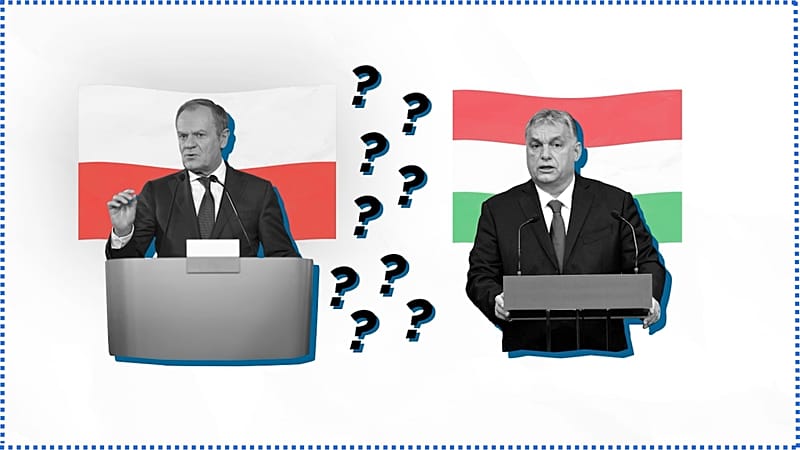
Shifting Alliances: The Fractured Friendship Between Poland and Hungary
Once heralded as the formidable duo of Central Europe, the political alliance between Poland and Hungary has spectacularly fractured, leaving a trail of suspicion and acrimony. For years, under the previous Law and Justice (PiS) administration in Warsaw, Poland and Hungary maintained an almost inseparable bond. This partnership served as a crucial shield, allowing both nations to deflect and mitigate penalties imposed by the European Union. However, the landscape of European geopolitics shifted dramatically with Russia’s full-scale invasion of Ukraine in early 2022, creating a profound chasm between the two former allies.
Poland, under its previous government, emerged as one of Ukraine’s most vocal and unwavering champions, providing significant support and advocating for robust international action against Russia. In stark contrast, Hungarian Prime Minister Viktor Orbán maintained a markedly different stance, notably refusing to sever crucial ties with Russian President Vladimir Putin. This divergence in foreign policy, particularly concerning Russia’s aggression, deepened the rift between Warsaw and Budapest. The disagreement became so pronounced that even Jarosław Kaczyński, the influential conservative leader of Poland’s PiS party, publicly admonished Orbán, urging him to confront the reality of Russian atrocities.
The situation has since escalated, transforming the once-close relationship into a considerably more toxic dynamic. Hungary has, in recent times, reportedly become a refuge for Polish politicians associated with the former PiS government, individuals now seeking to evade legal repercussions under the new, pro-EU administration led by Prime Minister Donald Tusk. Among those reportedly finding sanctuary in Hungary is Zbigniew Ziobro, Poland’s former Justice Minister, who is allegedly seeking to avoid facing 26 criminal charges related to corruption and abuse of power.
The diplomatic ties between Warsaw and Budapest suffered a near-complete derailment recently following alarming reports. These allegations suggest that Hungary’s Foreign Minister may have been involved in leaking sensitive details of European Union meetings to Moscow. Such revelations prompted Prime Minister Tusk to publicly acknowledge that Warsaw had harbored suspicions of such a betrayal for an extended period.
This ongoing conflict is now not only straining international relations but is also creating significant internal divisions within Poland itself. President Karol Nawrocki, whose political alignment is often described as aligned with the “Make America Great Again” (MAGA) movement, has openly defied the pro-EU stance of Prime Minister Tusk. Nawrocki’s decision to travel to Budapest and stand alongside Prime Minister Orbán, particularly in the lead-up to the crucial April 12 elections in Hungary, underscores the deepening political polarization.
This dramatic turn of events represents a tragic historical irony. Historically, Poland and Hungary have shared deep cultural and political connections. In the late Middle Ages, the two nations were even linked by shared monarchs, such as Louis the Great and Stephen Báthory, who ruled over both kingdoms. For centuries, these two nations navigated the challenges of surviving powerful empires, enduring the devastation of world wars, and living under communist regimes, often in solidarity.
However, it appears that contemporary geopolitical alignments and the persistent influence of Russia are now severing a bond that was long defined by the enduring proverb: “Pole and Hungarian, two good friends, together for the sword and the wine.” This old adage, symbolizing a historical camaraderie forged through shared struggles and mutual support, now serves as a poignant reminder of a partnership that has seemingly succumbed to the pressures of modern political realities and diverging national interests. The once-unshakeable alliance has dissolved, replaced by suspicion, political maneuvering, and a stark divergence in their approaches to regional security and international relations.