Europe’s Shifting Stance on China: Navigating Trade Tensions and Strategic Realignment
European capitals are demonstrating a noticeable shift towards a more accommodating approach to China, a recalibration largely driven by escalating trade and geopolitical tensions with the United States. While the European Union maintains that conditions for a formal trade deal remain unmet, overtures from Beijing are finding increasingly receptive ears across the continent.
German Chancellor Friedrich Merz recently articulated a vision that includes the possibility of a future trade agreement with China. Speaking in the German parliament, Merz stated, “We have set quite a lot in motion when it comes to trade policy. I can also envisage further agreements, for example, in the longer term an agreement with the People’s Republic of China.” These remarks, made shortly after his inaugural visit to China as Chancellor, suggest that China’s sustained outreach for a trade pact with the 27-member bloc has yielded positive reception in some European quarters.
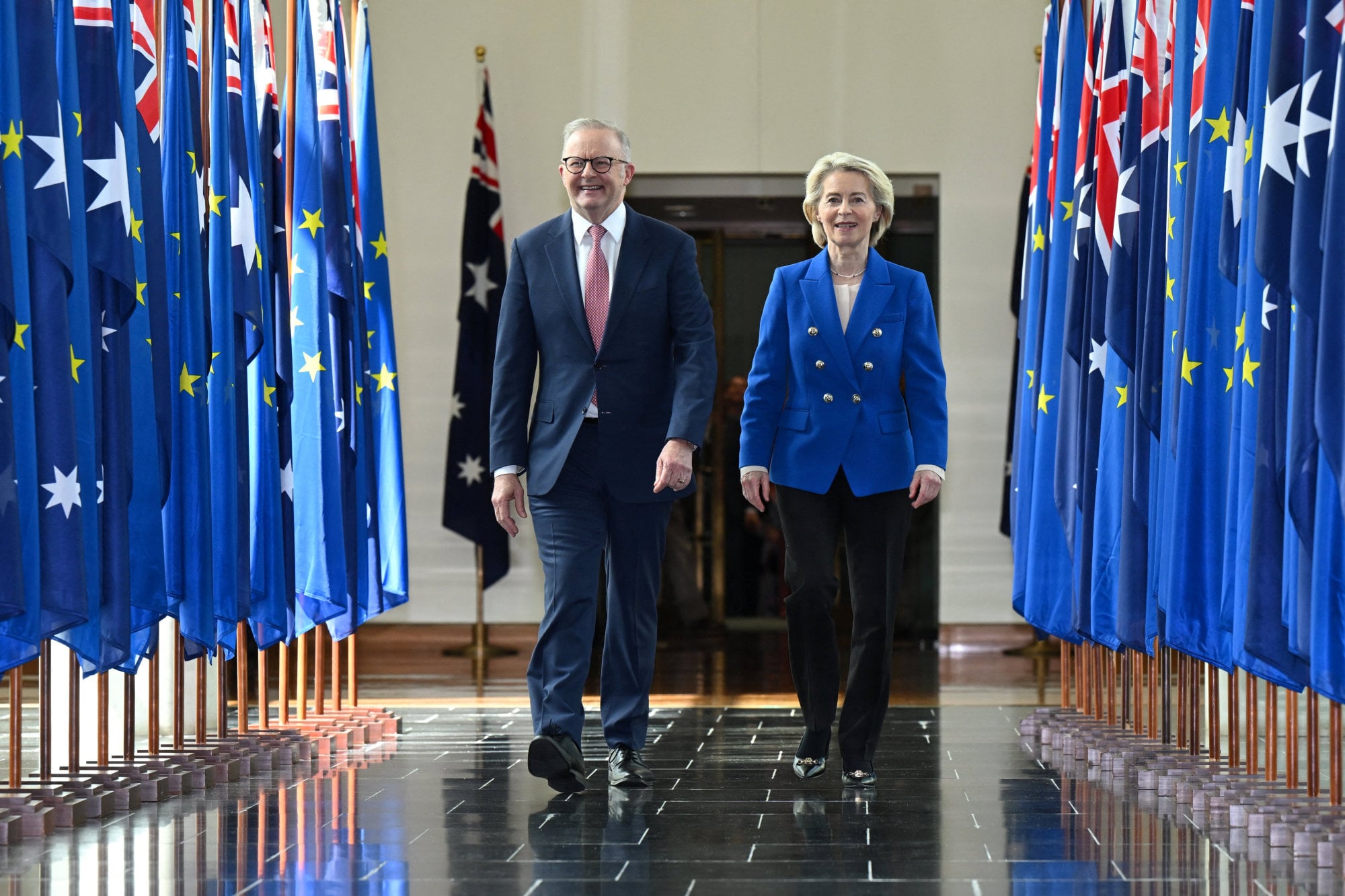
Merz emphasized the imperative for “strategic partnerships around the world in order to strengthen ourselves, especially our exports,” a sentiment that emerged in the context of a recently agreed trade deal between the EU and Australia. This underscores a broader European strategy to diversify economic relationships and bolster export capabilities in the face of global economic uncertainties.
Underlying Concerns and EU’s Position
Despite these evolving sentiments, official channels within Brussels indicate no immediate plans to initiate free-trade negotiations with China. The EU’s primary concern remains the resolution of existing trade imbalances and disputes. European officials have consistently voiced grievances regarding the opacity of China’s state subsidies, which they argue lead to industrial overcapacity and a surge of competitively priced exports flooding European markets. Furthermore, Beijing’s imposition of export controls on rare earth materials last year has acted as a significant impediment to bilateral relations.
European Commission President Ursula von der Leyen, in a recent address in Australia, articulated the bloc’s unease: “The bloc ‘cannot and will not absorb China’s export-led growth model and its industrial overcapacity.’ Both the threat to our supply-chain security and the shock to our industrial base need urgent responses.” Data further illustrates the growing trade imbalance, with China’s trade surplus with the EU expanding significantly in early 2026 compared to the previous year. For Germany, this surplus saw a dramatic increase of 139 percent.
Noah Barkin, an analyst specializing in EU-China relations at the Rhodium Group, described Merz’s comments as “quite a stunning statement.” He noted that Beijing’s push for a free-trade agreement with the EU is primarily aimed at maintaining access to European markets for its goods, while the Chinese market is increasingly becoming less accessible to EU and particularly German exports due to explicit import substitution policies.
Diplomatic Engagements and Shifting Alliances
The diplomatic landscape has also witnessed significant developments. Wednesday saw a flurry of engagements between China and the new Dutch government. A call between Premier Li Qiang and Prime Minister Rob Jetten, along with a meeting of their respective trade ministers on the sidelines of the World Trade Organization’s ministerial conference in Cameroon, marked a notable step. The sight of Dutch trade chief Sjoerd Sjoerdsma engaging cordially with Chinese Commerce Minister Wang Wentao was particularly noteworthy, given that Sjoerdsma had been under Beijing’s sanctions since 2021. These sanctions were imposed after he spearheaded a parliamentary proposal labeling China’s treatment of its Uyghur minority as “genocide.” Sjoerdsma’s subsequent plans to visit Beijing for trade talks suggest a de-escalation of these punitive measures.
“Had a constructive conversation with Chinese Minister Wang Wentao at #WTOMC14,” Sjoerdsma posted on social media. “We discussed our strong trade & investment partnership and WTO reforms. We agreed to hold economic and trade consultations in China soon, I will use this opportunity to lead a trade mission there.”
EU trade chief Maros Sefcovic was also scheduled to meet his Chinese counterpart at the same event, where he was expected to raise a range of concerns regarding commercial ties. This engagement, described as a “stocktake” meeting, is part of a series of recent EU-China interactions. Earlier in the week, the bloc’s top trade enforcer, Denis Redonnet, visited Beijing for negotiations on export controls, and a delegation from the People’s Liberation Army met with EU defense officials in Brussels. However, detailed trade deal discussions were not anticipated.
Lithuania’s Pivot: A Reassessment of Taiwan Relations
Even within traditionally more assertive European stances towards Beijing, signs of a thaw are emerging. Lithuania’s Prime Minister Inga Ruginiene publicly acknowledged that the Baltic state had gained “exactly zero benefit” from its engagement with Taiwan, while experiencing “a significant negative one” from China following the establishment of a Taiwanese diplomatic presence in Vilnius under the previous administration.
“The main mistake was made when we rushed ahead… and established an office under a name that no one else in the EU had used until now, thus finally severing all, even business, relations with China,” Ruginiene stated. She elaborated that this policy yielded no benefits from Taiwan and significant disadvantages from China.
The opening of the Taiwanese Representative Office in 2021, using a name that diverged from the standard “Taipei Economic and Trade Offices” used elsewhere in Europe, triggered a strong reaction from Beijing. China responded by removing Lithuania from its customs system, effectively halting Lithuanian exports, expelling its ambassador, and recalling its own envoy.
However, Lithuanian President Gitanas Nauseda has recently downplayed the likelihood of the office’s name being changed, suggesting that the issue was resolved years ago. He characterized the situation as a strategic move for Taiwan and acknowledged China’s reaction, but indicated that Lithuania is not prepared to capitulate to “ultimate demands under any conditions.” Any alteration to the office’s name, he stressed, would require mutual agreement between Lithuania and Taiwan.
It is understood that the current Lithuanian government is dissatisfied with Taiwan’s perceived failure to fulfill investment commitments made around the time the representative office was established. While Taipei announced substantial funds for investment in Lithuanian industry and business projects, the actual capital inflow has reportedly been significantly lower than pledged. Sources close to Taipei have cited challenges in directing private sector investment due to a lack of concrete opportunities and the Lithuanian government’s inability to dictate capital allocation.
Vilius Kriauciunas, chief political and economic adviser of the Lithuanian Business Confederation, commented on the discrepancy, stating, “Our job is not to question Lithuanian foreign policy. We would like to remind Taiwan that they promised to invest US$1 billion, but they put in 1 or 2 percent. When we talk about solidarity and values, keeping your promises is one of the main values.”