Kathmandu, May 17 — The Nepali Congress, Nepal’s long-standing political party, is facing internal challenges.
Following the Supreme Court’s acknowledgment of the Gagan Thapa group as the official Nepali Congress on April 17, it seemed the internal conflict within the party had come to an end. However, this has not been true. Various attempts to maintain unity within Congress are not producing any success, according to party officials.
Concluding a three-month conflict regarding the party’s validity, the Supreme Court officially acknowledged Thapa’s Congress last month, enabling opposing groups to conduct simultaneous activities throughout the nation.
The party is moving towards a division, stated former vice president Purna Bahadur Khadka, who is spearheading the faction of dissenting voices within the party. This group has been conducting alternative initiatives and exerting pressure on the Thapa-led Congress, claiming that Thapa has not succeeded in becoming the party’s president.
A person affiliated with the Thapa faction informed the Post that the Khadka group is prepared to establish a new political party on May 29, which falls on Republic Day.
In pursuit of party unification, the Khadka faction insisted that the current central working committee headed by Thapa be dissolved and a new one established to organize the party’s 15th general convention.
The camp also suggested that the party’s central committee should be formed with representatives from both factions. It further called for the 15th general convention of the party to be held under the guidance of Sher Bahadur Deuba, by dissolving the current central committee headed by Thapa.
Deuba, who served as the party’s leader until mid-January, is currently residing in Hong Kong following the current administration issuing an arrest warrant for him and his spouse in connection with a money laundering investigation.
At a gathering in Surkhet on Saturday, Khadka mentioned that the Nepali Congress experienced a division because of Girija Prasad Koirala, and also credited him with the party’s eventual reunification. After the split, another leader of the Nepali Congress, Sher Bahadur Deuba, who was then the prime minister, established the Nepali Congress (Democratic) in 2002. Referring to this, Khadka noted that currently, it is entirely up to President Thapa to decide whether to bring the party together or keep it divided.
Khadka stated that he had shared the same opinion a few days prior while engaging in talks with Thapa and the party’s Vice President Bishwa Prakash Sharma.
The party is on the brink of splitting, a route I have stated we should avoid,” Khadka said, remembering his discussion with Thapa. “Whether to merge or separate the party is your [Thapa’s] duty.
Khadka stated, “Following the Supreme Court’s validation of the Thapa-led Congress after the Special Convention, I requested him [Thapa] to take on the role of president for all Congress leaders and members.”
The current dissatisfaction within the party arose when Thapa, along with another leader named Sharma, convened a special meeting of the party in January. The gathering elected Thapa as the party’s president, removing Deuba, who had been at the helm since March 2016.
To address the internal conflict, Thapa provided tickets to certain senior members of the Deuba-Khadka group as well as to another group headed by Shekhar Koirala for the March election. Regarded as a “problem solver,” the Koirala faction has not succeeded in uniting the two groups for party consolidation.
Thapa’s initiatives before the election were unable to bridge the divide between the two groups. Rather, the Deuba-Khadka group continued to urge the Thapa faction towards a dignified party reconciliation.
Although there have been secret conversations and talks, Congress leaders state that no advancement has been made in uniting the two factions thus far. In recent weeks, both sides have been holding separate events across all provinces.
The Deuba-Khadka faction is now aiming to establish a new contact office and is searching for a rental property, according to a leader. “In the end, this will serve as our new party headquarters if the groups do not come together,” the leader mentioned.
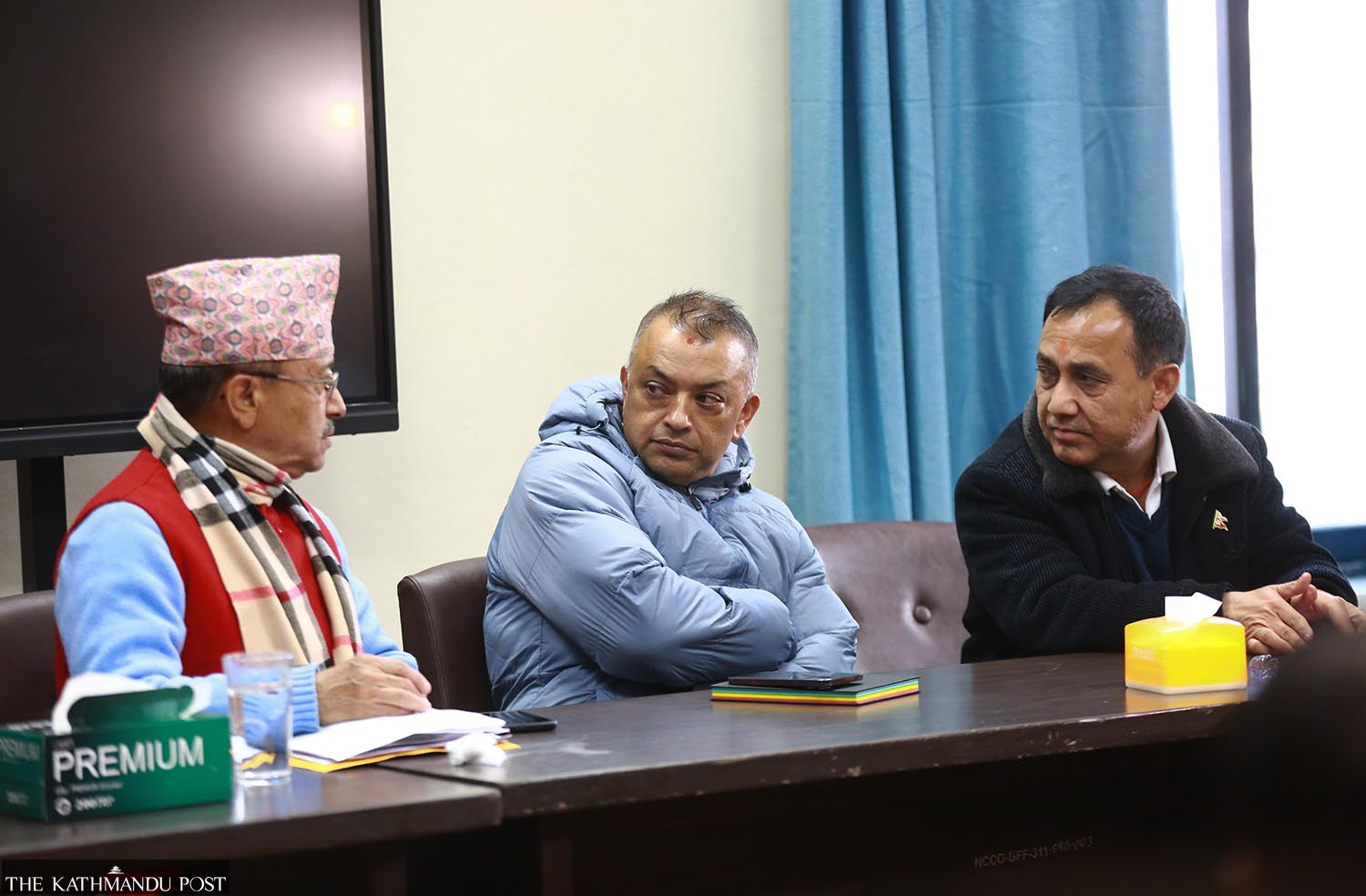
Recently, Thapa met with Khadka and talked about a plan to maintain the party’s cohesion. Thapa also had a comparable discussion with Koirala, who is said to be somewhat favorable and lenient towards Thapa. “The responsibility rests with Thapa, and he needs to present a proposal for party unity,” Koirala stated to the Post. “I am willing to give up anything for the sake of party unity.”
The current point of conflict is the Khadka faction’s request to establish an organizing committee for the party’s 15th general convention. Thapa is reportedly not in favor of this request. There is also disagreement within the Congress about the allocation and reallocation of active party members. The Khadka group has rejected the current distribution system.
Furthermore, the recent selection of 19 Congress leaders as members of the central working committee has also intensified the conflict within the Congress.
Sharma, the party’s vice president, acknowledges the existence of conflict and division within the party, yet contends that “there are specific approaches that can be used to achieve party unity.”
Each party has its own distinct approach for settling the conflict,” Sharma stated. “Initiatives are being made to bridge the divide.
The Khadka camp has also accused the Thapa-led Congress of being responsible for the party’s disgraceful loss in the March election. The Congress was left with 38 seats in the vote where the Rastriya Swatantra Party nearly achieved a two-thirds majority.
A Congress party member, NP Saud, who previously served as the foreign minister, mentioned that there is a slight possibility of party unity at present.
The manner in which both sides are conducting parallel demonstrations of power makes me question the likelihood of party unity at this time,” Saud stated. “I am unsure where these separate meetings will lead us.