Concerns Over U.S. Approach to Chinese Intellectual Property
A former high-ranking intelligence official has raised significant concerns about the approach taken by the U.S. government towards intellectual property issues with China, particularly in the context of President Donald Trump’s interactions with Chinese leader Xi Jinping.
Sue Gordon, who previously served as deputy director of national intelligence during Trump’s first term, has voiced her worries regarding the president’s perceived indifference to the issue of American intellectual property being stolen by Chinese companies. In an interview with MS NOW’s Nicolle Wallace, she expressed her concern over the president’s comments on the matter.
Gordon highlighted that Trump had stated, “We do things, and they do things, and that’s the way it is,” when discussing protections for U.S. companies. She pointed out that Trump added, “I’d like to see it taken care of. But they’ve been doing that for 50 years.”
Gordon, who resigned from her position on August 9, 2019, after being passed over for the role of national intelligence director, emphasized that the president was incorrect in his assessment. She explained that the U.S. has traditionally maintained a clear boundary between its government and private sector. However, she questioned whether this distinction still holds true during Trump’s second term.
In response to Wallace’s inquiry, Gordon remarked, “Well, I guess, it’s a great point – thanks for depressing me even further today.” She went on to assert that there is indeed a difference. “On one level, spying is what, a really old profession, and it has been one of the great tools of strategic advantage for nations, nations worldwide for the longest time since Gettysburg and before that. But we are a nation of laws, and I’ve lived in this world, and I haven’t seen that those laws have gone away, and they do.”
She continued, “They do create boundaries, and also just intellectually, we have had a bright line between what I’m going to call civilian casualties, even that to include economic casualty, and there just is, you know, we we don’t go trooping into Chinese companies and steal their intellectual property. We just, that isn’t for the same reason we don’t go trooping into our companies and steal intellectual property. So he’s wrong about that.”
Gordon argued that Chinese law is fundamentally different when it comes to intellectual property. “There is a difference, and probably the most concrete difference is that they have national security laws that insist that every Chinese citizen or company, when asked, must provide their information that they have of any data of somebody else’s that goes through, and we don’t – that isn’t our law, so it isn’t the same,” she said. “I reject the notion that it’s the same. Now, if it’s being done differently by some people and it hasn’t been discovered yet, but just intellectually, it’s a different thing.”
She concluded by noting the impact of these actions on U.S. relationships with allies and partners. “That’s exactly the impact with our allies and partners,” she added. “It’s like we’ve changed sides.”
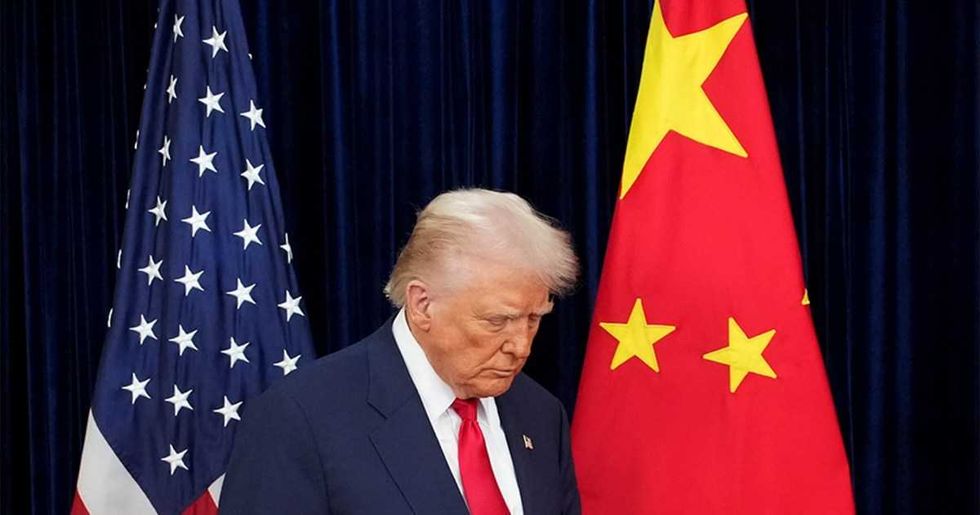
The Broader Implications of the Trump-Xi Summit
The concerns raised by Sue Gordon extend beyond the immediate issue of intellectual property. They reflect a broader apprehension about the implications of the Trump-Xi summit and the potential consequences for U.S. global standing.
Gordon, a former principal deputy director of national intelligence, has highlighted the severity of the situation, suggesting that the actions taken by the U.S. government could have far-reaching effects on international relations. Her comments underscore the need for a more robust and principled approach to dealing with China, especially given the complexities of modern geopolitics.
The summit between Trump and Xi Jinping has drawn considerable attention, not only for the diplomatic discussions but also for the underlying tensions that exist between the two nations. As the U.S. navigates its relationship with China, the importance of maintaining clear boundaries and upholding the rule of law becomes increasingly evident.
In addition to the concerns raised by Gordon, there are other reports that highlight the challenges faced by the U.S. in its dealings with China. These include allegations of cyber attacks and the potential for espionage, which further complicate the already delicate relationship between the two countries.
As the U.S. continues to grapple with these issues, the need for a coherent and consistent strategy becomes paramount. The lessons learned from past interactions with China must inform future decisions, ensuring that the U.S. maintains its position as a leader in the global arena while safeguarding its interests and values.