The Escalation of the Morocco–Senegal AFCON Dispute
What began as a chaotic Africa Cup of Nations final in Casablanca has since widened into a cross-border dispute involving CAF rulings, appeals, fan arrests, boycott calls, and an ongoing case at the Court of Arbitration for Sport. This timeline traces how a match Senegal won on the field was later overturned in Morocco’s favor, and how the fallout moved from the pitch into courtrooms, federations, and politics.
April 8 — CNDH: AFCON Final Rioters Subject to ‘Fair Trial’
The Moroccan National Council on Human Rights (CNDH) stated that its monitoring of the Senegalese rioters’ trial shows “no rights violations,” assuring all defendants are subject to a fair trial that meets all necessary standards.
April 7 — CAF Head on Official Visit to Senegal
Patrice Motsepe is set to travel to Senegal on Wednesday for an official visit, to hold talks with President Bassirou Diomaye Faye and meet officials from the Senegalese Football Federation, to monitor developments in the final CAF ruling.
April 6 — Case Drifts Into Legal Limbo
With no ruling from the Court of Arbitration for Sport and no timetable set, the dispute moved into an open-ended holding pattern. A Sports Village Square analysis described the case as being in “legal limbo,” citing conflicting accounts from both federations and from officials linked to CAF’s referee structures.
Senegal’s football federation said on Monday its Africa Cup of Nations title was not under legal threat, despite a CAF appeals ruling that awarded Morocco a 3 to 0 victory in the final and recorded Senegal as having lost by withdrawal.
April 5 — New Claims Intensify Final Dispute
Goal.com reported allegations that Senegalese players did not comply with post-match doping control procedures after the final. The same day, Le Monde reported, citing a memorandum submitted by Morocco’s football federation during a February CAF executive committee meeting, that referee Jean Jacques Ndala Ngambo had received “institutional instructions” not to issue further cards to Senegal players during the match, with the stated aim of preserving the game.
Late March to Early April — Jailed Fans Turn Row Political
Eighteen Senegalese supporters who attended the final in Rabat were tried in Morocco and sentenced to prison terms of up to one year for hooliganism. Senegal’s football federation protested the verdicts, while demonstrators in Dakar described the detained supporters as “hostages.” Calls for a consumer boycott of Moroccan goods and services also gathered momentum. Senegalese Prime Minister Ousmane Sonko said the affair appeared to go beyond sport and called it regrettable for two friendly nations. The supporters’ appeal hearing was postponed twice and reset for April 13, 2026.
March 29 — Legal Positions Harden as CAS Waits
The African Committee for Sports Ethics and Deontology said it expected CAS to confirm Morocco’s title, citing the wording of Article 84, while CAF’s own appeals ruling had already applied that provision to award Morocco a 3 to 0 win and dismiss all other requests.
CAF president Patrice Motsepe told reporters the confederation would respect whatever CAS decided, declining to comment further on the substance of the case while proceedings were under way.
March 28 — Senegal Defies CAF with Paris Trophy Parade
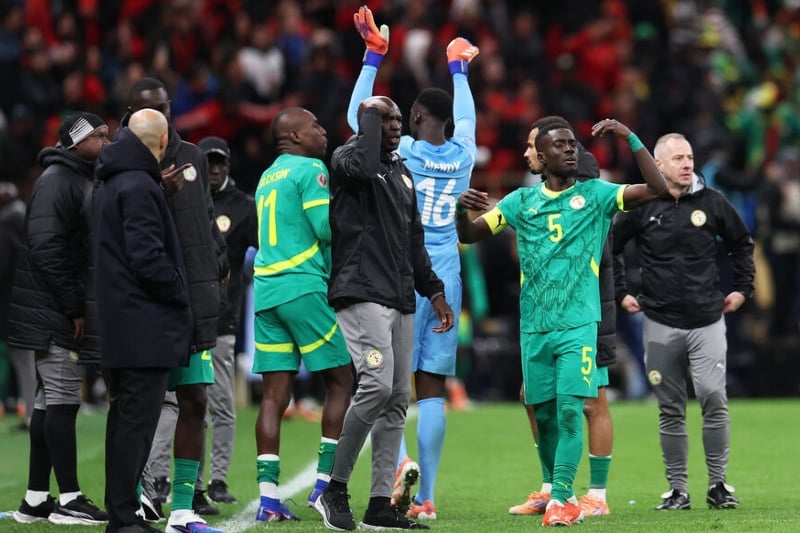
Senegal captain Kalidou Koulibaly and his teammates carried the AFCON trophy onto the Stade de France pitch before a friendly against Peru on March 28 in a show of defiance after CAF’s ruling. Two days earlier in Paris, Senegal football federation president Abdoulaye Fall had described the decision as “the most grossly unfair administrative robbery” in football history.
The federation also said Senegal’s World Cup jersey had initially kept one star because production began in August 2025, although later reports said a second star had since appeared on other versions of the kit.
March 25 — CAS Formally Registers Senegal’s Appeal
CAS confirmed that it had registered the Senegalese Football Federation’s appeal against both CAF and the Moroccan federation under case number CAS 2026/A/12295. Senegal requested a suspension of procedural deadlines until it received the full CAF decision and its reasoning.
CAS said it would appoint an arbitration panel but did not set a hearing schedule. Morocco, for its part, said the matter was settled on its side and that the title stood.
March 18 — Morocco Hails Ruling as Senegal Reels
CAF’s appeals decision on March 17 awarding Morocco a 3 to 0 victory in the AFCON final prompted celebratory reactions in Moroccan media and public discourse. In Senegal, the federation rejected the ruling and criticism quickly mounted, setting off a broader wave of political and public backlash in the days that followed.
March 17 — CAF Appeals Board Awards Title to Morocco
Fifty-eight days after the final, CAF’s appeals board upheld Morocco’s appeal. Citing Articles 82 and 84 of the Africa Cup of Nations regulations, it ruled that Senegal’s walkoff amounted to an automatic withdrawal regardless of the players’ later return to the field and completion of the match.
The board also said the original disciplinary body had erred procedurally by failing to properly hear Senegal on the forfeit issue. The certified result was amended to Morocco 3, Senegal 0, and Morocco was declared AFCON 2025 champion.
February 13 — CAF Meeting Note Adds to Morocco’s Case
At a CAF executive committee meeting in Dar es Salaam, remarks later attributed to Olivier Savary, head of CAF’s referees committee, said referee Jean Jacques Ndala Ngambo had received “institutional instructions” during the stoppage not to caution returning Senegalese players, in order to “preserve the match,” according to a 40-page memorandum submitted by FRMF secretary general Tarik Najm as part of Morocco’s appeal.
Early February — Morocco Takes Forfeit Case to Appeals Board
After CAF’s disciplinary board rejected Morocco’s protest over alleged Senegal violations of Articles 82 and 84 of the AFCON regulations, the Moroccan federation said on February 3 that it would appeal to CAF’s appeals board. Rabat argued that Senegal’s conduct should have triggered the competition’s forfeit provisions rather than being treated only as a disciplinary matter.
January 28 — CAF Sanctions Both Sides But Leaves Title in Place
CAF’s disciplinary commission sanctioned both federations after the final but did not alter the result, leaving Senegal in possession of the title. Senegal was fined a total of $615,000, including $300,000 for supporter misconduct, $300,000 for unsporting conduct, and $15,000 for team violations. Coach Pape Thiaw received a five-match ban and a $100,000 fine for inciting the walkoff, while Iliman Ndiaye and Ismaila Sarr were each suspended for two CAF matches.
Morocco was fined $315,000 for ball boy delays, laser use by supporters, and player behavior around the VAR area, while Achraf Hakimi was suspended for two matches. Morocco immediately said it would appeal, arguing the sanctions did not reflect the gravity of the walkoff and that the incident should have been treated as a forfeit under the competition rules.
January 19 — Player Illness Fuels Poisoning Rumors
Krepin Diatta, Pape Matar Sarr, and Ousseynou Niang were taken to hospital after falling ill around the final. Reports on January 20 said Niang had been discharged by the next morning, while Diatta and Sarr remained under observation. No public medical cause was established.
On January 25, French sports doctor Jean Pierre de Mondenard published a note saying three Senegal players had suffered “serious” health episodes before or during the final and used the phrase “doping to lose.”
January 18 — AFCON Final Descends Into Walkoff Chaos
Morocco hosted Senegal in the AFCON 2025 final at the Grand Stade de Casablanca. Before kickoff, three Senegal players, Krepin Diatta, Pape Matar Sarr, and Ousseynou Niang, were withdrawn or fell ill during the warmup and were taken to Mohammed VI University Hospital in Rabat. In stoppage time, referee Jean Jacques Ndala Ngambo disallowed what appeared to be a valid Senegal goal scored by Ismaila Sarr.
Three minutes later, after a VAR review, he awarded Morocco a penalty for a foul by El Hadji Malick Diouf on Brahim Diaz. Senegal coach Pape Thiaw then led his players off the pitch in protest, prompting a suspension of roughly 15 to 17 minutes. The players later returned, Diaz saw his Panenka saved by Edouard Mendy, and the match went to extra time, where Senegal won 1 to 0 on the field.