A Historic Apology from South Korea
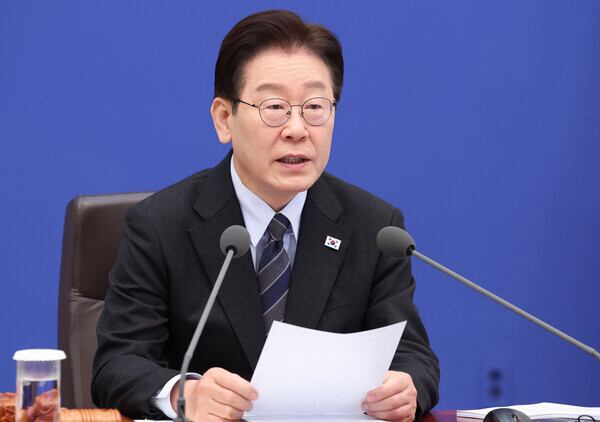
From September of last year to January of this year, there were four instances where civilians from South Korea sent drones north of the Military Demarcation Line (MDL). In response to these incidents, President Lee Jae Myung expressed regret on the 6th, stating, “Although it was not the intention of our government, we express regret to North Korea for the unnecessary military tensions caused by some irresponsible and reckless actions.” This statement was made during the opening remarks at a Cabinet meeting that also served as an emergency economic review meeting, held at Cheong Wa Dae.
President Lee emphasized the need for immediate institutional improvements and swift implementation of enforceable measures to prevent similar cases from recurring. This marks the first time a South Korean president has expressed regret to North Korea regarding the drone issue, which is unprecedented in the history of inter-Korean relations. Despite North Korea having infiltrated drones into South Korean airspace over 10 times since 2014, it has never apologized or expressed regret.
A Shift in Tone and Diplomatic Implications
During the ‘West Sea Defense Day Commemorative Ceremony’ on the 27th of last month, families of the Cheonan victims reportedly asked President Lee to demand an apology from North Korea. He responded with skepticism, saying, “Will North Korea apologize just because we ask them to?” However, ten days later, he expressed his intention to apologize to North Korea.
North Korea responded to President Lee’s expression of regret through a statement released by Kim Yo-jong, the Party’s Secretary-General. She praised the move as demonstrating the “honest and bold attitude of a great person,” which can be interpreted as North Korean leader Kim Jong-un’s evaluation. Kim Yo-jong also mentioned President Lee by name, stating that the South Korean government’s direct expression of regret and mention of preventive measures were seen as “highly fortunate and a wise decision for his own sake.”
Despite this positive response, Kim Yo-jong reiterated that the South Korean side must cease all reckless provocations and abandon any attempts at contact. This implies no change in Kim Jong-un’s policy of designating South Korea as an “enemy state.” However, Cheong Wa Dae expressed hope that this mutual confirmation between the leaders would contribute to peaceful coexistence on the Korean Peninsula.
A Unique Precedent in Inter-Korean Relations
It is highly unusual for a sitting South Korean president to express “regret” over actions by their own side rather than North Korean provocations. The only precedent is when former President Roh Moo-hyun, ahead of the 2003 Daegu Universiade, said, “It was inappropriate. I regret it,” after conservative groups burned North Korean flags and portraits of Kim Jong-il at a rally. Even then, Roh did not directly apologize to North Korea.
President Lee’s expression of regret came after the military-police joint task force (TF) investigation into the incident concluded on the 31st of last month. The TF concluded the incident was a “personal deviation” by civilians, including a graduate student in his 30s, Oh, and referred an NIS officer and an active-duty soldier involved in the drone infiltration to civilian and military prosecutors, respectively, on charges of aiding the enemy.
The TF investigation began at North Korea’s demand. On January 10 of last year, North Korea’s Army General Staff Office spokesperson accused South Korea of “grave sovereignty-infringing provocations” and released photos of drones that crashed in North Korea in September of last year and January of this year.
Political and Strategic Motivations
Analysts suggest that President Lee’s expression of regret stems from the recognition that the previous administration’s provocations toward North Korea, including the December 3 emergency martial law declaration, were problematic. At a foreign press briefing in December of last year, when asked if he would apologize to North Korea over suspicions that the military spread anti-North Korea leaflets to justify martial law, President Lee said, “I think an apology is necessary, but I’m worried it might be used for ‘pro-North framing’ or political ideological battles, so I haven’t spoken openly.”
Some in the ruling party view President Lee’s expression of regret as a prelude to facilitating U.S.-North Korea communication ahead of the U.S.-China summit scheduled for May. President Lee visited China from January 4–7 of this year, just before North Korea raised the drone issue, and there were remarks that the visit aimed to “achieve U.S.-North Korea dialogue during U.S. President Donald Trump’s scheduled visit to China in April.”
The Broader Context
Amid the Middle East crisis spreading security and economic instability, the need to stabilize the Korean Peninsula and ease inter-Korean tensions likely influenced President Lee’s apology. At the meeting that day, he stated, “Disputes worldwide are shaking the international order based on shared rules and reciprocity. In such times, peace and stability on the Korean Peninsula are more critical than ever, and we ourselves must be responsible for them.”
Membership Offers
– 5900 won membership, 2900 won for newspaper readers, Chosun Membership
– 55000 won worth of 8 newspapers and magazines, Chosun Membership
– Receive 7000 points to use like cash for smart shopping, Chosun Membership