China, May 17 — At the Zhengzhou facility of Chinese electric vehicle leader BYD, a new electric car chassis is assembled on the production line in under a minute, primarily driven by robots instead of human labor.
Since setting up its operations in the Zhengzhou Airport Economy Zone in September 2021, BYD has developed a large-scale production facility that produces electric vehicles and essential automotive parts, including batteries. Covering an area of 10.67 square kilometers, the site produces complete EVs as well as numerous key components used in their assembly.
The factory handles the main stages of vehicle manufacturing, such as stamping, welding, painting, and assembly. In addition to these fundamental processes, BYD has set up further facilities on the premises to produce motors, electronic control units, power sources, powertrains, air conditioning systems, steering mechanisms, interior trim, lighting, frames, seats, and other crucial components. Blade batteries, one of BYD’s key battery technologies, are also produced at this location.
As per the company, Zhengzhou currently possesses a full industrial ecosystem capable of manufacturing BYD vehicles from start to finish.
The company stated in a press release that the factory’s key competitive edge lies in its 98 percent automation level, reflecting top-tier intelligent production standards.
Within the factory, robots significantly outnumber human employees. Automated equipment performs welding tasks, assembles car components, and detects production flaws.
During a recent tour of the factory, only a few employees were visible on the production floor. BYD states that 98 percent of its welding tasks are performed by approximately 1,500 robots at the facility.
“A car body can be finished in under a minute,” stated Liu Xueliang, BYD’s Asia Pacific General Manager, as he provided a tour to a group of Nepali journalists visiting the factory. He mentioned that the company has made significant production improvements in a short time by utilizing robotics extensively, which has been crucial in boosting manufacturing output.
Liu mentioned that over 120,000 individuals are employed in BYD’s research and development departments exclusively.
“Here, an electric vehicle is made in under a minute, and a battery cell is produced every three seconds,” he stated.
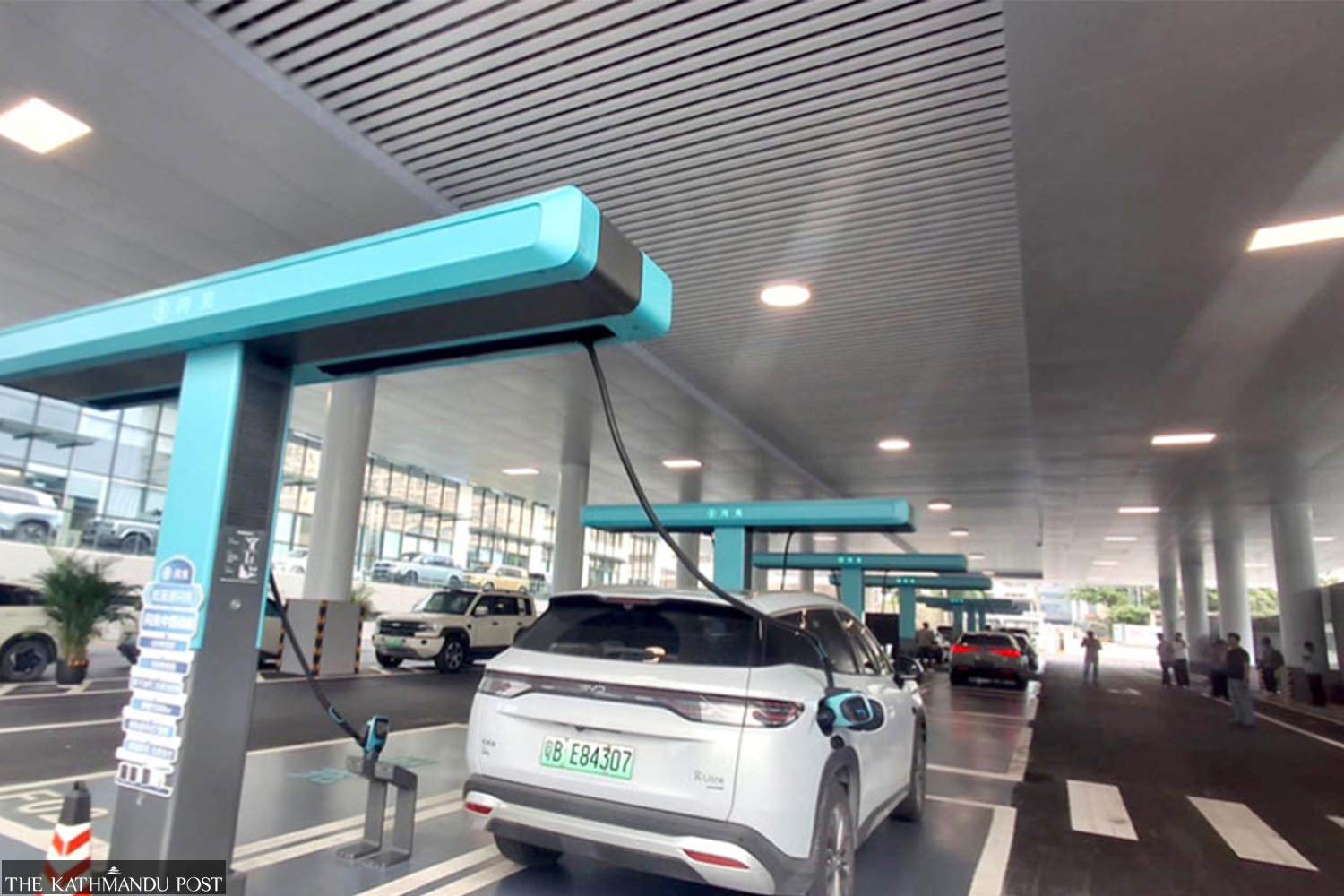
In Shenzhen, corporate representatives showcased BYD’s rapid charging technology, claiming it can charge a vehicle to 97 percent in approximately nine minutes, specifically eight minutes and 26 seconds.
As per the company, a nine-minute fast charge can provide a vehicle with a range of up to 988 kilometers. BYD is also quickly growing its fast-charging infrastructure throughout China. The company states that 4,239 charging points have already been established in various cities and areas, with intentions to operate 20,000 stations across the country by the end of 2026.
Liu stated that ongoing technological advancement is the sole method through which businesses can produce something significant for society.
For two decades, we have been working towards the technological vision we initially introduced in 2004. By 2024, we successfully reached that objective,” Liu stated. “We are a company that brings dreams to life, strives for them, and makes them real.
He mentioned that some individuals expressed curiosity about electric cars around twenty years back.
Consider this. Twenty years ago, who was interested in electric vehicles?” Liu stated. “We took part in the 2004 Beijing International Auto Show and showcased our first electric concept car there. That vehicle is now kept in the Zhengzhou museum.
Liu referred to Nepal as a significant market for BYD.
About 10 years ago, when I first came to Nepal, I noticed that the country was experiencing power shortages,” he mentioned. “I wondered how Nepal could promote the use of electric vehicles. However, after talking with government representatives and local collaborators, I was impressed by the positive outlook for Nepal’s future growth.
Although Nepal had limited infrastructure a decade back and faced difficulties due to the pandemic, Liu mentioned that BYD and Cimex managed to grow their company’s market footprint in the nation.
“The devotion and work attitude of the Nepali people were comparable to our own dedication,” he stated.