
The Impact of Football on Korea-Japan Relations
During a recent conversation with a Japanese journalist about the World Cup, I was told, “This time, South Korea’s image in Japan has worsened due to football. It seems it will negatively impact Korea-Japan relations.” Despite the current closeness between the leaders of South Korea and Japan, and the admiration many South Koreans have for Japanese football, this situation raises questions about what it signifies.
The issue began when news reports reached Japan after South Korea failed to secure an automatic spot in the Round of 32. On June 25, South Korea finished third in its group but still had hope depending on other matches. People hoped Japan would defeat Sweden by a large margin, but when the match ended in a 1-1 draw, headlines like “Japan didn’t help either” flooded the media. Some outlets criticized Japan’s tactics, writing, “Japan won’t help no matter what” and “Did Japan not want to win?” even attacking Moriyasu’s strategies. Domestically, criticism emerged: “Why should Japan help us?” and “Don’t blame others for your lack of skill.”
These reports reached Japan. Reactions like “Stop taking it out on others” and “I really don’t understand Koreans” followed. However, the majority opinion was, “It’s fortunate there are still reasonable Koreans,” preventing the situation from escalating into full-blown anti-Korean sentiment.
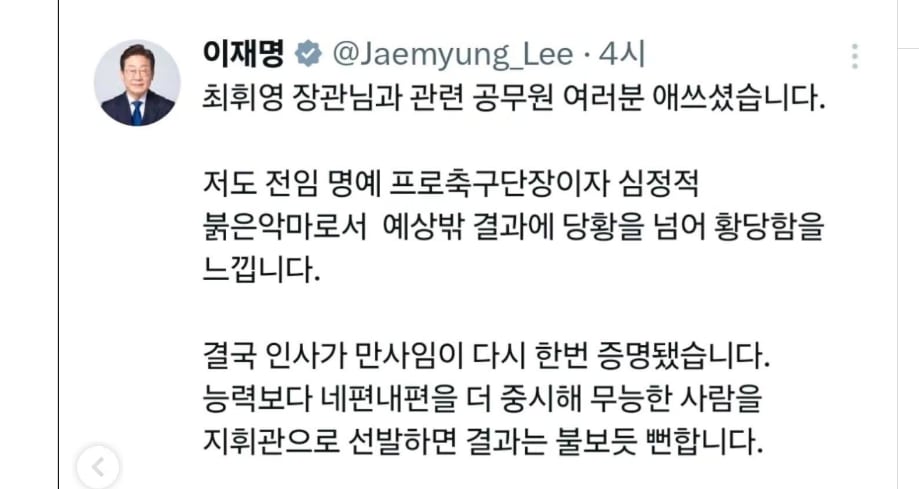
Fuel was added by President Lee Jae Myung’s social media post. Two days after South Korea’s elimination was confirmed, President Lee Jae Myung wrote, “I feel not just shock but utter disbelief. If you select an incompetent person as a commander, the outcome is obvious,” directly criticizing Coach Hong Myung-bo. The term “incompetent” seemed to shock Japanese people even more. Major newspapers covered the news, and a Yahoo Japan headline about it received over 9,400 comments. Reactions poured in: “Even if there are problems, it’s unimaginable for a leader to publicly criticize the national team” and “Who would want to coach South Korea now?”
While Japanese affection for Coach Hong, who previously played in the J-League, might have influenced this, the greater shock appeared to be, “How could a president…?” Criticism expanded to South Korea’s political culture and national character: “Koreans casually disparage others and other countries” and “It’s like watching North Korea’s public executions.” I recalled a Japanese person saying, “Seeing South Koreans criticize players and teams for losing a match makes them seem like they live in a miserable society.”
Of course, the national team’s performance was infuriating. The coach’s lack of tactics, incomprehensible player selections, and the football association’s entrenched cartel were all problematic. However, people in neighboring countries viewed the president as a head of state before seeing him as part of the “Red Devils.” This incident seems to have sown distrust in Japan, where people now wonder if South Korea might harshly criticize them if circumstances change. The leader’s personal attacks damaged the national image.
South Korea lost much in this World Cup—not just the four wasted years and the failure to advance to the Round of 32, but also the embarrassment of showing neighboring countries a shameful side through failed anger management and rash remarks. In the next four years, I hope both football and the people restore their honor through systematic reform and mature attitudes.
Key Takeaways from the Incident
- Media Influence: The way media outlets in Japan portrayed South Korea’s loss and subsequent reactions significantly impacted public perception.
- Leadership Criticism: President Lee Jae Myung’s public criticism of the coach sparked outrage and raised questions about South Korea’s political culture.
- Cultural Perceptions: The incident highlighted how cultural differences and communication styles can affect international relations, especially between neighboring countries.
- National Image: The event damaged South Korea’s image in Japan, leading to concerns about future diplomatic interactions.
Future Outlook
The World Cup serves as a reminder of the importance of sports in shaping national identities and international relations. While the immediate consequences of this incident are concerning, they also present an opportunity for reflection and growth. Both South Korea and Japan must work towards understanding each other better, fostering mutual respect, and building stronger ties that go beyond the realm of sports.
By addressing the underlying issues in football governance and political communication, South Korea can rebuild its reputation and demonstrate a commitment to positive change. Similarly, Japan can continue to support healthy competition while maintaining its own values and standards. Through these efforts, both nations can move forward with a more balanced and respectful relationship.