Malinin’s Daring Display Secures USA Gold Amidst Olympic Spectacle
In a breathtaking display of athletic prowess that defied conventional expectations, American figure skater Ilia Malinin has once again cemented his status as a pioneer in the sport. While he opted not to attempt his signature, gravity-defying quadruple axel during the crucial team event, his performance was nothing short of spectacular, ultimately clinching the gold medal for the USA.
Malinin, a mere 21 years old, found himself carrying the weight of his nation’s hopes as the final skater for Team USA. In a sport where a single misstep can spell disaster, his routine was marked by a daring edge, including a moment where he faltered, nearly losing his balance and hitting the ice. Such a lapse, under normal circumstances, could have jeopardised a team’s chances at the coveted gold.
However, Malinin’s repertoire is far from ordinary. He successfully landed an astonishing five different types of quadruple jumps, each a testament to the extreme difficulty and precision required. His confidence in these feats is palpable, having recently quipped to The Atlantic, “I broke physics. Now I think physics doesn’t apply to me.” This audacious claim was validated on the ice, as these extraordinary manoeuvres generated enough points to not only compensate for his near-fall but also to propel the American team to victory. They finished ahead of Japan, whose star skater Yuma Kagiyama had narrowly defeated Malinin in the preceding “short” program. Italy rounded out the podium, earning a jubilant bronze.
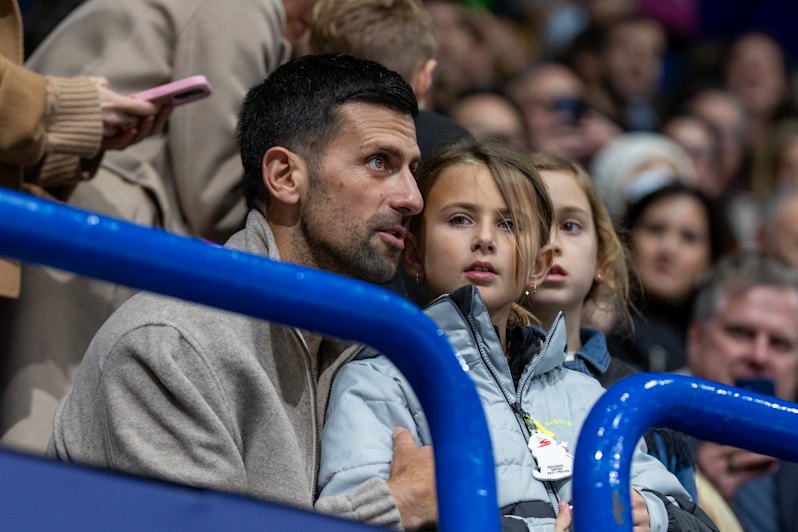
Among the captivated spectators in the stands was tennis legend Novak Djokovic. His presence wasn’t attributed to cheering for Georgia’s skater or enjoying the pulsating dance music that filled the breaks between performances. Instead, Djokovic’s attention was firmly fixed on Malinin.
The moment that truly drew a gasp from the tennis icon was Malinin’s now-iconic backflip, executed late in his winning performance. Djokovic’s stunned reaction, hands clasped to his head in disbelief, perfectly encapsulated the audience’s awe. Malinin, visibly thrilled by Djokovic’s acknowledgment, spoke of the encounter as a “once-in-a-lifetime moment,” expressing his delight at having such a renowned athlete witness his artistry.
While the backflip doesn’t contribute any bonus points from the judges, its inclusion is a deliberate choice, as explained by one of the American journalists following his every move. It’s a clear demonstration of his showmanship and willingness to push boundaries.
Beyond his aerial acrobatics, Malinin’s routines are characterised by a distinctive flair, including the use of his own voice, delivered in a slow rap style, as part of his musical accompaniment. His chosen piece, titled “The Voice,” offers a stark contrast to more traditional skating music, showcasing his unique artistic vision.
Even the “Quad Gods” of figure skating are not immune to pressure. Malinin experienced this firsthand during the short program, where nerves appeared to get the better of him. He scored over ten points shy of Kagiyama, with an under-rotated quad lutz, a performance that put the American team’s gold medal aspirations in jeopardy.

Reflecting on this rare dip in performance, Malinin attributed it to the overwhelming experience of his Olympic debut. “Honestly, I had to sit around for a few hours wondering why that happened,” he admitted after his triumphant free skate on Sunday, where he secured an impressive 200.03 points, the highest among the men.
He elaborated on the profound impact of the Olympic environment: “I didn’t really understand the impact of the Olympic environment… I think I was more in shock of really just being at the Olympics for the first time.” His subsequent self-reassurance was clear: “So I really just told myself, ‘OK, now you’ve experienced it for the very first time so … now you can come with a different mindset, a different energy, really just take it as any other competition.’”
Malinin’s post-competition remarks serve as a clear indication that he has shed any lingering Olympic debutant nerves. He is now poised to elevate his game, soaring even higher in the upcoming individual event.
While he did not explicitly state it, it is widely speculated that his decision to forgo the quadruple axel in the team event stemmed from a strategic assessment of risk. As the team’s anchor skater, the potential consequences of a fall were too significant. In the individual competition, however, this burden of responsibility is lifted. “I’ve got everything under control,” he declared, signalling his readiness to unleash his full potential.
The Winter Olympic Games are being broadcast across Australia on the 9Network, 9Now, and Stan Sport.
For those seeking to stay updated, a dedicated sports newsletter, delivering news, results, and expert analysis every Monday, is available for sign-up.