Electricity Rates to Remain Steady as KEPCO’s Financial Health Takes Precedence
Seoul, South Korea – Consumers and industries will see no immediate change in their electricity bills as authorities have opted to maintain current rates for the second quarter of the year, spanning April to June. This decision comes despite a recent decrease in international fuel costs, a trend that would typically signal a reduction in electricity tariffs. However, the paramount concern for the government is the precarious financial standing of Korea Electric Power Corporation (KEPCO), the nation’s primary electricity provider, which continues to grapple with a colossal debt exceeding 200 trillion Korean won.
KEPCO formally announced its decision on March 23rd, stating, “We will maintain the fuel cost adjustment rate for the second quarter of 2026 at the same +5 won per kilowatt-hour (kWh) as before.” This commitment to stability, while seemingly counterintuitive given falling global energy prices, underscores a complex balancing act between economic realities and the need for a robust energy infrastructure.
Understanding the Components of Your Electricity Bill
The electricity bill that households and businesses receive is a composite of several charges. These typically include:
- Basic Charge: A fixed cost component.
- Power Quantity Charge: Based on the amount of electricity consumed.
- Climate and Environment Charge: A levy intended to address environmental concerns and promote sustainable practices.
- Fuel Cost Adjustment Rate: A dynamic element designed to reflect the volatility of international energy prices.
The fuel cost adjustment rate, introduced in the first quarter of 2021, is a quarterly mechanism to pass on fluctuations in global energy markets to consumers. This rate is calculated based on the average prices of key commodities such as bituminous coal, liquefied natural gas (LNG), and Brent crude oil over the three months preceding the relevant quarter. The system allows for adjustments of up to ±5 won per kWh. A significant surge in international energy prices can lead to an addition of up to 5 won per kWh, while a decline can result in a deduction of the same amount.
The Impact of Global Events on KEPCO’s Finances
KEPCO has consistently applied the maximum positive adjustment of +5 won per kWh to the fuel cost adjustment rate since the third quarter of 2022. This period coincided with a dramatic escalation in international energy prices, fueled by a confluence of factors including the lingering effects of the COVID-19 pandemic, widespread supply chain disruptions, and the geopolitical ramifications of the Russia-Ukraine war.
Internally, KEPCO’s calculations for the current quarter indicated that the appropriate adjustment rate should have been -11.2 won per kWh. This figure reflects the recent stabilization and downward trend in international fuel costs, which had previously surged dramatically. In principle, based on these calculations and the system’s design, electricity rates should have been reduced for at least two consecutive quarters.
Prioritizing KEPCO’s Financial Stability
Despite the calculated room for a rate reduction, the Ministry of Climate, Energy and Environment, the governing body overseeing these decisions, directed KEPCO to maintain the fuel cost adjustment rate at its current level of +5 won per kWh. The primary driver behind this directive is KEPCO’s overwhelming debt. By the end of the previous year, KEPCO’s consolidated debt had ballooned to 206 trillion won, with outstanding borrowings reaching 130 trillion won. The daily interest burden alone amounts to a staggering 11.9 billion won. While the fuel cost adjustment system is intended to mirror energy price volatility, the government has deemed it more critical to address KEPCO’s financial solvency.
It is important to note that maintaining the fuel cost adjustment rate does not equate to an outright freeze on all electricity tariffs. The government retains the authority to adjust other components of the electricity bill, such as the power quantity charge or the climate and environment charge, which could lead to overall increases or decreases in electricity rates. However, a spokesperson from the Ministry of Climate, Energy and Environment indicated that no separate discussions concerning broader electricity rate adjustments are currently underway.
Outlook for Industrial Consumers and Future Reforms
Industry observers anticipate that electricity rates are likely to remain unchanged in the near future. This outlook is shaped by the ongoing challenges in resolving KEPCO’s substantial debt and the recent resurgence in international energy prices, partly attributed to renewed geopolitical tensions in the Middle East.
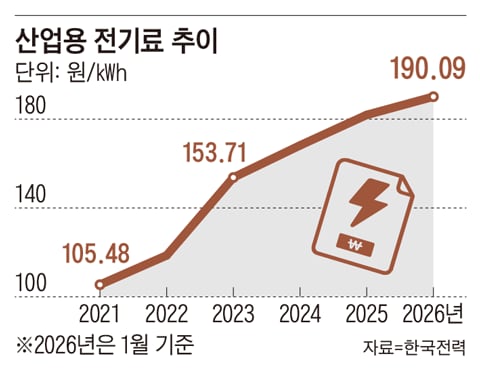
Major industrial manufacturers, who have already absorbed a significant increase of approximately 70% in industrial electricity rates over the past four years, are expected to continue facing financial pressures. Industrial electricity rates have seen a steady climb, rising from 107.3 won per kWh in 2013 to 153.71 won in 2023, and further to 181.90 won last year. By January of the current year, these rates had reached 190.09 won per kWh.
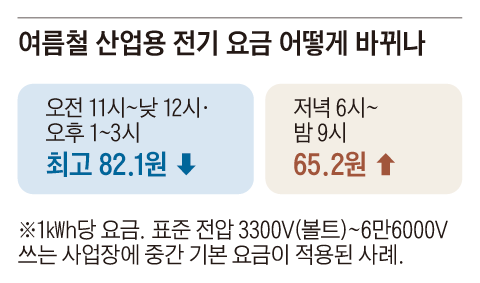
In a move to alleviate some of these burdens, the government has finalized a “seasonal and time-based electricity rate reform plan” specifically targeting large industrial consumers (Type B) utilizing over 300 kW of power. Scheduled for implementation from April 16th, this reform is projected to result in reduced rates for an estimated 97% of the approximately 40,000 workplaces classified under industrial (Type B) tariffs, affecting around 38,000 sites.
The cornerstone of this reform is a departure from the traditional model of higher daytime rates and lower nighttime rates. Instead, it will introduce a structure where daytime rates will be cheaper, and nighttime rates will be more expensive. This innovative approach aims to address the issue of surplus power generation during the day, particularly with the increased integration of solar energy from expanded renewable energy sources, while simultaneously easing the financial strain on industries.