A New Era of Tensions and Deals
On July 8, President Donald Trump made a surprising statement during his meeting with Turkish President Recep Tayyip Erdogan in Ankara. He insisted that the United States should have control over Greenland, which is currently under the jurisdiction of Denmark. This claim has sparked significant concern among European allies, as it contradicts the principles of mutual defense that form the foundation of NATO.
Trump emphasized that Greenland is an important strategic location for the US, claiming that it is surrounded by Chinese and Russian ships. He stated, “That should be controlled by the United States, not by Denmark.” These remarks have raised questions about the stability of transatlantic relations, especially as NATO leaders were working to address other concerns raised by Trump regarding defense spending among member nations.
Addressing NATO Concerns
At this year’s summit, European countries and NATO Secretary-General Mark Rutte were focused on addressing Trump’s long-standing complaint about insufficient defense spending by European allies. The alliance aims to strengthen its collective security and ensure that all members contribute adequately to their own defense.
In addition to these discussions, Trump announced the lifting of sanctions on Turkiye, which had been imposed after the country purchased a Russian missile defense system. This move marks a shift in US-Turkey relations and is seen as a gesture of goodwill towards Erdogan, the summit’s host.
Turkiye was excluded from the F-35 fighter jet program in 2019 due to its acquisition of the S-400 missile defense systems. Despite this, there has been a warm personal relationship between Trump and Erdogan since Trump’s first term. The removal of sanctions could potentially pave the way for Turkiye’s return to the F-35 program, although several legal hurdles remain.
Strategic Military Investments
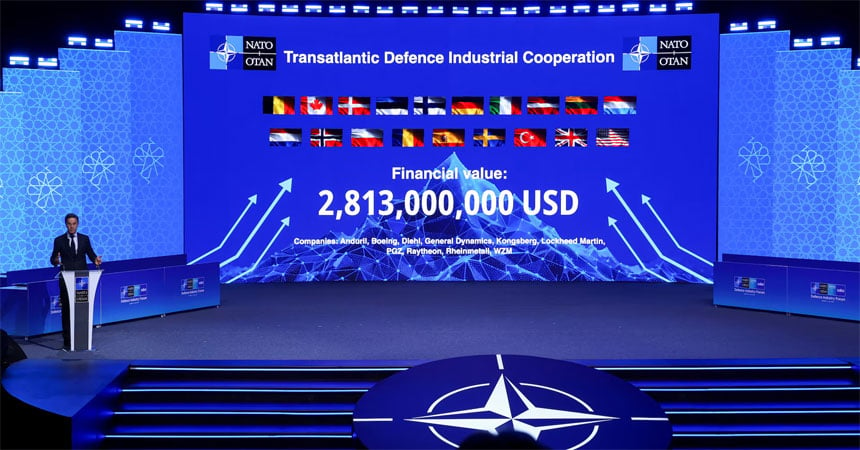
As part of efforts to appease Trump, NATO showcased a series of military projects worth billions of dollars. These investments were highlighted as “money well spent” by Secretary-General Rutte, who aimed to satisfy the US president’s concerns about defense spending.
NATO does not own any weapons, but it does operate a fleet of 14 AWACS early warning radar surveillance planes that are approximately 50 years old, along with some newer surveillance drones. A deal to replace the aging planes was announced, with Swedish manufacturer Saab supplying up to 10 new GlobalEye surveillance aircraft for a 10-nation consortium.
Swedish Prime Minister Ulf Kristersson expressed pride in the project, stating that the twin-engine aircraft would be “made within the alliance for all the alliance.” Some of the projects will be funded through a system of cheap loans for defense purposes set up by the European Union, which includes up to $170 billion raised on capital markets.
Strengthening US-Turkey Relations
During their meeting, Trump and Erdogan displayed their strong personal rapport. Erdogan welcomed Trump with an elaborate ceremony involving cannons, military officials on horseback, and jets flying overhead emitting red, white, and blue smoke. Trump praised their relationship, noting, “There’s a chemistry that works between us.”
Erdogan expressed hope that the US would sell F-35 planes to Turkiye, emphasizing that Trump always stands by his word. However, the potential sale of F-35s to Turkiye could complicate relationships with other allies, such as Israel. Israeli Prime Minister Benjamin Netanyahu has urged the Trump administration not to proceed with the sale, citing concerns over Erdogan’s statements against Israel.
Even if sanctions are lifted, US law still restricts Turkiye from purchasing F-35s while it possesses the S-400 missile defense systems. This legal barrier remains a significant challenge for any potential deal.
Conclusion
The events at the NATO summit highlight the complex dynamics between the US and its allies. While efforts are being made to address concerns and strengthen partnerships, the path forward remains fraught with challenges. The interplay between strategic interests, legal constraints, and political relationships continues to shape the future of international alliances.