
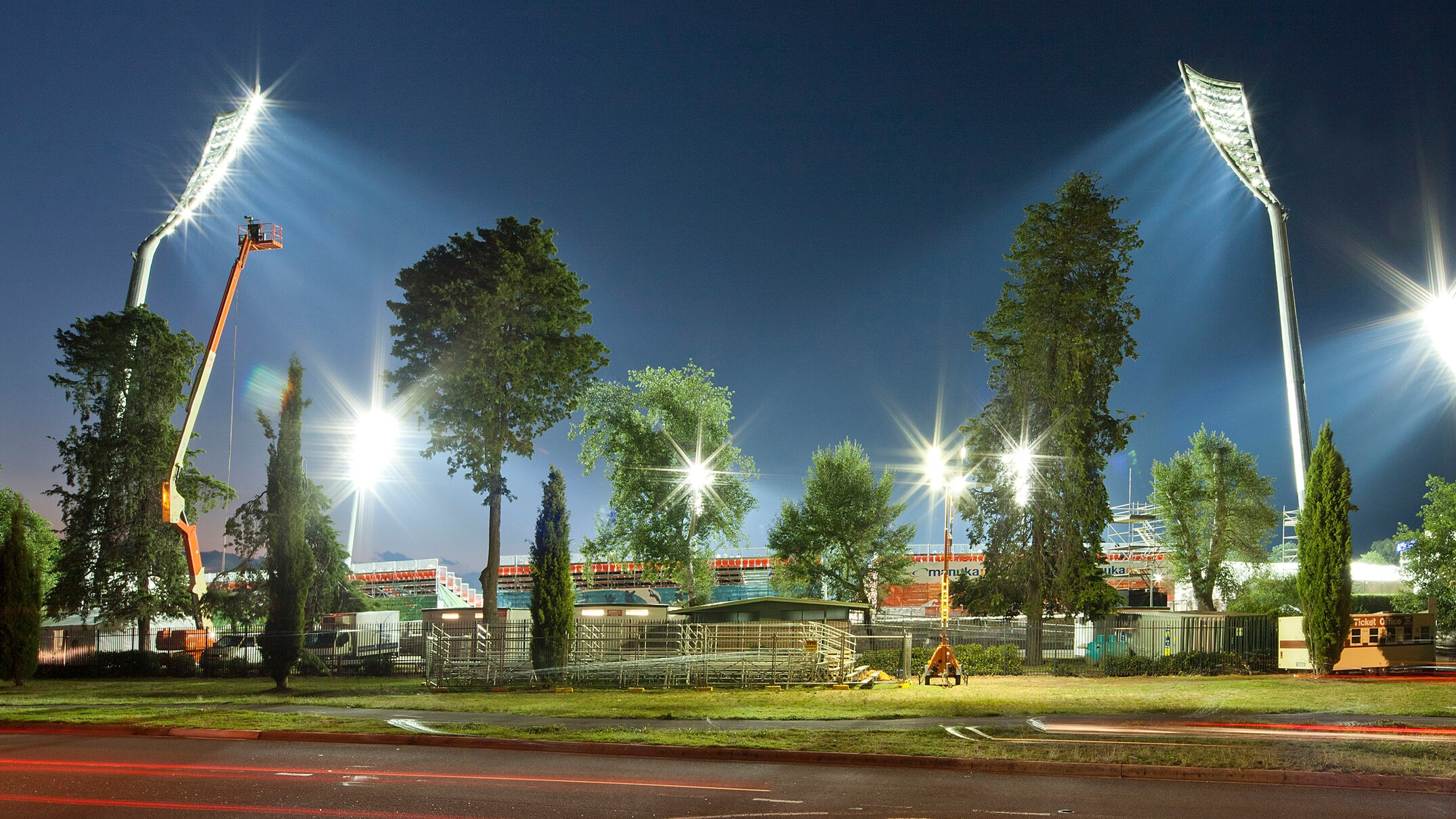
Canberra’s iconic Manuka Oval is home to a rather unique architectural feature: its six towering light poles, standing at an impressive 47 metres high. But take a closer look, and you’ll notice they’re not quite standing straight. These colossal structures are deliberately designed with an inward lean. This isn’t an aesthetic choice; it’s a direct consequence of a stringent planning regulation known as RL617.
The Invisible Ceiling: Understanding RL617
RL617, while not a daily concern for most Canberrans, is a well-known and respected rule among developers, planners, and architects in the nation’s capital. This regulation meticulously dictates the maximum height for any structure within Canberra’s designated Parliamentary Zone. The limit is set at 617 metres above sea level, a precise elevation tied to a specific point on the landscape: the grassy summit of Parliament House’s expansive lawns.
Rodney Moss, a former director at Cox Architecture, explained the impact of this rule. “When you look across Civic and think it’s all a bit stunted… it’s because of that,” he noted. The intention behind RL617 is deeply rooted in preserving the vision of Canberra as a “bush capital,” a concept championed by its original designer, Walter Burley Griffin. The rule formalised in 1990 by the National Capital Authority (NCA) as a cornerstone of the National Capital Plan, prioritises the dominance of the natural environment over built structures. By establishing Parliament House’s rooftop as the “grass ceiling,” the city’s skyline is effectively capped, ensuring that the natural vistas and the sense of open space are maintained.
Currently, only Parliament House’s flagpole and the distinctive dome of the Australian War Memorial are permitted to pierce this invisible line.
Engineering a Solution: The Manuka Oval Lighting Dilemma
The challenge of adhering to RL617 became particularly apparent in 2012 when Manuka Oval underwent an upgrade to install broadcast-quality lighting. This upgrade was crucial to enable the venue to host more night-time sporting events. Mr Moss detailed the technical hurdle. “In order to give you television-quality light on the oval, the lights need to be a certain height,” he explained.
However, the proposed height for these essential lights would have unequivocally breached the RL617 limit. The planning rule, being unyielding, necessitated a creative engineering solution. “What we did was bend the lights so that they came down below 617 metres above sea level, and then we made the light head into a shovel, so that the maximum amount of light is right on the edge,” Mr Moss elaborated. This ingenious design ensured compliance with the National Capital Plan while still providing the necessary illumination for the oval. The outcome, he described, was “quite terrific.”
This angled design, while solving the height issue, introduced significant engineering complexities and, consequently, increased costs. “If it was straight up in the air, you’ve got a footing that goes straight down. That’s OK,” Mr Moss commented. “If you’ve got this huge weight leaning forward, then the footings have to be much larger because it wants to fall over.” The added structural requirements to counteract the leaning force meant the project was considerably more expensive than a standard vertical installation.
The City’s Growth Spurt: Re-evaluating Canberra’s Skyline
The RL617 planning rule, while instrumental in shaping Canberra’s unique character, doesn’t extend to all areas of the city. Key urban centres such as Woden, Gungahlin, and Belconnen fall outside its jurisdiction. As Canberra’s population continues to grow, nearing half a million residents, the question of adapting or revisiting RL617 has become a pertinent one, requiring careful negotiation between the ACT government and the NCA.
Catherine Townsend, the ACT government architect, views this as a critical juncture for the city. “I think this is a coming-of-age conversation for the city,” she stated. “We’ve had a rule that has preserved a certain attitude to how the city grows, and I think it’s now time that we sit down and have an adult discussion about where the city goes in the future.”
Ms Townsend doesn’t advocate for a uniformly taller city but suggests a more nuanced approach. “We’re not looking for a city that climbs uniformly higher, but some activation and some punctuation points, with higher, slender buildings would be, I think, a welcome addition,” she proposed. “I think there’s a discussion for the community, about what we want to see next.”
Seeking an Urban Climax: Redefining Canberra’s Centre
In essence, RL617 acts as a discreet guardian of Canberra’s skyline, drawing an invisible boundary across the horizon. This regulation, according to Ms Townsend, leaves areas like City Hill with significant unrealised potential, particularly as the surrounding buildings near their completion. While she doesn’t envision buildings being constructed on City Hill itself, she notes that the heritage-listed trees currently serve as a visual barrier, obscuring the southern vistas.
Ms Townsend harbours a vision for a landscape and skyline that more accurately reflects contemporary Canberra. “What are we going to do with City Hill? What do we think about raising the height limits in the city to provide a more exciting and larger-scale expression of, ‘We have arrived at the centre of the city’?” she mused.
This sentiment is echoed by Mr Moss, who believes RL617 provides a clear explanation for a feeling many locals and visitors have experienced but struggled to articulate. “Canberra is lacking in urban climax,” he observed. “The city lacks a visual declaration of arrival. You sort of drive in and you think, ‘Where is it?’” The ongoing dialogue around RL617 represents a crucial step in defining Canberra’s future urban identity and its visual presence on the national stage.



Leave a Reply