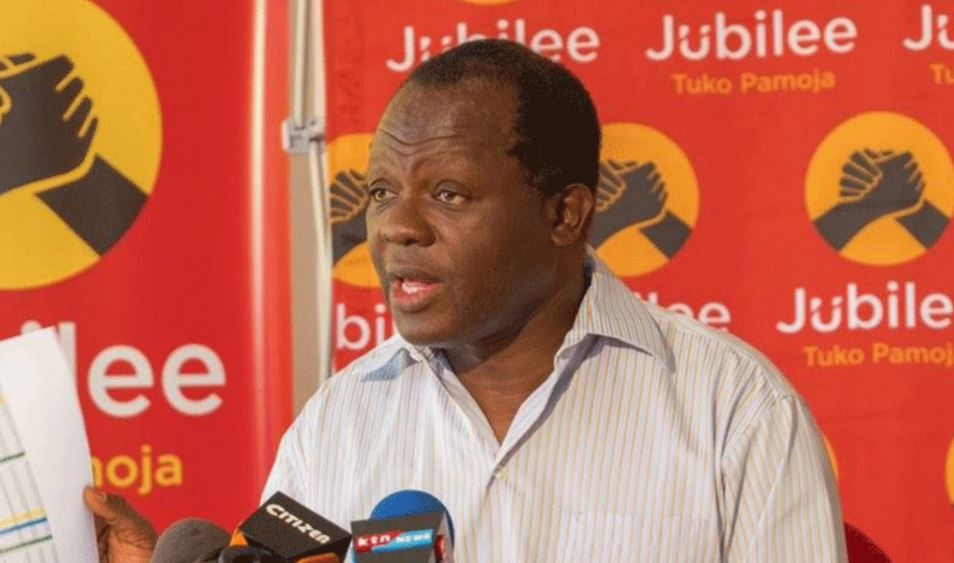
The protracted legal dispute between former Cabinet Secretary Raphael Tuju and the East African Development Bank (EADB) has traversed nearly seven years of court proceedings. What began as a commercial disagreement has escalated into a highly publicized saga, drawing allegations of political machinations against the former minister. This chronicle traces the evolution of this complex case.
The Genesis of the Dispute: A Loan Agreement
In April 2015, a significant financial agreement was struck. Mr. Tuju’s company, Dari Ltd, along with SAM Company, entered into a loan arrangement with EADB. The bank committed to disbursing a sum of $9.3 million. The intended purpose of this loan was for Mr. Tuju to acquire a 20-acre parcel of land in Karen, Nairobi, with the vision of developing a high-end, mixed-use luxury project.
To secure this substantial loan, EADB required collateral. The assets pledged included the very property being acquired with the loan funds, Entim Sidai, as well as Tamarind Karen and Dari Business Park. Furthermore, personal guarantees were provided by Mr. Tuju himself and his children: Mano, Alma, and Yma.
The loan disbursement commenced on July 31, 2015. The initial tranche, amounting to Sh932.7 million, was allocated to the purchase of a historic 94-year-old bungalow. This property, originally constructed by Scottish missionary Albert Patterson, was then operating as a distinguished, high-end restaurant.
The second tranche of the loan, approximately Sh270 million, was earmarked for the construction of residential units. The expectation was that the sale of these units would then be utilized to service the loan obligations. Mr. Tuju was granted a 24-month grace period, with the repayment schedule slated to begin in 2017.
The Courtroom Battle Commences
The first signs of discord emerged in November 2017. EADB initiated the legal process by issuing demand letters to Mr. Tuju and his associated companies, formally requesting the repayment of the outstanding loan. The bank’s position was that Mr. Tuju had failed to meet his interest payment obligations, asserting that the loan facility was “substantially in default” by the year 2016.
However, Mr. Tuju presented a different narrative. He contended that the full loan amount had not been disbursed by EADB, a situation he claimed led to significant cash flow challenges and consequently stalled the development project. He argued that EADB disbursed only Sh932.7 million for the initial tranche, falling short of the agreed Sh943.9 million. Moreover, he alleged that the bank reneged on its commitment to provide Sh294 million designated for the construction of luxury homes.
Mr. Tuju further elaborated that EADB directly paid the Sh932.7 million to the seller of the bungalow. Subsequently, he claimed, the bank demanded additional security for the construction of the Sh100 million villas. “Having failed to disburse the balance of $102,916 (then Sh10.4 million) and a further Sh294 million, the first defendant inevitably experienced cash flow challenges,” Mr. Tuju stated in his defense. He accused EADB of facilitating the land acquisition but withholding the crucial development funds, the proceeds of which would have been instrumental in servicing the loan.
In response to the escalating dispute, EADB initiated arbitration proceedings against the borrowers and their guarantors, Mr. Tuju and his children. The matter eventually reached the High Court in the UK. On June 19, 2019, High Court judge Daniel Toledano ruled in favor of EADB, awarding the bank $15,162,320.95.
Following this ruling, EADB sought to have the UK judgment recognized and enforced in Kenya by filing an application in the High Court in Nairobi. Mr. Tuju and Dari Ltd vehemently opposed this application, raising allegations of bias. They argued that Michael Sullivan, who represented the bank, and Judge Toledano shared legal chambers, suggesting a potential conflict of interest. The High Court in Nairobi, however, dismissed this argument. The UK decision was formally adopted as a High Court judgment in Kenya on January 7, 2020, under the provisions of the Foreign Judgments (Reciprocal Enforcement) Act.
Undeterred, the former Cabinet Secretary escalated the legal challenge to the Court of Appeal. His arguments extended beyond the claims of bias, asserting that EADB had actively obstructed efforts to make the properties viable for other potential lenders, including KCB Group and private equity investors. The appellate judges, in their decision to reject Mr. Tuju’s appeal, emphasized that both parties had voluntarily agreed to be governed by English law. They concluded that the judgment could not be set aside simply on the grounds of perceived error.
Mr. Tuju then took his case to the Supreme Court, where he succeeded in obtaining a temporary suspension of the seizure of his assets pending the determination of his application. However, before the Supreme Court could hear the case, Mr. Tuju sought to introduce additional evidence. This application was rejected. In the aftermath, the former CS leveled accusations of bias against the Supreme Court judges, leading to their subsequent recusal from the case.
Renewed Legal Maneuvers and Insolvency Proceedings
The legal battle returned to the High Court in February 2020. EADB commenced various insolvency proceedings against Mr. Tuju and his children. This included issuing statutory demand notices and appointing receiver managers to oversee the charged properties.
In April 2023, EADB appointed Muniu Thoithi and George Weru of PricewaterhouseCoopers (PwC) as receiver managers. However, they were reportedly denied access to the properties. Consequently, the bank initiated contempt of court proceedings against Mr. Tuju and his children for their alleged obstruction.
The Auction and Subsequent Challenges
October 2024 marked a significant event with the auction of Dari Coffee and Garden Restaurant. The property was sold for Sh450 million to Ultra Eureka Ltd, a company associated with Jackson Kiplimo Chebett, a co-owner of Stabex International Ltd. Mr. Tuju, however, contested this sale.
The planned sale of other key properties, namely Entim Sidai Wellness Sanctuary, Tamarind Karen, and Dari Business Park, was subsequently halted by the court. This intervention came after Mr. Tuju challenged the valuation of these properties, which had been conducted by Knight Frank Valuers, an firm appointed by EADB. EADB had initially instructed Garam Investments Auctioneers to proceed with the sale of these assets to recover the outstanding debt.
Mr. Tuju took his case back to court, arguing that he had not been properly served with a statutory notice, as mandated by Section 90 of the Land Act. He also invoked the “in duplum” rule, a legal principle that limits the interest recoverable by a lender to the principal amount of the debt. He contended that EADB was seeking to recover $35,051,622 (approximately Sh4.5 billion), an amount that significantly exceeded the original principal sum owed.
While the matter was still under consideration by the Supreme Court, Mr. Tuju returned to the High Court, declaring his readiness to settle the debt. He secured court orders to maintain the status quo, which included a suspension of insolvency proceedings and any further auctions of his properties, pending the resolution of his application. The High Court acknowledged that while a lender has the right to recover its investment or realize its security in cases of default, a borrower must be given an opportunity to be heard when expressing a willingness to repay the debt.
Dari Ltd indicated that it had secured alternative funding from other lenders who were prepared to settle the loan under court supervision. EADB, however, opposed this application. The bank stated that as of December 20, 2019, the outstanding debt stood at $16,550,608 (Sh2.14 billion). Furthermore, EADB expressed no interest in mediation, citing that the case had been in court for four years without any repayments from the Tujus. The bank noted that the last payment received was a mere $10,000 (Sh1.2 million) in August 2016.
Mr. Tuju criticized Knight Frank Valuers, accusing them of conducting superficial “desktop valuations” and relying on “web-based enquiries.” He argued that these valuation reports did not accurately reflect the true worth of the properties and therefore should not be used to justify a forced sale. Valuation reports purportedly conducted in July 2026 placed Tamarind Karen and Dari Business Park at Sh590 million (market value) and Sh442.5 million (forced sale value), respectively. Entim Sidai was valued at Sh1.395 billion (market value) and Sh1.046 billion (forced sale value) in the same reports. The lender’s objective was to sell these properties to recover a debt of $35,057,622 (approximately Sh4.5 billion).
In July 2024, Mr. Tuju’s attempt to reopen the long-standing legal battle proved unsuccessful. The court ruled that the issues he raised had already been conclusively determined in previous rulings. He had petitioned the High Court to review its January 2020 decision that recognized the EADB judgment obtained in London. This London ruling mandated him and his companies to repay the 2015 loan, a debt that had since ballooned to over Sh4.5 billion. Mr. Tuju contended that new and significant evidence had emerged, warranting a reconsideration of the judgment that had paved the way for the auction of his properties. “The matter has been finally decided by a court of competent jurisdiction. This court will not permit a collateral attack on a final and valid foreign judgment already recognised by this court and the appellate court,” the High Court stated in its ruling.
Mr. Tuju claimed that the purported new evidence stemmed from the cross-examination of a key bank witness, David Odongo. He alleged that Mr. Odongo had confirmed that the 2015 loan was structured in two phases and had retracted crucial parts of earlier sworn affidavits that were used to secure the UK judgment and its recognition in Kenya. According to Mr. Tuju, the witness also admitted that the loan agreement encompassed both land acquisition and the construction of villas, but that the facility agreement itself only reflected the initial phase.
Contempt of Court Findings
In March 2026, Mr. Tuju and his children faced consequences for contempt of court. They were each fined Sh100,000 for deliberately disregarding court orders issued on March 2 and March 13, 2020. These orders specifically required them to grant receiver managers access to the properties.
Just days later, the High Court lifted an order that had been preventing the transfer of the property to Ultra Eureka Ltd. This action followed the dismissal of a suit filed by Dari Limited and Mr. Tuju. Their lawsuit had alleged that the auction was unlawful, asserting that it violated interim court orders and occurred while they were still contesting the legality and enforceability of the loan facility agreement.