SpaceX IPO Anticipation Fuels Surge in Aviation and Space Stocks
Shares of U.S. companies operating within the aviation and space sectors have experienced a significant uplift following widespread reports that a highly anticipated Initial Public Offering (IPO) for SpaceX, the pioneering space exploration venture led by Tesla CEO Elon Musk, is on the horizon. This development comes amid a period of robust expansion for the space industry, further amplified by recent announcements from tech giants like NVIDIA and Tesla regarding their intentions to develop specialized, space-grade chips for data centers intended for deployment in orbit. These strategic moves have collectively heightened investor optimism and expectations for firms engaged in aerospace and space-related endeavors.
SpaceX IPO Looms, Space Companies Rally
On the 25th of the month, U.S. technology-focused media outlet The Information reported that SpaceX could be preparing to submit its IPO application as early as this week. Established in 2002, SpaceX has cemented its position as a leader in the private commercial space industry. Industry analysts are projecting that the SpaceX IPO could achieve a valuation of up to $75 billion, a figure that would mark it as the largest in history. According to insights from CNBC, the corporate valuation of SpaceX could potentially reach an unprecedented $1.75 trillion at the time of its public offering. This surge in anticipation follows SpaceX’s recent merger with xAI, Elon Musk’s artificial intelligence startup. The combined entity was subsequently valued at $1.25 trillion. Musk has previously articulated his vision, stating that “space-based AI is the solution for technological expansion in the long term,” underscoring the synergistic potential between advanced space technologies and artificial intelligence.
This significant news has directly translated into a sharp increase in the stock prices of various U.S. space-related companies. Investors are keenly anticipating that SpaceX’s public listing will not only bring the company into the spotlight but also serve as a catalyst for accelerated growth across the entire space ecosystem. Reuters observed, “Investor enthusiasm for the space sector is surging, driven by falling launch costs, expanding satellite networks, and growing interest in on-orbit data center infrastructure. This is facilitating new capital inflows into next-generation aerospace and space infrastructure companies.”
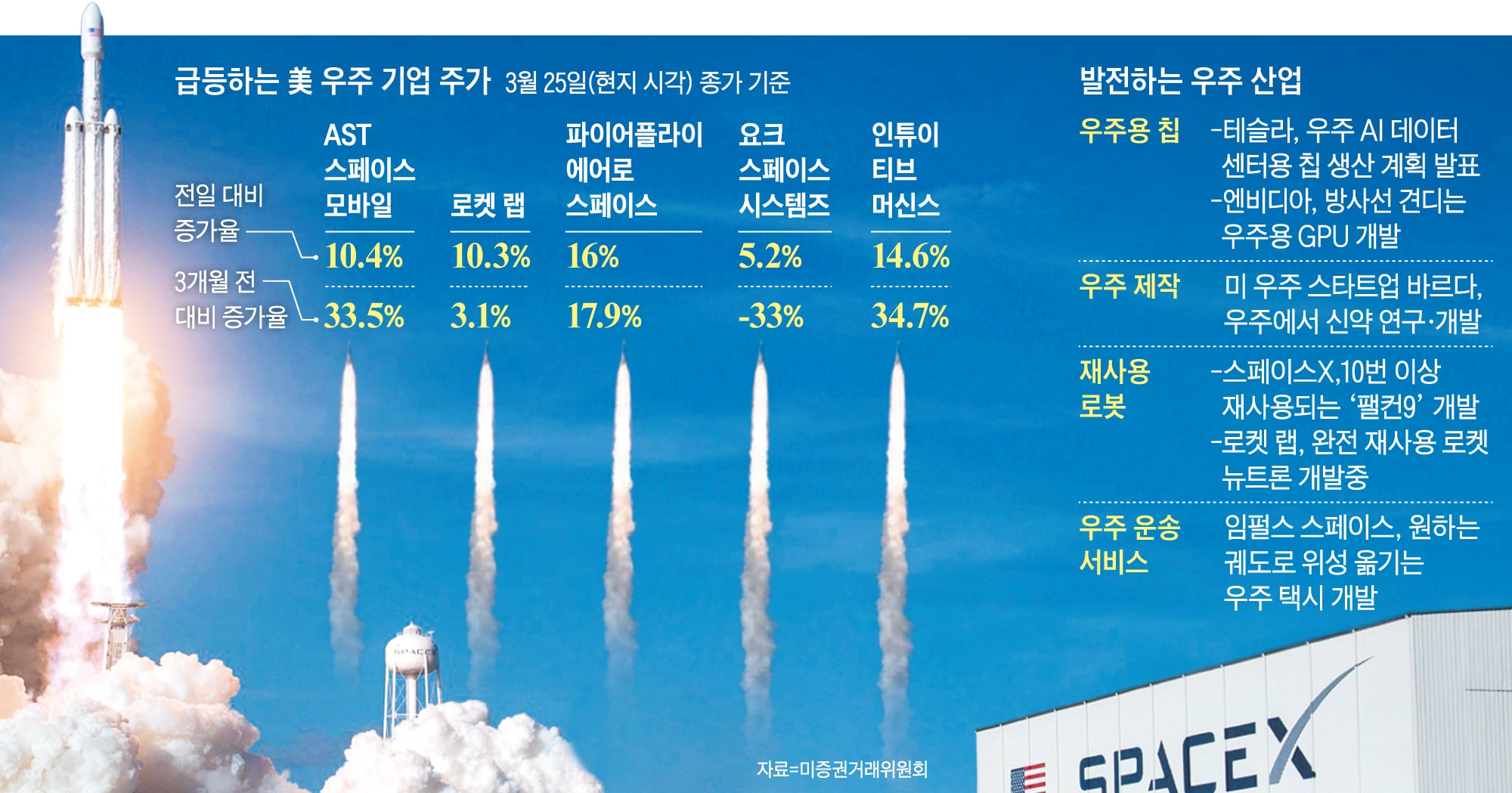
Illustrating this trend, while the broader Nasdaq index saw a modest increase of just 0.8% compared to the previous day, AST SpaceMobile, a company focused on satellite design, experienced a remarkable surge of 10.4%, reaching $96.00. This represents a substantial 33.5% increase over the past three months. AST SpaceMobile is actively working towards deploying a constellation of 45–60 satellites into orbit by the close of the current year.
Rocket Lab, a Los Angeles-based entity specializing in the manufacturing and launching of small satellites, saw its stock price climb by 10.3% to $72.80 from its previous day’s close. Shares of EchoStar, a communications company that holds SpaceX stock, also demonstrated positive momentum, with an increase of over 7%.
Firefly Aerospace, a manufacturer of medium-sized rockets such as the “Alpha” and a participant in lunar exploration missions, experienced an impressive surge of approximately 16%, reaching $27.50. Earlier this month, the company announced its 2023 revenue figures, reporting $159.8 million, a significant 163% year-on-year growth. York Space Systems, a manufacturer of small satellites that became publicly traded in January, recorded a 5.2% rise from its previous day’s trading. Intuitive Machines, a developer of U.S. landers for lunar exploration missions, concluded its trading day at $20.50, marking a 14.6% increase.
The Rapid Expansion of the Space Industry
The space industry is currently undergoing a period of rapid and dynamic expansion. A key driver of this growth has been the accelerated development of reusable rocket technology by manufacturers like SpaceX. The adoption of reusable rockets significantly reduces production costs and allows for the repeated use of the same booster components, thereby increasing the frequency of launches. For instance, SpaceX’s reusable Falcon 9 rocket saw its launch count dramatically increase from 25 in 2020 to an impressive 165 in the past year.
As the economic viability of reusable rocket technology becomes increasingly evident, other companies are intensifying their efforts in this domain. Rocket Lab currently operates the partially reusable small rocket “Electron” and is actively developing the fully reusable “Neutron” rocket.
Elon Musk has recently unveiled ambitious plans to produce specialized space-grade chips specifically designed for the operation of AI data centers located in space. At NVIDIA’s annual conference, GTC 2026, the company showcased the “Space One Vera Rubin Module,” an advanced AI system engineered for space-based data centers.
In parallel, U.S. space startup Varda is pioneering drug research and development (R&D) in space. The company utilizes specialized equipment capable of precise control over temperature, pressure, and vibration, alongside automated production facilities and data recording devices, to conduct experiments in the microgravity environment. Impulse Space, founded by former SpaceX executive Tom Mueller, has developed a comprehensive “space transportation service” aimed at efficiently moving satellites to their designated orbits. Meanwhile, Slingshot Aerospace is addressing the growing challenge of space congestion by creating a sophisticated “space traffic system” designed to manage potential satellite collisions with space debris.