
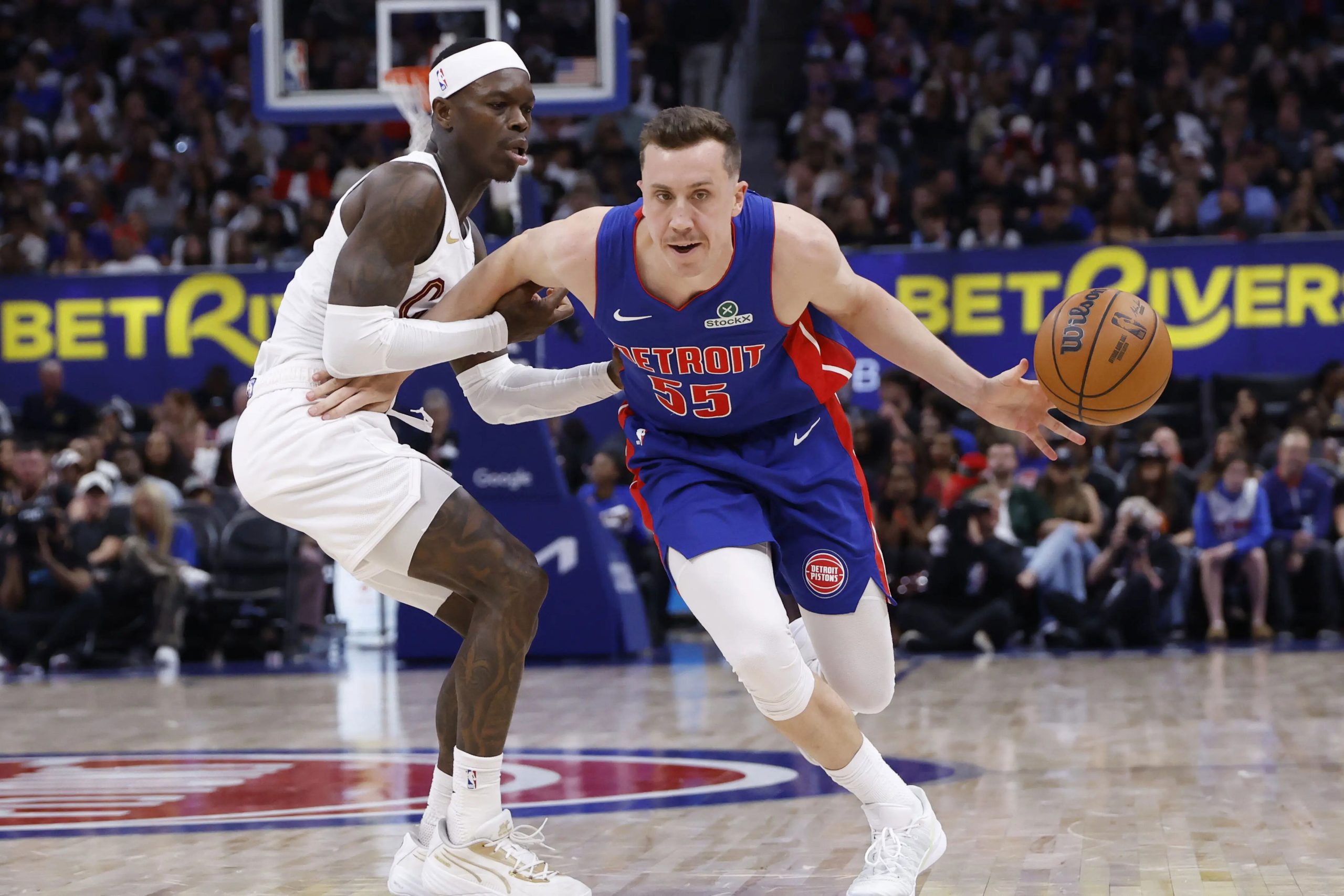
Detroit Pistons’ Shooting Guard Carousel: A Season in Review
The 2025-26 NBA season presented a fascinating narrative for the Detroit Pistons’ shooting guard rotation. After a previous season that heavily leaned on floor-spacing and three-point prowess, often at the expense of shot creation and defensive grit, this year’s cohort promised a more versatile offering. The new additions brought the potential for dribble penetration, effective attacks on closeouts, and a more robust defensive presence, all while maintaining crucial perimeter shooting capabilities.
With heightened expectations and a deeper roster than in the preceding year, the question looms: how did this evolving shooting guard unit perform? As the offseason beckons, is the position sufficiently fortified, or do the Pistons need to actively seek reinforcements? Let’s dissect the performances of each player who manned the shooting guard spot.
Grading the Pistons’ Shooting Guards: 2025-26 Season
Duncan Robinson: B+
The 2025-26 season was pivotal for Duncan Robinson, serving as a true “prove-it” year. Following a challenging performance in the 2025 playoffs, Robinson arrived in Detroit via a sign-and-trade deal involving Simone Fontecchio. His primary objective was to reclaim his status as one of the league’s elite marksmen, and he achieved this with flying colours. Robinson connected on an impressive 220 three-pointers, marking his fourth season with over 200 triples and his highest tally since the 2021-22 campaign.
His shooting remained a formidable weapon throughout the regular season and into the postseason. In 13 playoff contests, Robinson averaged 12.2 points per game, boasting a scorching 45% clip from beyond the arc. He provided the Pistons with a dependable floor spacer and a reliable secondary scoring option. His ability to command defensive attention by stretching the floor effectively opened up driving lanes for Detroit’s primary playmakers, ensuring the offence flowed smoothly.
Caris LeVert: C
Caris LeVert, the Pistons’ most significant free-agent acquisition, was brought aboard to inject scoring, playmaking, and secondary ball-handling into the second unit. While he showcased flashes of brilliance and had his moments of impact, consistency proved to be a recurring challenge. LeVert was occasionally prone to turnovers, leading to avoidable possessions for the team, and his shot selection sometimes raised eyebrows. These inconsistencies ultimately prevented him from fully embodying the role Detroit had envisioned when signing him.
Despite the ebb and flow of his performance, LeVert undoubtedly provided value off the bench through his capacity to generate offence for both himself and his teammates. There were periods where his scoring and playmaking provided a much-needed spark to the second unit, and he demonstrated a commendable willingness to compete on the defensive end. However, the turnovers and inconsistent decision-making ultimately capped his season’s overall grade, preventing it from reaching a higher echelon.
Javonte Green: A-
A late addition to the roster during the offseason, Javonte Green was initially viewed more as a depth option rather than a guaranteed rotation player. As the season unfolded, however, Green emerged as one of Detroit’s most valuable role players. His defensive versatility, infectious energy, and veteran leadership were instrumental in solidifying the effectiveness of the second unit. Furthermore, his knack for making crucial plays earned him the unwavering trust of the coaching staff.
Green’s impact resonated on both ends of the court. He participated in all 82 games and consistently ranked among the league’s top performers in steals, finishing in the top 20 with 102 steals. He also placed fourth in steals per 36 minutes (2.5) and third in steals per 100 possessions (3.4). Offensively, Green enjoyed the most efficient shooting season of his career, setting new personal bests in field-goal percentage, three-point percentage, and free-throw percentage.
Jaden Ivey / Kevin Huerter: D+
Entering the season, Jaden Ivey was widely considered a prime candidate for a significant bounce-back performance and a cornerstone of the Pistons’ future. Regrettably, he never quite recaptured the dynamic offensive form that had endeared him to Pistons fans. The explosive burst, unwavering confidence, and aggressive downhill attacks that once defined his game were inconsistent throughout the season. This led Detroit to make the difficult decision to move him at the trade deadline.
Kevin Huerter, on the other hand, arrived in Detroit with the hope of rediscovering his shooting touch but struggled to find a consistent rhythm. While there were glimpses of the player who had been a valuable contributor in previous seasons, a combination of injuries and streaky shooting hampered his ability to make a significant impact.
Ultimately, neither Ivey nor Huerter provided the stability and production the Pistons had hoped for at the shooting guard position, leaving lingering questions about the long-term outlook for this crucial spot on the roster.
Chaz Lanier / Wendell Moore Jr. / Colby Jones: INC
Chaz Lanier was drafted with the expectation of his shooting prowess translating to the NBA level. However, this did not immediately materialise, as he shot a modest 28.4% from three-point range over 34 games. Encouragingly, his 37.2% mark from deep in G League action suggests that his shooting potential remains intact.
Wendell Moore Jr. saw limited action, appearing in just six games for the Pistons. However, he impressed in the G League, averaging a robust 19.8 points on strong shooting splits of 53% from the field, 41% from three, and 81% from the free-throw line. Colby Jones played a single game for Detroit before being waived, leaving an insufficient sample size to provide a meaningful evaluation of his potential with the team.
The Final Verdict
The Detroit Pistons’ shooting guard position experienced a season of distinct highs and significant lows. Duncan Robinson and Javonte Green proved to be valuable acquisitions, delivering on their respective roles. Conversely, Caris LeVert, Jaden Ivey, and Kevin Huerter largely fell short of expectations, leaving room for improvement. While the Pistons have some solid contributors in place, if the organisation aims to elevate production from this position, further upgrades could certainly be on the table during the upcoming offseason.
Overall Grade for the Shooting Guard Position: C


Leave a Reply