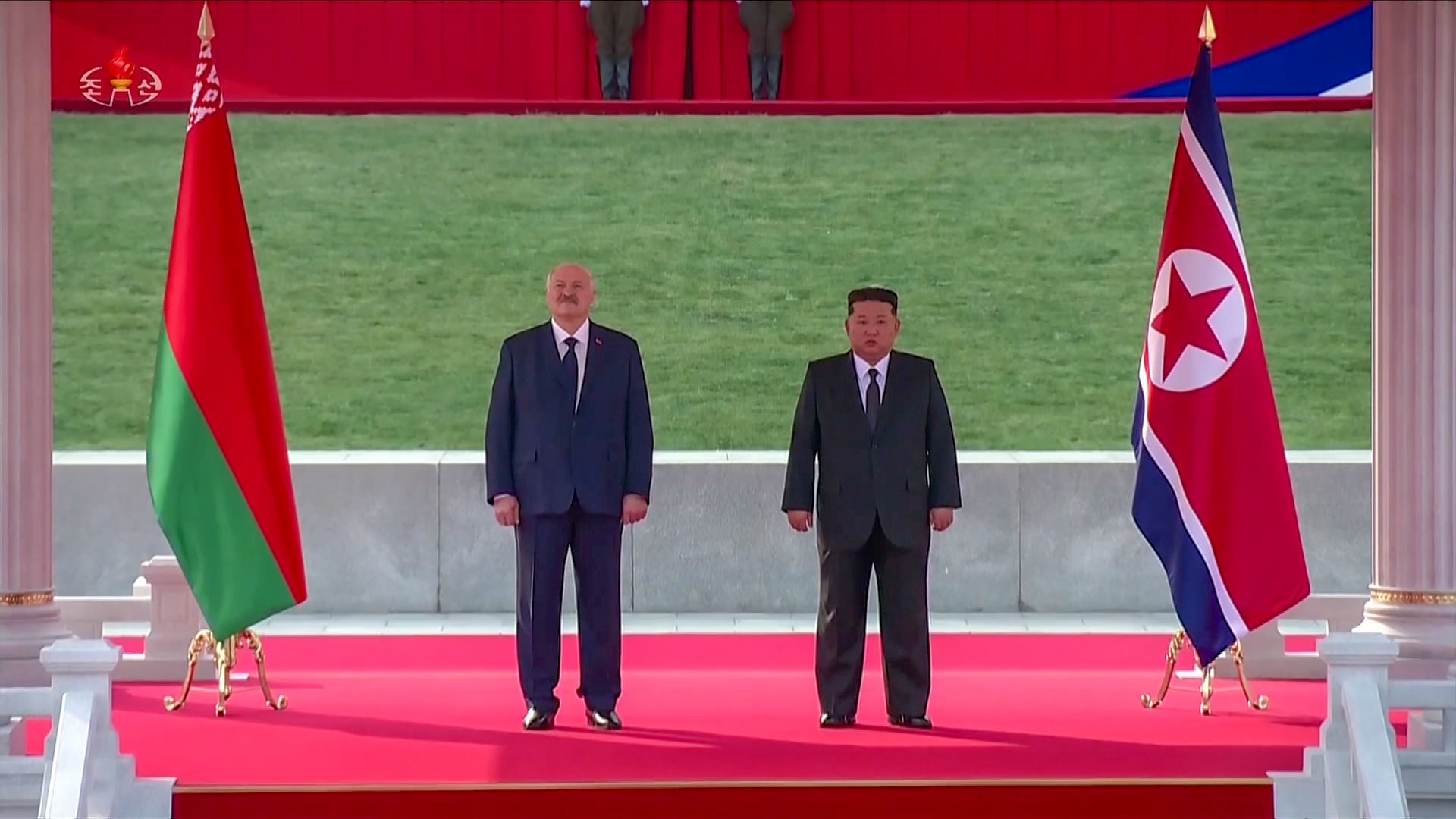
North Korea and Belarus Forge Closer Ties: Summit Explores Cooperation Amid Shifting Geopolitical Landscape
Pyongyang, North Korea – North Korean leader Kim Jong-un has convened with Belarusian President Aleksandr Lukashenko in a landmark summit aimed at bolstering bilateral cooperation between the two nations. The high-profile visit, the first by a Belarusian head of state to the reclusive North, has ignited speculation about the potential for a deepened military alliance, mirroring the recent pact between North Korea and Russia.
According to reports from the Belarusian state news agency Belta, President Lukashenko arrived in Pyongyang on July 25th, where he engaged in summit talks with Chairman Kim Jong-un. The visit is expected to culminate in the signing of a comprehensive treaty on friendship and cooperation. Footage released by Belta depicted Lukashenko’s arrival at Sunan Airport, where he was greeted by Kim Tok-hun, the First Deputy Prime Minister of North Korea, and participated in a formal welcoming ceremony that included an inspection of the honor guard.
Maksim Ryzhkov, the Belarusian Minister of Foreign Affairs, had previously articulated the primary objective of the visit: “Our primary interest in North Korea is to strengthen genuine friendly and partnership relations.” He further indicated that the upcoming treaty would encapsulate mutually beneficial opportunities across a wide spectrum of sectors. It is anticipated that approximately ten treaties and agreements will be finalized during this visit, encompassing foundational friendship pacts alongside accords in critical areas such as education, health, industry, agriculture, and information technology.
Belarus, a staunch ally of Russia, has actively supported Moscow’s military operations in Ukraine. South Korean officials anticipate that economic cooperation will be a central theme of discussions during Lukashenko’s stay. The visit is also viewed as a strategic move to reinforce trilateral coordination among North Korea, Russia, and Belarus, a bloc increasingly seen as challenging the established international order. The two nations re-established diplomatic relations in 1992 and subsequently formed a joint trade and economic cooperation committee in 1995. After a prolonged period of inactivity, this committee reconvened for its third meeting in Pyongyang in May of the previous year, signaling a renewed commitment to economic engagement.
Military Cooperation on the Horizon?
Beyond economic ties, the prospect of enhanced military cooperation between North Korea and Belarus is a significant point of discussion among international observers. Analysts suggest that the summit could lay the groundwork for a military treaty, akin to the one recently signed with Russia.
- Expert Analysis: Lee Kwan-se, director of the Far East Research Institute at Kyungnam University, noted the possibility of a military treaty with Belarus, emphasizing the need for close monitoring of President Lukashenko’s visit.
- Strategic Alignment: Kim Sang-beom, director of the North Korea Research Center at the same institute, highlighted the importance of examining Chairman Kim Jong-un’s pronouncements on a “multipolar system” and the recent military agreements with Russia in the context of Lukashenko’s visit.
The Nuclear Dimension and Belarus’s Strategic Position
Belarus occupies a unique strategic position as a nation under Russia’s nuclear umbrella. In 2023, the defense ministries of both countries formalized an agreement concerning the storage of Russian tactical nuclear weapons on Belarusian territory. This arrangement was further cemented in the following year when the presidents of Belarus and Russia signed a document establishing the legal framework for Russia’s provision of nuclear security assurances to Belarus.
Cho Seong-ryoul, a visiting professor at Kyungnam University’s Department of Military Studies, detailed the extent of this cooperation. He stated that starting around July 2023, Russia began transferring nuclear warheads for Iskander missiles and air-dropped nuclear bombs to Belarus. Furthermore, the Iskander-M short-range ballistic missile system, with a range of approximately 500 kilometers, has been integrated into the Belarusian military. Belarusian Su-25 and Su-30 fighter jets have also been modified to carry nuclear weapons and are reportedly deployed for combat readiness.
Joint military exercises, such as the second-phase tactical nuclear operations drill conducted in June 2024 and the Zapad-2025 exercise held the previous year, underscore the deepening military integration. These activities are assessed as indicative of a practical operational readiness between the armed forces of Belarus and Russia, further amplified by the potential for expanded collaboration with North Korea.