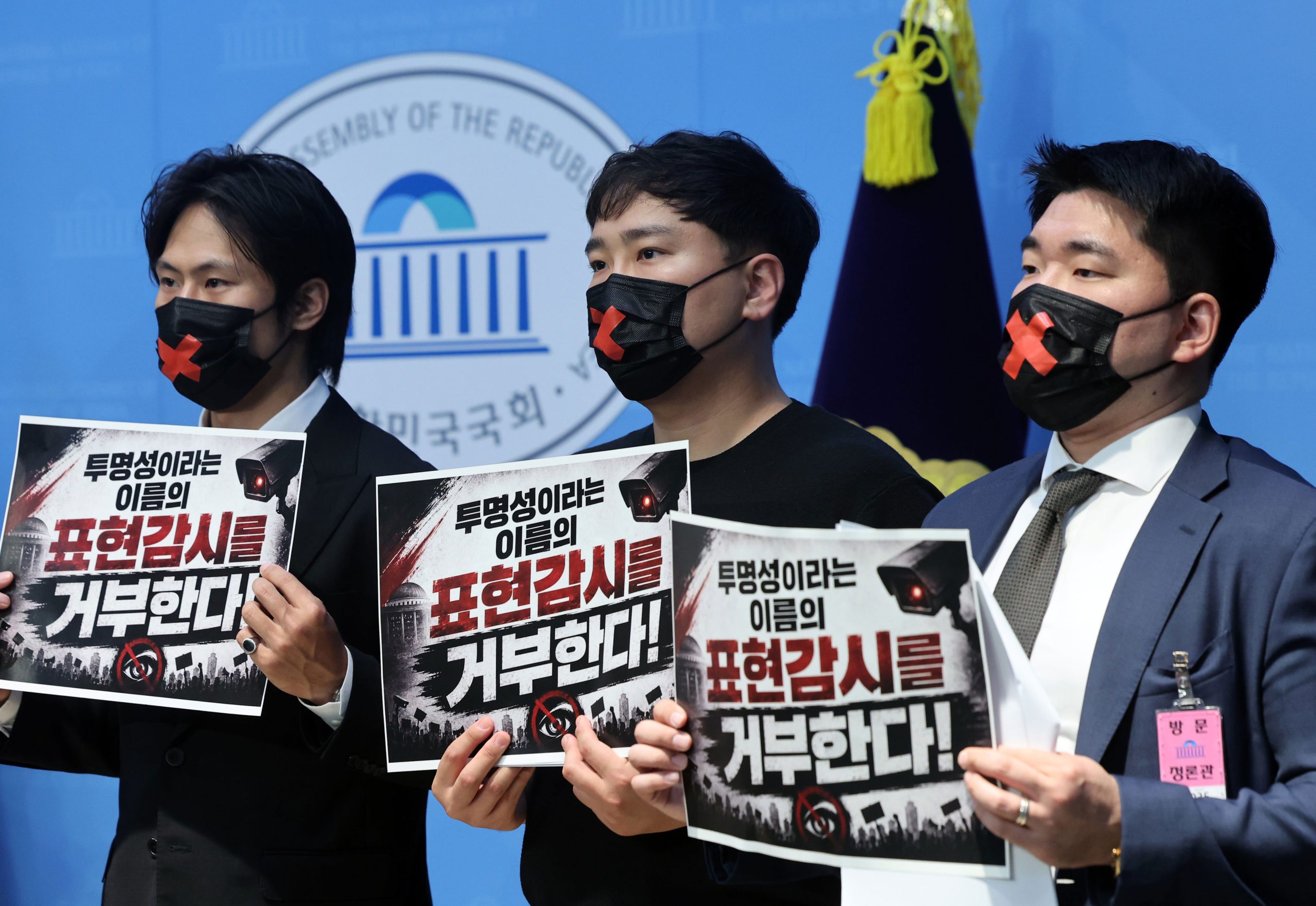
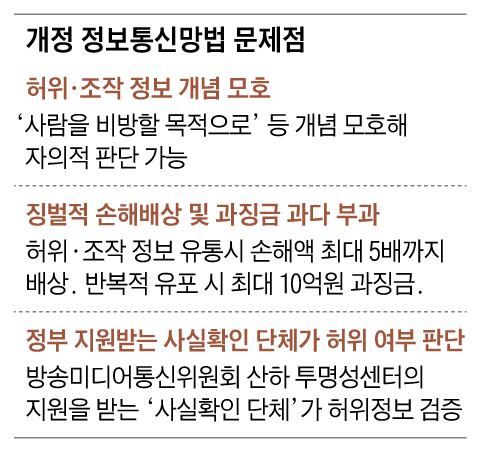
On the first day of the revised Information and Communications Network Act’s implementation, July 7, online communities were flooded with posts criticizing the law and offering tips on how to avoid being reported for spreading false or manipulated information. Political circles continued to voice their concerns, calling it “a law that excessively infringes on freedom of expression” and “an attempt to silence the public.” The revised law imposes damages of up to five times the actual harm caused by the distribution of “false or manipulated information” online, including by internet media, and imposes fines of up to 1 billion Korean won for malicious or repeated dissemination.
Opposition parties and even pro-government groups like People’s Solidarity for Participatory Democracy opposed the bill, citing concerns over freedom of expression. However, the Democratic Party of Korea pushed it through last year using its majority, leading to its enforcement from today.
Legal and civic groups: “Restricting freedom of expression, de facto censorship”
On this day, online communities and social media platforms were filled with posts titled “How to Overcome July 7,” “How to Write Without Getting Reported,” and “Moving to overseas platforms rather than facing censorship.” Not only users but also legal and civic groups raised voices, asking, “Isn’t this a nationwide surveillance of communications under the guise of blocking false information?” Even pro-government groups like People’s Solidarity for Participatory Democracy and the Lawyers for a Democratic Society had previously expressed concerns about the revision.
Jeon Sang-beom, a former Presiding Judge and attorney at Logos Law Firm, pointed out, “The criteria for determining ‘false information’ in the law are too broad or unclear,” adding, “There are concerns that this could shrink freedom of expression for the public and media.” Kim Hyun, former president of the Korean Bar Association, stated, “Even the Constitutional Court strictly interprets laws that infringe on freedom of expression, but the provision allowing punitive damages of up to five times the harm already excessively violates basic rights.” He added, “Government-funded organizations will determine whether information is false or manipulated. This is akin to communism, effectively restricting opinions opposing government policies.”
Ambiguity in defining illegal information, fears of rampant lawsuits
Critics highlight the law’s vague definitions of illegal, false, and manipulated information. The law defines illegal information as “content that publicly reveals false facts with the intent to defame someone and damage their reputation.” False information is defined as “information where all or part of the content is false,” and manipulated information as “information altered to mislead people into believing it is factual.” Legal experts noted, “It will be difficult to determine intent to defame or the falsity of content.”
Due to this ambiguity, concerns grew that users might file lawsuits against each other indiscriminately. Under the current law, anyone who discovers false or manipulated information can report it to platform operators. Large platforms with over 1 million daily users must notify users upon receiving a report and may take actions like deletion, blocking, limiting exposure, or suspending accounts based on their policies. Lee Seong-yeop, a professor at Korea University’s Graduate School of Technology and Innovation Management, warned, “There are concerns that people may file lawsuits claiming posts they dislike are manipulated or false, leading to social conflicts as disputes over right and wrong escalate.”
People Power Party to pursue constitutional review and law revision
The People Power Party decided to pursue a constitutional review and a full revision of the law. Party leader Jang Dong-hyeok stated, “The prime minister, a former Naver executive, said he would ‘firmly respond to false information and illegal activities,’ but if he were still at Naver, he would have opposed this first.” He added, “If it doesn’t suit President Lee Jae Myung’s taste, it becomes ‘false information,’ and criticizing Lee Jae Myung becomes an ‘illegal act.’ Media outlets are already self-censoring due to Lee Jae Myung’s SNS intimidation.” Jeong Jeom-sig, the floor leader, said, “We will request a constitutional review of the ‘mouth-blocking law’ and push for a full revision removing toxic clauses.”
However, the government and ruling party insist, “This is a necessary measure to block false information online.” Prime Minister Han Seong-sook, a former Naver CEO, attended a Cabinet meeting and stated, “As the online sphere expands, side effects from illegal activities like spreading false and manipulated information are growing.” She added, “This revision aims to minimize such side effects.” Han Byung-do, the Democratic Party of Korea’s floor leader, called it “a minimum institutional device to prevent the production and spread of false information and hold accountable those responsible,” adding, “Framing this law as a government censorship tool distorts the facts.”
월 5900원 멤버십, 신문 독자에게는 2900원, 조선멤버십
55000원 상당의 신문-잡지 8종 마음껏 보기, 조선멤버십
현금처럼 쓸 7000포인트 받아 알뜰한 쇼핑, 조선멤버십