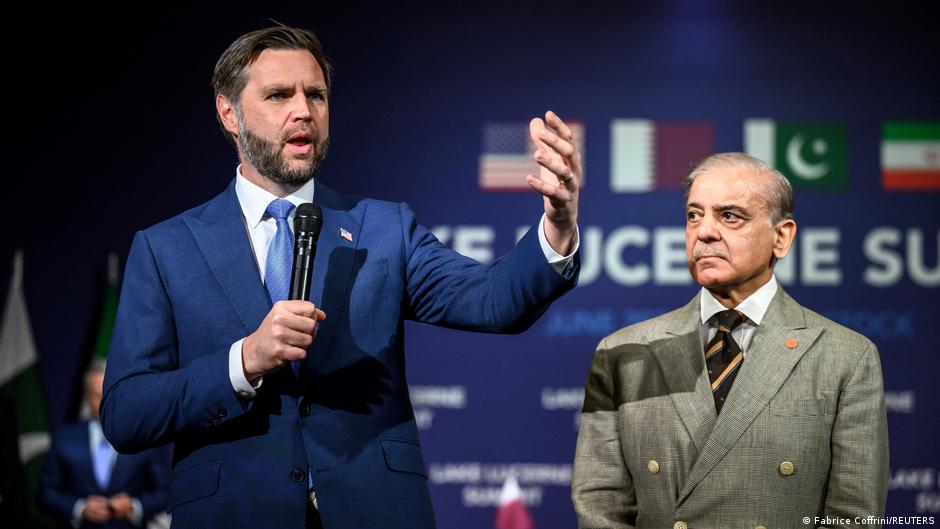
Both the US and Iranian delegations were in Switzerland on Sunday for talks According to mediators from Qatar and Pakistan, the talks ended with both sides agreeing on a roadmap The US delegation is headed by Vice President JD Vance, who arrived on Sunday morning Iran’s delegation, headed by Parliamentary Speaker Bagher Qalibaf, arrived earlier Talks are happening amid tensions in the Strait of Hormuz, which Iran said it was closing following Israel’s attacks in Lebanon Hezbollah and Israel are blaming one another for breaking the latest ceasefire Israel says it will remain in south Lebanon ‘security zone’ which Lebanese officials refer to as an occupation
Read here for the latest developments on the Iran war and the wider Middle East on Sunday, June 21.
Tired of missing our real-time updates? Click here to add us as a Preferred Source on Google . Then tap the “Star” or “Preferred” to keep DW News at the top of your feed.
Qatar: Explosion at Ras Laffan factory leaves several injured
Qatar’s interior ministry said a “technical incident” led to an explosion at the Ras Laffan industrial zone, causing some injuries.
Qatari authorities have said that Sunday’s explosion was the result of an internal issue, but the site had already been badly damaged in the recent war between the US, Israel and Iran.
Iranian attacks during the war targeted Gulf energy infrastructure including Ras Laffan, which forced Qatar to halt gas production.
“An internal explosion occurred in one of the factories in the Ras Laffan Industrial Area following a technical incident,” the ministry said.
“Civil defence teams have begun handling the incident,” it added.
A later statement confirmed that a “technical malfunction” had “led to a number of injuries.” No details were provided about the number of people injured.
Iranian top negotiator tells US to be ‘careful’ with threats
Iranian chief negotiator and parliament speaker Mohammad Bagher Ghalibaf warned the United States against threatening Iran while negotiations are underway.
“Don’t they think that if their threats had any effect, they would not have reached today’s state of desperation? We do not take American threats into account,” Ghalibaf said in a post on the platform X.
“They would do better to be careful with their statements; our armed forces are ready to respond to them in a different manner. No matter what they say, we are the ones who act.”
Ghalibaf’s statement comes in response to a post by US President Donald Trump on his Truth Social platform in which he said that Washington could resume its bombardment of the West Asian country.
“Iran must immediately stop their highly paid PROXIES in Lebanon from causing trouble,” Trump said. “If they don’t, we’ll hit Iran very hard again, just like we did last week, only harder!!!”
Iran has demanded Washington ally Israel halt its invasion of southern Lebanon as part of its own peace negotations with the United States.
Ahead of the peace talks underway in Switzerland, Iran and the United States signed a memorandum of understanding that stipulated the two parties would “refrain from the threat or use of force against each other.”
No German Hormuz mission decision likely to come soon, Pistorius says
German Defense Minister Boris Pistorius said that it was unlikely that the German military, known as the Bundeswehr, would receive a parliamentary mandate to quickly dispatch a mission to assist the United States in securing the Strait of Hormuz.
“Ultimately, the cork in the bottle neck of the Strait of Hormuz was pushed in by Donald Trump, not by us, but we have an interest in getting it out again,” he told German public broadcaster ARD.
The minister stressed that the reopening of the waterway was in Europe and Germany’s interest but ruled out Berlin’s involvement in military operations during active hostilities, adding that it was not clear whether negotiations in Switzerland would lead to a durable ceasefire.
“I cannot tell whether a stable situation and a ceasefire are taking hold, such that a decision could even be made regarding a mandate for the Bundeswehr,” Pistorius said.
US President Donald Trump has previously called for Washington’s allies to assist in securing the crucial passage, which was effectively blocked by Tehran after the US launched its war against Iran on February 28.
Pistorius’ statement comes after the Bundeswehr on Thursday said it was preparing minesweepers for a possible mission in the strait, with two vessels having passed from the Mediterranean through the Suez Canal.
Netanyahu says Israeli forces to remain in Lebanon for ‘as long as necessary’
Israeli Prime Minister Benjamin Netanyahu vowed to keep Israeli forces in Lebanon.
“We will remain in the security zone in southern Lebanon for as long as necessary to protect the cherished residents of the north and all the citizens of Israel… Nothing will alter that commitment,” Netanyahu said.
Iran has demanded a ceasefire in Lebanon as part of peace negotiations between Tehran and Washington.
Netanyahu also said that Israel would ensure Iran doesn’t develop a nuclear weapon.
“And with regard to Iran: whatever political developments may unfold, I will not allow Iran to acquire nuclear weapons. As long as I serve as prime minister of Israel, that will not happen,” he said.
While the United States and Israel accuse Iran of planning to develop a nuclear weapon, Tehran maintains its nuclear program exclusively serves civilian purposes.
US energy secretary says dozens of ships passed through Hormuz yesterday
In an interview with conservative US broadcaster Fox News, US Energy Secretary Chris Wright said 67 ships went through the Strait of Hormuz yesterday.
“The day before, it was 55 ships. In terms of oil and oil products — about equal to where we were before the conflict,” Wright said.
Wright said traffic is “flowing through the strait quite nicely” due to a US military presence.
He said Iran has not yet demined a central shipping channel in the Strait but claimed the US opened a separate one down south. Wright said the US military had been escorting ships through the southern channel.
Wright’s statements come after Iran claimed it had shut down Hormuz due to fighting in Lebanon between Israel and Hezbollah. The US has rejected Iran’s statement that Hormuz is closed.
Trump threatens Iran over ‘proxies’ in Lebanon
Amid the talks in Switzerland, President Trump took to his Truth Social platform to threaten Iran.
“Iran must immediately stop their highly paid PROXIES in Lebanon from causing trouble,” Trump said, presumably a reference to Hezbollah.
“If they don’t, we’ll hit Iran very hard again, just like we did last week, only harder!!!”
JD Vance lauds ‘historic’ talks between US and Iran
US Vice President JD Vance, who is present at the talks, lauded the “historic meeting” between the US and Iranian representatives to implement the Memorandum of Understanding.
“What we’re trying to accomplish is through diplomacy to work together to transform the Middle East,” Vance said.
He said Iran has been “driver of regional instability” but noted the talks could lead to this no longer being the case. US President Donald Trump asked us to turn over a “new leaf” in the US relationship with Iran, Vance explained.
“We have made great progress in the last few hours,” Vance claimed.
Qatar announces start of US-Iran negotiations
US Vice President JD Vance and Iranian officials have begun negotiations in Switzerland, mediator country Qatar has announced.
In addition to Vance, Trump’s special envoy Steve Witkoff and his son-in-law Jared Kushner are involved in the negotations.
Iranian Parliament Speaker Mohammad Bagher Qalibaf and Iranian Foreign Minister Abbas Araghchi are representing Tehran in the dialogue.
Pakistan Prime Minister Shehbaz Sharif is present at the talks as well and involved in mediation.
Israeli defense minister says troops will remain in southern Lebanon
As talks in Switzerland are getting underway, Israeli Defense Minister Israel Katz said Israeli forces will remain in a “security zone” in southern Lebanon.
“There has never been, and there is currently no restriction on IDF soldiers in Lebanon from acting to eliminate threats… As Prime Minister Benjamin Netanyahu and I have made clear: Israel will not withdraw from the security zone in Lebanon,” Katz said in a statement, referring to the Israel Defense Forces (IDF), or Israeli military.
The so-called Israeli security zone runs roughly 10 kilometers (6 miles) into Lebanon’s territory. Israel is remaining in this area as a measure to protect northern Israel from the Iran-backed Hezbollah paramilitary group, which Israel and many other countries view as a terrorist organization.
Lebanese officials have described Israel’s security control over southern Lebanon as an occupation and Hezbollah has claimed that it has fought back Israeli troops to seeking to expand control over the area.
Iran said it would not agree to a broader deal with the US unless the conflict in Lebanon ends. Iran has also claimed to have closed the Strait of Hormuz in response to continued tensions in Lebanon.
US VP Vance meets with Pakistani PM Sharif on sidelines
US Vice President JD Vance met with Pakistani Prime Minister Shehbaz Sharif on the sidelines of the talks in Switzerland.
Pakistan is the key mediator that helped facilitate the Memorandum of Understanding between the US and Iran.
Switzerland confirms all parties have arrived for talks
Switzerland’s Foreign Ministry said all relevant parties have arrived in Bürgenstock for talks.
“The US delegation, led by US Vice President JD Vance, the Iranian delegation, led by the Speaker of the Iranian Parliament, Mohammad Bagher, and the mediators, Pakistan and Qatar, have arrived arrived at the Bürgenstock,” the foreign ministry posted on X.
“Talks between the parties are set to begin today,” the post added.
Iranian Foreign Ministry spokesperson Esmaeil Baghaei earlier said that quadrilateral talks with the US, Iran, Pakistan and Qatar would happen in the afternoon.
UN nuclear chief thanks Switzerland for support and role in US-Iran talks
Interational Atomic Energy Agency chief Rafael Grossi met with Swiss Foreign Minister Ignazio Cassis in Bürgenstock where the US-Iran talks are slated to take place.
“At this critical moment, it’s important to give diplomacy every opportunity to succeed,” Grossi said.
Iran’s uranium enrichment and the monitoring of its nuclear sites are a major point of contention between the US and Iran.
“Thanks to Switzerland for its longstanding support of the Agency and its commitment to multilateral diplomacy,” he added.
Iran says Lebanon main topic of talks in Switzerland
Iranian Foreign Ministry spokesperson Esmaeil Baqaei said fighting in Lebanon will be the main topic of the talks between US and Iranian representatives in Switzerland.
Baqaei accused Israel of violating its “commitment in Lebanon.” Fighting between Israel and Iran-backed Hezbollah ramped up in Lebanon on Saturday despite a truce.
However, Baqaei said a “fragile cessation” of fire in Lebanon has been established since Saturday evening.
Other topics on the agenda include unfreezing Iranian assets and the issuing of licenses for the sale of Iranian oil, Baqaei explained. Oil sales are a major driver of the Iranian economy.
Baqaei spoke with Iranian state broadcaster IRNA after an initial meeting between Iranian Foreign Minister Abbas Aragchi and Ignazio Cassis, a member of the Swiss Federal Council who also serves as foreign minister.
Baqaei said Iranian officials would also hold dialogue with Qatari and Pakistani representatives. Later on Saturday afternoon, a quadrilateral meeting is set to take place between the US, Qatar, Pakistan and Iran.
JD Vance lands in Switzerland
US Vice President JD Vance has arrived in Switzerland for talks with Iranian negotiators.
Vance’s office said that he and his wife, Usha Vance, arrived at Emmen Air Base outside Lucerne at just before 6 a.m. local time.
Before boarding his flight, Vance said he hoped to “make progress on the nuclear issue, make progress on the Lebanon ceasefire issue.”
Pakistani Prime Minister Shehbaz Sharif heading to Switzerland for talks
Pakistan, a key mediator in US-Iran talks, confirmed that Prime Minister Shehbaz Sharif had left for Bürgenstock, Switzerland, to participate in the talks “on the implementation of the Islamabad Memorandum of Understanding.”
Pakistan’s Foreign Ministry said in a statement that high-level delegations from Iran, Qatar and the United States would be part of the talks.
The statement went on to say that Sharif would hold bilateral talks with the delegations, including Switzerland,”to reaffirm Pakistan’s enduring commitment to dialogue and durable peace in the region.”
Pakistan has positioned itself as a mediator in the ongoing conflict and has hosted talks and served as an intermediary in diplomatic efforts to bring the warring parties together.