
The Entrepreneurial Payoff: Unpacking the Real Income Potential Down Under
Venturing out on your own, ditching the regular nine-to-five for the thrill of entrepreneurship, often conjures images of sky-high earnings and ultimate financial freedom. While the allure of greater income potential is undeniable, a recent deep dive into income data suggests that this dream isn’t always the reality for the average Aussie entrepreneur, at least not in the early stages.
A comprehensive analysis of tax and income data, spanning from 2000 to 2015, has shed light on the financial trajectory of self-employed individuals compared to their traditionally employed counterparts. The findings reveal a nuanced picture, indicating that while the path to entrepreneurial riches might be steeper initially, the long-term rewards can be significantly more substantial.
Early Years: A Tale of Two Incomes
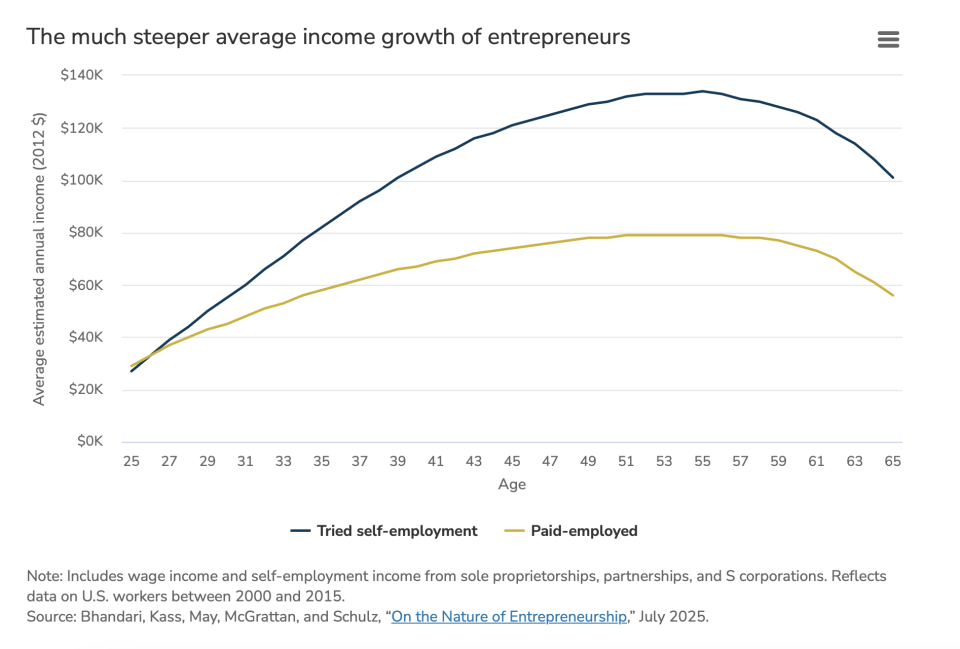
When individuals first embark on their entrepreneurial journeys, the financial landscape can appear less rosy than anticipated. At the tender age of 25, the study found that the average entrepreneur was bringing home around $27,000 annually (adjusted to 2012 dollars). This figure is slightly shy of the $29,000 earned by a paid employee at the same age. This early disparity might be attributed to the initial investment of time and capital required to get a new venture off the ground, often before it starts generating consistent profits.
The Turning Point: Age 30 and Beyond
However, this trend doesn’t persist. As entrepreneurs gain experience and their businesses mature, the tables begin to turn. By the age of 30, a significant shift occurs. The average entrepreneur’s income jumps to $55,000, a notable increase from their earlier earnings and a substantial 22% more than the $45,000 pocketed by those still on a traditional payroll. This suggests that the early struggles often pave the way for more robust financial gains.
Widening the Gap: The Senior Entrepreneurial Advantage
The income advantage for entrepreneurs continues to grow with age. By the time individuals reach their mid-50s, the gap between self-employed and paid employees becomes even more pronounced. At age 55, the average entrepreneur is earning a remarkable $134,000 annually, a staggering 70% more than the $79,000 earned by their conventionally employed peers. This illustrates the compounding effect of successful entrepreneurial ventures over a lifetime.
Beyond the Average: The Reality of Inequality
It’s crucial to understand that these average figures, while informative, mask a significant level of income inequality within the self-employed community. The study highlights that “the typical dollar in self-employment does not come from the typical self-employed individual.” This means that while some entrepreneurs are achieving extraordinary financial success, a larger proportion may not be experiencing the same level of prosperity.
- Concentration of Wealth: A striking 80% of the income earned by the self-employed is generated by individuals earning $100,000 or more annually. This indicates that a smaller, high-earning segment of entrepreneurs is disproportionately contributing to the overall self-employment income pool.
- Early Earnings Discrepancy: Tax data reveals that many individuals who are primarily self-employed earned less over the sampled years than their paid-employee counterparts with similar backgrounds. However, in aggregate, this subgroup holds a significantly smaller share of the total income compared to those who earned more than their peers.
Dispelling Myths About the Self-Employed
The research also aimed to debunk common misconceptions surrounding self-employment. It challenges the notion that entrepreneurs are solely:
- Gig workers seeking flexibility: While flexibility is often a perk, the primary motivation isn’t always just about arranging work schedules.
- Misfits avoiding unemployment: The data suggests that individuals switching to self-employment often had higher prior earnings, implying they weren’t necessarily pushed into it due to a lack of traditional job opportunities.
- Inventors seeking venture capital: While some entrepreneurs do seek external funding, the study indicates that many start their businesses without relying heavily on large cash windfalls or significant debt.
- Tax dodgers misreporting income: This stereotype is not supported by the findings, which analysed tax data.
The Resilience and Reward of Entrepreneurship
A key takeaway from the study is the resilience and long-term earning potential associated with persistent entrepreneurship. The findings suggest that:
- Higher Earnings Growth: Most entrepreneurs who remain in business experience greater income growth than those who stay in paid employment.
- Attractive Risk-Return Profile: When protected from the most severe financial shocks, self-employment emerges as an attractive option. It’s not as puzzling from a risk-versus-return perspective as previously thought, indicating that the potential rewards often justify the inherent risks.
The insights from this extensive study offer a more realistic and nuanced perspective on the entrepreneurial journey, particularly for those in Australia considering a similar path. While the initial stages may demand patience and perseverance, the long-term financial rewards for successful entrepreneurs can be substantial, offering a compelling alternative to traditional career trajectories.